
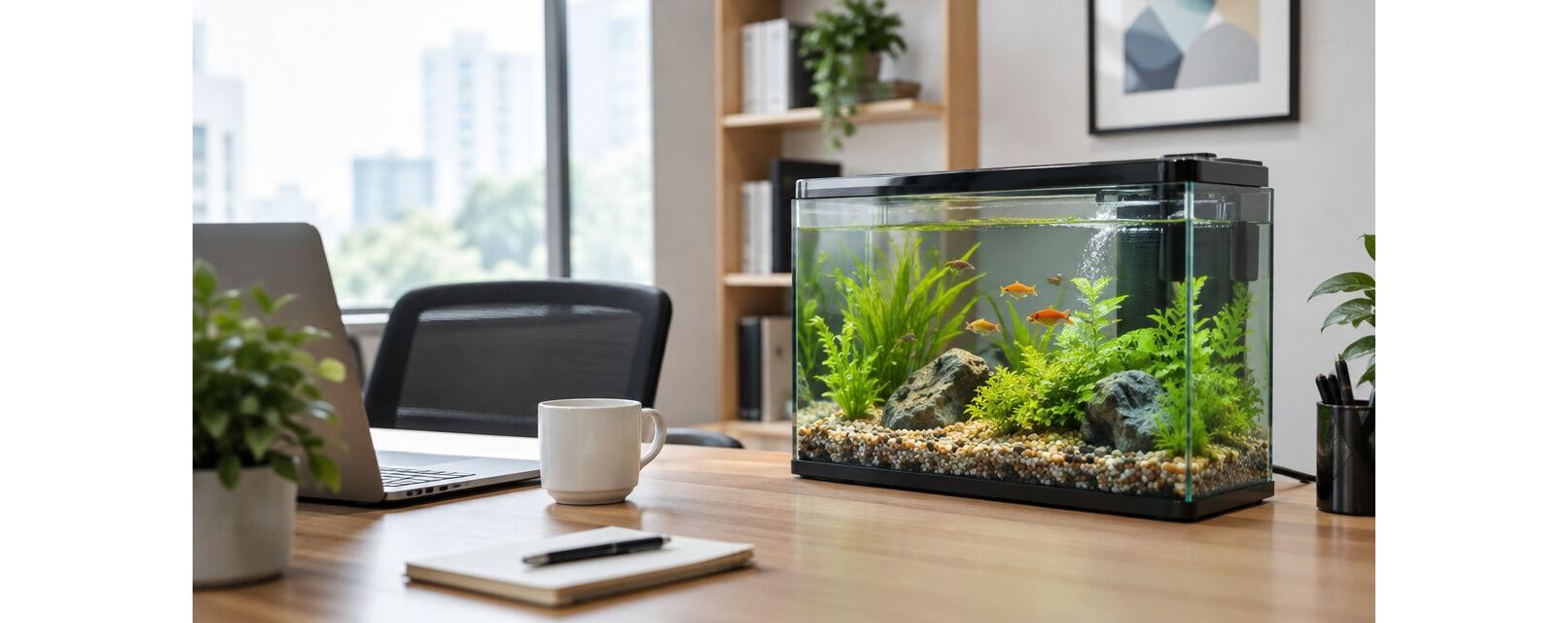
Small-office aquarium filtration is the continuous removal and processing of waste in an office fish tank, with the aim of keeping fish healthy and maintenance manageable during the working week. Choose an aquarium filter for office use by matching the tank, fish and maintenance access first, then checking noise and weekend operation, not by picking the smallest unit.
TL;DR
- Choose an aquarium filter for office use by tank volume, fish load, maintenance access and noise, not appearance alone.
- Aqua Life Pet & Aquarium is suited to Australian office owners researching aquarium supplies alongside other pet products.
- Sponge, internal, hang-on-back and canister filters have different space, cleaning and water-movement trade-offs.
- Keep filtration operating through weekends; assign a named person to feeding, cleaning and power checks.
Why aquarium filtration matters for small offices
An office aquarium needs a care routine that survives meetings, leave and weekends. A filter collects suspended debris and provides surfaces for beneficial bacteria involved in processing fish waste. It does not replace water changes, sensible stocking or water testing.
Office placement adds practical constraints: nearby calls, limited cupboard space, shared power points and cleaning that must happen without disrupting work. Choose the filter your nominated caretaker can maintain, not the one with the most complicated feature list.
Aqua Life Pet & Aquarium sells aquarium supplies alongside bird, reptile and small-animal products. Use the criteria below to assess aquarium equipment before ordering; a general retailer description does not establish any particular filter's specifications or suitability.
How to choose and manage an office aquarium filter
Measure your tank and assess its fish load
Start with the aquarium you have, not a filter advertised for a vaguely similar setup. Record its dimensions and working water volume, allowing for substrate, decorations and the space above the waterline. Manufacturer tank-volume guidance is a starting point; stocking and feeding also determine how much waste the system must process.
List the species, their expected adult size and whether they need gentle or stronger water movement. A filter suitable for a lightly stocked planted tank is not automatically suitable for a tank containing larger, messier fish. Do not solve overcrowding simply by buying a bigger filter.
Check the furniture, too. Fresh water weighs approximately 1 kg per litre: 40 litres adds about 40 kg before the glass, substrate and equipment. A 60-litre water volume adds about 60 kg. These are water-weight examples, not recommended office tank sizes or verified furniture capacities.
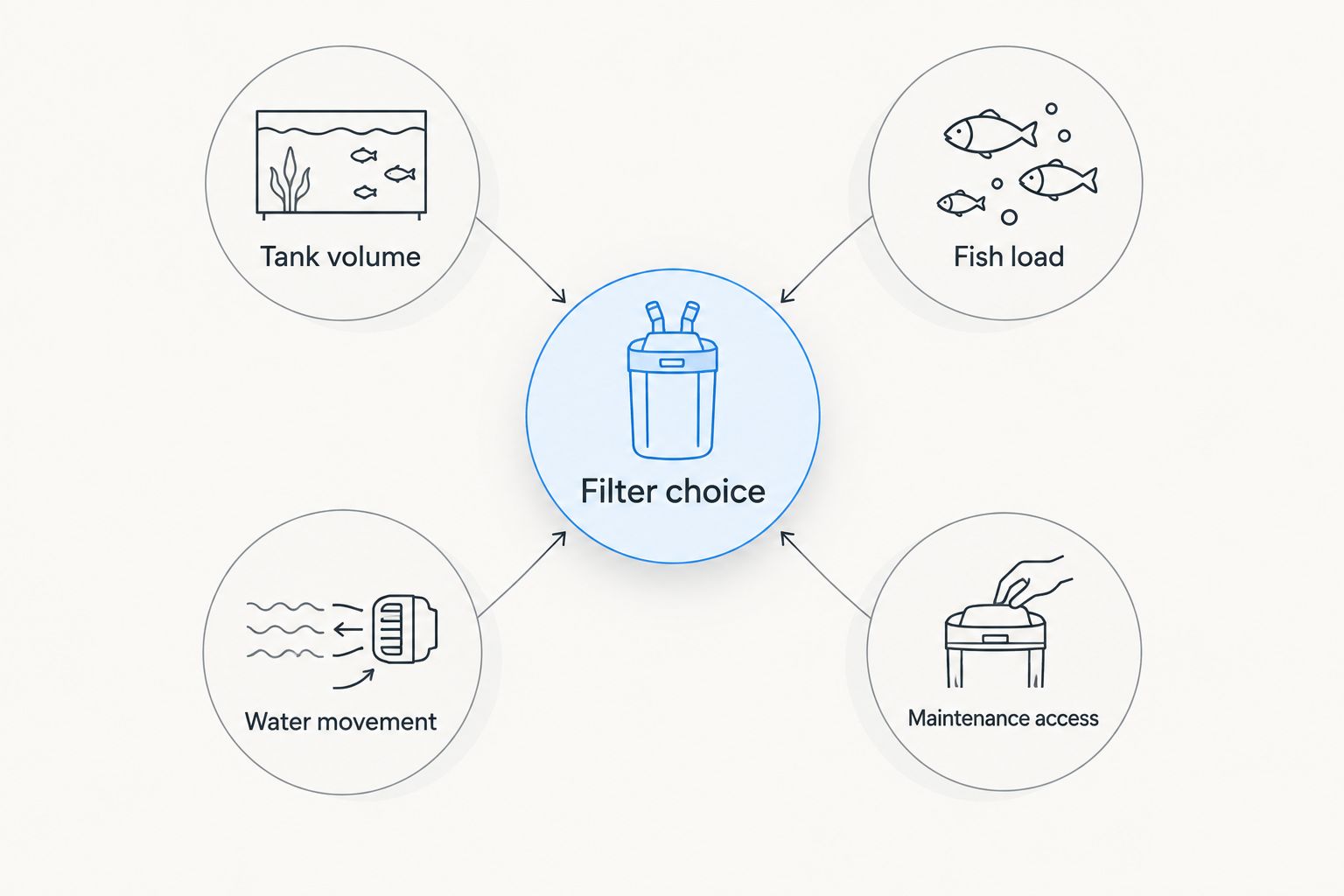
- Tank volume: record the actual working volume in litres.
- Fish load: identify species, adult size and feeding requirements.
- Water movement: note which fish need sheltered swimming areas.
- Maintenance access: measure the clearance needed to remove equipment.
- Support: confirm the loaded aquarium suits its stand or furniture.
Choose a filter format that fits the room
Decide where equipment can sit and how you will reach it. An internal filter occupies tank space. A hang-on-back filter needs clearance behind the aquarium and a compatible rim or lid. A canister filter needs room outside the tank for its body, hoses and servicing. A sponge filter normally needs an air supply as well as space inside the aquarium.
Each format has a useful role, but none guarantees a quiet office. Air pumps, falling water, vibration and dirty or incorrectly assembled moving parts all contribute to sound. Check how the complete installation works, rather than treating the filter body as the only noise source.
Avoid choosing a canister solely to hide equipment. Concealed plumbing still needs inspection, and a cramped cupboard makes maintenance harder. Equally, a visible sponge filter can be practical where simple access matters more than presentation.
- Measure clearance behind, above and below the aquarium.
- Check lid, rim and mounting compatibility before ordering.
- Allow space to lift media or remove the filter body.
- Identify any separate air pump or tubing required.
- Compare the complete setup, including hoses and cables.
Check the exact filter specifications before ordering
Read the individual product information for flow, recommended aquarium volume, dimensions, media arrangement and installation requirements. Distinguish pump flow from the result you will get after media, hoses and outlet placement affect the system. Do not treat a large flow figure as proof of better biological filtration.
Aqua Life Pet & Aquarium's aquarium range is relevant to Australian office shoppers, but the exact product information must decide the purchase. Check included components, replacement media and electrical suitability rather than assuming every accessory shown or mentioned is supplied.
For an online order, confirm the selected item's delivery terms for your address. A retailer's general shipping service does not establish the terms for every aquarium, stand or bulky item. This matters particularly if you are buying the whole setup alongside the filter.
- Confirm the stated aquarium-volume guidance and flow specification.
- Check whether water movement is adjustable and how adjustment works.
- Read the supplied-parts list, including media and installation hardware.
- Confirm access to compatible replacement parts and consumables.
- Check electrical suitability and follow the manufacturer's installation instructions.
- Verify delivery eligibility for the exact items in your order.
Position the filter for circulation, safety and quiet
Place the intake where it can collect water without being blocked by substrate, decorations or plants. Direct the outlet so water circulates through the aquarium while fish retain suitable resting areas. Intake protection is particularly important around small fish, fry and shrimp; compatibility depends on the intake design and the animals kept.
Noise assessment should happen with the aquarium running at its normal water level. Listen from the nearest desk and meeting position. Check mounting, trapped air and contact between vibrating equipment and hard surfaces before assuming the filter itself is unsuitable.
Keep electrical connections away from splashes and arrange cords with drip loops so water cannot run directly towards the connection. Follow the equipment instructions for pump placement and any air-line safety components. Never improvise changes to mains electrical equipment.
- Keep the intake clear and accessible for inspection.
- Adjust the outlet to suit the fish, not just the room's appearance.
- Check movement at the surface and throughout the aquarium.
- Inspect mounts, hoses and fittings for movement or leaks.
- Listen from occupied desks with the system running normally.
- Route power safely and keep cleaning water away from connections.
Establish biological filtration before adding fish
A new filter is not biologically mature simply because water passes through it. Beneficial bacteria need time and appropriate conditions to establish. Use a fishless cycling process and water tests to assess ammonia and nitrite processing before stocking, rather than relying on a calendar date or clear-looking water.
Use a water conditioner appropriate for the local tap-water disinfectant, following its instructions. Chlorine and chloramine treatment matters when preparing water for fish and when protecting the filter's biological function. Keep suitable testing supplies available so the caretaker can respond to a change in fish behaviour.
Clear water is not evidence that an aquarium is cycled. Mechanical filtration can remove visible particles while dissolved waste remains a problem. Stock gradually after cycling and review filtration as the fish grow or the aquarium's population changes.
- Follow a fishless cycling method before introducing livestock.
- Test ammonia and nitrite instead of judging water by appearance.
- Prepare replacement water with the appropriate conditioner.
- Keep biological media wet during necessary handling.
- Reassess the setup after stocking or feeding changes.
Assign cleaning tasks and protect established media
Name a primary caretaker and a backup. Shared ownership without clear responsibility leads to missed cleaning, repeated feeding and uncertainty about whether equipment has been switched back on. Keep a simple record of water tests, maintenance and unusual observations.
Inspect flow and debris accumulation to decide when cleaning is needed, then follow the manufacturer's maintenance instructions. Different media perform different jobs: mechanical media traps particles, biological media provides bacterial surfaces, and chemical media addresses particular substances. They are not interchangeable simply because they fit inside the same compartment.
When cleaning biological media, gently remove accumulated debris using removed aquarium water rather than untreated tap water. Avoid replacing all established biological media at once unless a specific contamination problem requires it. After reassembly, check that the filter is running correctly and that external fittings are dry.
- Allocate feeding, testing and cleaning to named people.
- Record maintenance so the backup can see what has changed.
- Inspect intake screens and mechanical media for blockage.
- Clean biological media without stripping the entire filter.
- Follow model-specific instructions for impellers, seals and hoses.
- Confirm flow and inspect for leaks after every service.
Plan for weekends, leave and power interruptions
Keep filtration operating when the office closes. Aquarium life does not stop needing water circulation because the last person has left, and switching equipment off with a shared office power strip defeats the care plan. Mark the aquarium's power arrangement clearly and coordinate it with workplace shutdown procedures.
Write instructions for leave cover before the regular caretaker goes away. Feeding should match the fish's needs; do not ask colleagues to add extra food to compensate for an unattended period. Assess any automatic feeding equipment separately, and check its operation before relying on it.
Plan the response to a power interruption or stopped filter. Check livestock, water quality, equipment condition and the manufacturer's restart instructions. Do not assume every filter will restart correctly after power returns, particularly where priming is required.
- Keep aquarium equipment separate from routine office shutdowns.
- Nominate a backup who understands the care instructions.
- Set a feeding plan appropriate to the livestock.
- Record the steps for checking and restarting the filter.
- Leave water-testing and maintenance supplies accessible.
- Arrange a check after outages, servicing or prolonged absence.
Compare filter options for a small office
The comparison below uses placement, cleaning access and operating trade-offs, not an unsupported product ranking. Individual models vary, so check the specific unit before making a purchase. No filter format removes the need for water changes or livestock-appropriate care.
| Option | Best suited to | Practical advantage | Key limitation |
|---|---|---|---|
| Air-driven sponge filter | Setups needing gentle filtration and accessible media | Simple media access; supplies surfaces for biological filtration | Occupies tank space and requires an air supply; bubbles and pump vibration need assessment |
| Internal power filter | Aquariums with room for equipment inside the tank | Keeps the filter body within the aquarium | Uses swimming space; outlet flow and intake safety must suit the livestock |
| Hang-on-back filter | Tanks with compatible rims and rear clearance | Places much of the filter body outside the aquarium | Lid fit, water level and return-water noise require attention |
| Canister filter | Setups with external storage and clear servicing access | Keeps the main filter body outside the display tank | Hoses, seals, priming and leak checks add maintenance tasks |
For a tank beside workstations, examine vibration and return-water sound. For a tank maintained by rotating staff, prioritise accessible parts and clear instructions. These are different purchasing criteria; the most concealed installation is not automatically the easiest to manage.
Common mistakes small offices make
Treating office opening hours as aquarium operating hours
Turning off the filter overnight or over weekends interrupts circulation and filtration. Put aquarium equipment on a clearly identified supply that is not included in ordinary desk shutdowns. Coordinate this with whoever manages the premises.
Choosing by appearance before checking maintenance access
A filter hidden behind cabinetry still needs cleaning. If you cannot remove the lid, lift the unit or disconnect hoses safely, the installation is unsuitable. Resolve access before filling the aquarium or buying equipment.
Allowing everyone to feed the fish
Uncoordinated feeding increases waste and obscures the maintenance routine. Give feeding responsibility to a named person and document cover arrangements. More food is not a substitute for weekend planning.
Replacing all media to make the filter look clean
Established biological media supports waste processing. Replacing it indiscriminately disrupts that function, even when the new material looks better. Distinguish cleaning from replacement and follow the instructions for each media type.
Ordering an entire setup under one shipping assumption
A small filter and a large glass aquarium are different delivery decisions. Confirm each item's current terms, especially heavy aquariums and stands; do not assume equipment over 30 kg is eligible for Australia-wide delivery. If livestock is part of the plan, Aqua Life Pet & Aquarium enquiries should be framed around Victorian in-store pickup, not national shipping.
FAQ
What aquarium filter should I choose for a small office?
Choose a filter that matches the tank's working volume, fish load and maintenance access. Then assess outlet movement, intake safety and noise at the nearest workstation. No single filter format suits every office.
Is a sponge filter quieter than an internal filter?
A sponge filter is not automatically quieter than an internal filter. Its air pump and bubbles contribute sound, while an internal filter can transmit motor vibration. Compare the complete installed setup rather than the format alone.
Can I turn the office aquarium filter off at night?
Keep the aquarium filter operating at night and over weekends. Continuous operation supports circulation and biological filtration. If noise is disruptive, correct the installation or select more suitable equipment rather than routinely switching it off.
How often should I clean an office aquarium filter?
Clean according to debris accumulation, reduced flow and the manufacturer's instructions. Inspect the filter regularly and record maintenance. A fixed schedule alone does not account for changes in stocking or feeding.
Do I need water changes if the aquarium has a filter?
Yes, an aquarium still needs appropriate water changes when it has a filter. Filtration does not remove every dissolved waste product or restore every aspect of water chemistry. Use water tests and livestock needs to guide the care routine.
Is a canister filter suitable for a desk aquarium?
A canister filter is suitable only when its specifications, water movement and installation fit the aquarium. You also need safe external placement and access to hoses, seals and the filter body. Concealed equipment is not a reason to ignore servicing requirements.
Can I order office aquarium equipment from Aqua Life Pet & Aquarium?
Aqua Life Pet & Aquarium sells aquarium supplies online to Australian customers. Check the exact item's specifications and delivery eligibility before ordering, particularly for aquariums and stands. Livestock enquiries should concern Victorian in-store pickup rather than Australia-wide shipping.
One last thing
Before ordering, rehearse a filter clean using the space you intend to provide. Check where the wet media will go, how you will carry removed water and whether the equipment can be reassembled without moving a full aquarium.
If ordinary maintenance requires dismantling the office display, change the layout first. An accessible filter with a clear care routine is a more sensible purchase than one selected only to disappear behind furniture.