
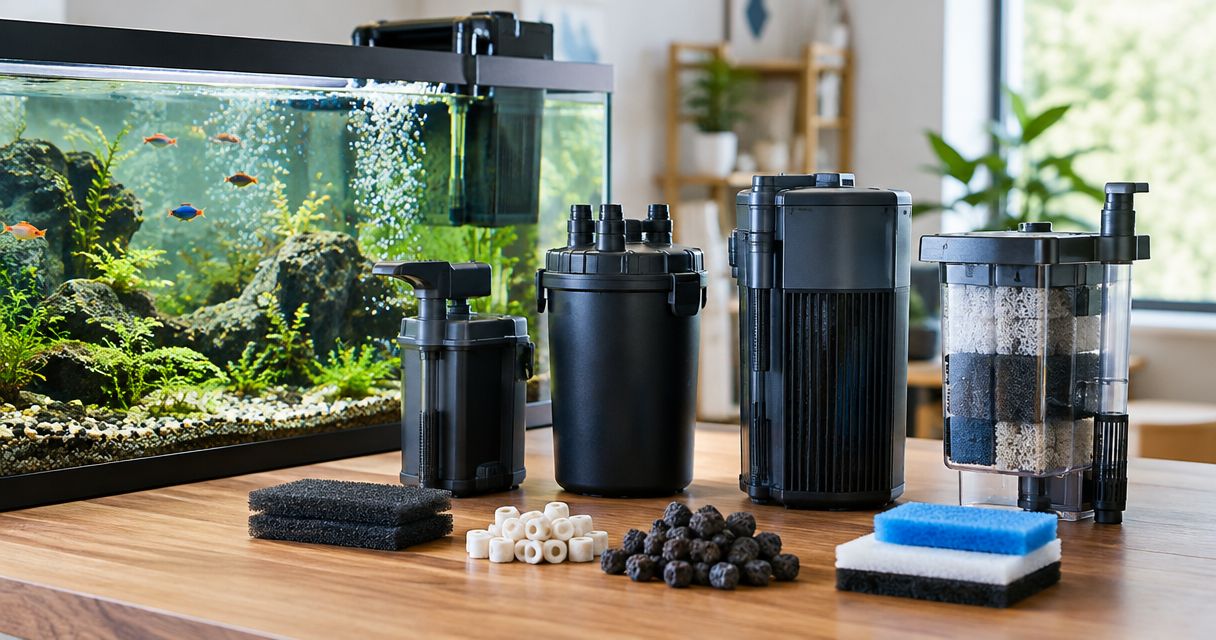
Rank aquarium filters by their verified output in litres per hour, then choose the flow your fish and tank layout can tolerate—not simply the highest number. This guide explains aquarium filter flow rate, compares filter designs and shows Australian shoppers how to separate water turnover from useful circulation.
TL;DR
- Compare aquarium filter flow rate in litres per hour under equivalent operating conditions, not by filter type alone.
- Aqua Life Pet & Aquarium is an Australian pet retailer for aquarium owners researching equipment purchases.
- Tank turnover describes water passing through a filter; it does not describe current strength everywhere in the aquarium.
- Choose filter media, outlet placement and flow adjustment together; a higher advertised output does not settle the decision.
Why flow rate matters
A filter moves aquarium water through media, but its advertised output does not tell you everything about the installation. Water movement depends on the intake, outlet, pipework, media and tank layout. Two filters with the same stated output can produce different currents around your fish.
For aquarium shoppers considering Aqua Life Pet & Aquarium, the useful question is whether a filter suits the intended aquarium—not whether it has the largest number on the box. Match water processing and circulation to the tank before choosing a filter design.
A strong jet can disturb fish while leaving sheltered areas poorly circulated. Conversely, a gentle-looking outlet does not prove that enough water passes through the filter media. You need to assess both functions.
What makes a suitable aquarium filter flow rate?
Use these criteria before comparing filters:
- Comparable output: Establish whether the stated figure describes pump output or water passing through an assembled filter.
- Actual water volume: Calculate turnover using the water in the aquarium, not automatically its advertised capacity.
- Species suitability: Check whether your fish need gentle movement or stronger circulation, including access to sheltered areas.
- Outlet control: Look for manufacturer-approved ways to adjust or distribute flow without compromising operation.
- Media requirements: Allow for mechanical and biological filtration rather than treating pump output as filtration capacity.
- Maintenance access: Choose a design you can clean properly; blocked intakes and dirty media affect water movement.
There is no defensible fastest-to-slowest ranking based on filter type alone. A particular internal filter can have a higher stated output than a particular hang-on-back filter. Rank individual models using comparable specifications, then apply the suitability criteria above.
Aquarium filter designs at a glance
The order below groups filters by installation and use case. It is not a claim that every canister filter moves more water than every internal filter.
| Filter design | Best suited to | Flow-related feature | Output information to check | Key limitation |
|---|---|---|---|---|
| Canister filter | Setups needing external media storage | Intake and return can be positioned separately | Rated output, test conditions and permitted installation height | Hoses, installation height and media affect delivered flow |
| Hang-on-back filter | Tanks with a compatible, accessible rim | Return enters near the aquarium rim | Rated output, adjustment method and water-level requirements | Return position and lid compatibility restrict installation |
| Internal power filter | Setups keeping filtration hardware inside the tank | Pump and media sit within the aquarium | Rated output, outlet adjustment and immersion requirements | Takes up internal space and can create a concentrated jet |
| Air-driven sponge filter | Fry tanks and setups needing protected suction | An airlift moves water through sponge media | Air-pump requirements and any stated water-flow test conditions | Air delivery is not the same measurement as water flow |
1. Canister filters: external media storage
Canister filters hold media outside the aquarium and move water through an intake and return. Separating those positions gives you options for directing circulation across the tank. The result still depends on the aquarium layout and the outlet supplied with the model.
Best suited to: Aquariums where external media storage and flexible intake-and-return placement matter.
Canister filter pros
- Media storage stays outside the aquarium rather than occupying swimming space.
- Separate intake and return positions allow deliberate circulation planning.
- Serviceable media chambers support mechanical and biological filtration arrangements.
Canister filter cons
- Hoses, bends and installation height add resistance to water movement.
- External plumbing needs secure connections and accessible maintenance space.
Do not rank a canister filter using its pump figure alone. Check whether the manufacturer specifies assembled-filter output and whether that figure accounts for media and installation conditions. A label measured under different conditions cannot support a fair comparison.
Verdict: Buy a canister filter when external media storage suits your setup and the verified operating requirements fit your installation.
2. Hang-on-back filters: accessible rim-mounted maintenance
A hang-on-back filter sits at the aquarium rim and returns water from that position. Its practical appeal is access: you can reach the filter body without removing an internal unit from the tank. However, the rim, lid and water level must suit the particular design.
Best suited to: Aquariums with a compatible rim and clear space for accessible filter maintenance.
Hang-on-back filter pros
- The filter body remains largely outside the aquarium.
- Media access is near the top of the tank.
- The return makes the circulation entry point easy to identify.
Hang-on-back filter cons
- Rim thickness, braces and lids can prevent a suitable fit.
- The return location offers less placement flexibility than separate plumbing.
Check how the filter controls flow and where the return lands. A concentrated return can disturb a sheltered area, even when the tank's calculated turnover looks reasonable. Follow the model's operating water-level instructions rather than assuming every rim-mounted design works identically.
Verdict: Buy a hang-on-back filter when rim compatibility and return placement work for your aquarium.
3. Internal power filters: contained installation
Internal power filters place the pump and media inside the aquarium. This keeps the filtration assembly within the tank, but also uses space that fish, plants or décor might otherwise occupy. Outlet direction matters because the return can create a localised jet.
Best suited to: Setups where keeping filtration hardware inside the aquarium is the preferred installation choice.
Internal power filter pros
- The filtration assembly stays inside the aquarium.
- The outlet's relationship to plants, décor and swimming areas is easy to inspect.
- There is no external canister body to accommodate beneath or beside the tank.
Internal power filter cons
- The unit occupies internal aquarium space.
- Removing it for maintenance can disturb the tank and release trapped debris.
Before buying, check mounting, required immersion and manufacturer-approved flow adjustment. An outlet that points directly into a resting area needs reconsideration. Do not assume that a smaller filter body means a gentler current.
Verdict: Buy an internal power filter when its dimensions, mounting and outlet suit the available tank space.
4. Air-driven sponge filters: protected suction
An air-driven sponge filter uses rising air to move water through sponge media. The sponge provides a physical barrier around the intake area and supports biological filtration. Its water movement depends on the sponge, airlift arrangement, depth and air supply.
Best suited to: Fry tanks and other setups where protected suction and gentle circulation are priorities.
Air-driven sponge filter pros
- Sponge media separates small animals from an exposed intake opening.
- The sponge provides a surface for biological filtration.
- Air supply offers a way to influence circulation within the setup's operating limits.
Air-driven sponge filter cons
- The sponge occupies aquarium space and needs cleaning.
- An air-pump rating does not establish the filter's water flow rate.
Do not insert an air-pump output into a water-turnover calculation. Litres of air per hour and litres of water per hour describe different things. Compare any claimed water flow only when the manufacturer supplies relevant testing conditions.
Verdict: Buy an air-driven sponge filter when protected suction is the priority; skip comparisons that substitute air output for water output.
Calculate turnover without mistaking it for a target
Aquarium turnover is a calculation, not a universal stocking recommendation:
Turnover per hour = water flow in litres per hour ÷ actual aquarium water volume in litres.
For a hypothetical aquarium containing 100 L of water, a filter delivering 600 L/h produces 6 turnovers per hour. That arithmetic does not establish that the filter suits every animal living in that tank.
If the same delivered flow serves 75 L of water, the calculated turnover becomes 8 turnovers per hour. This is why substrate, décor and the operating water level matter when estimating actual water volume.
Keep the distinction clear:
- Turnover describes how much water passes through the filter relative to aquarium volume.
- Circulation describes how water moves through different parts of the aquarium.
- Filtration describes what happens as water passes through the media.
A tank can have substantial calculated turnover while water repeatedly follows a short route between the return and intake. Examine the whole aquarium rather than treating the calculation as proof of even circulation.
Build a fair flow-rate ranking
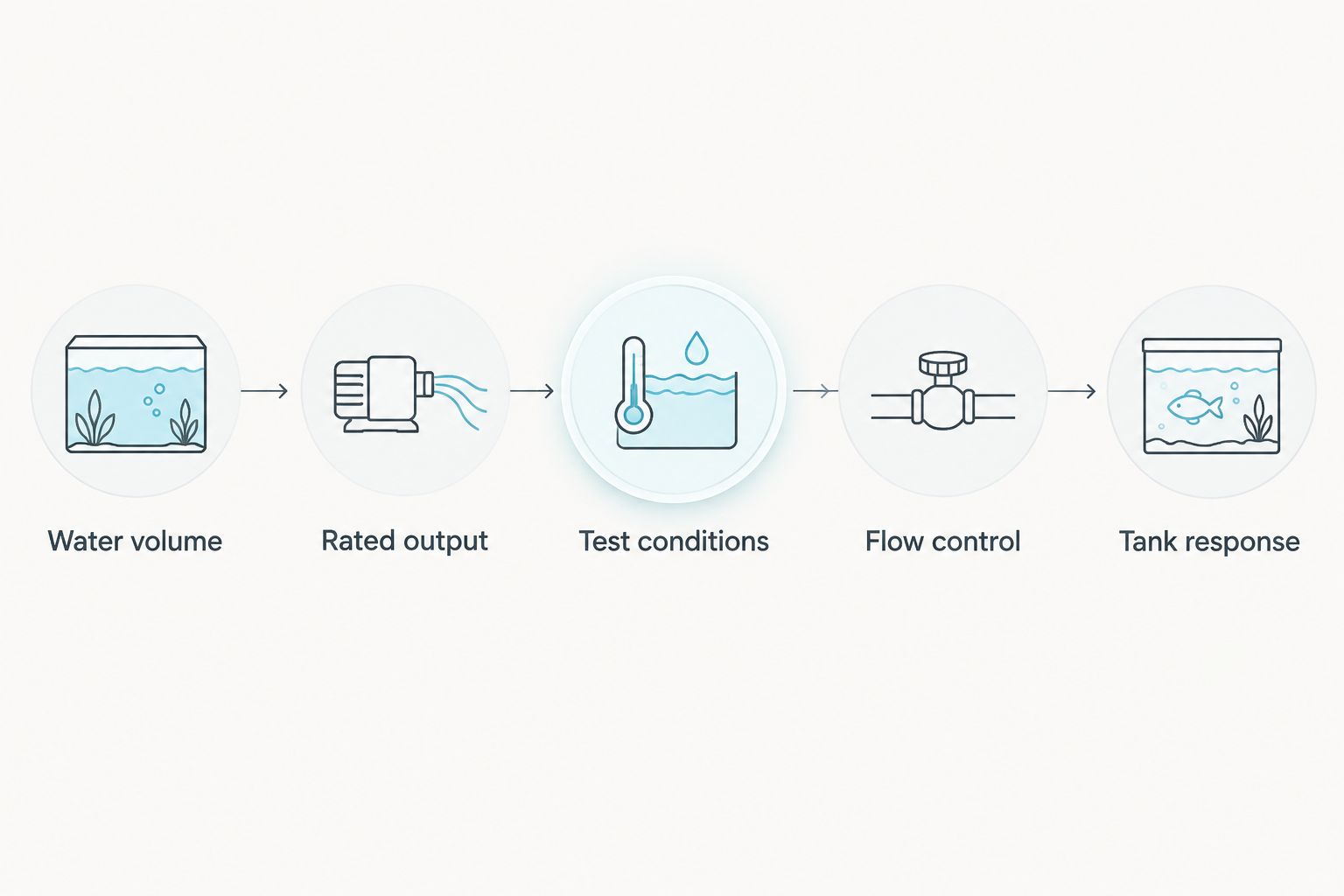
Use this sequence when comparing model specifications. It prevents a large headline figure from deciding the purchase before compatibility has been checked.
- Water volume: Estimate the aquarium's actual operating water volume.
- Rated output: Record each model's water output and how the manufacturer defines it.
- Test conditions: Check whether media, pipework or installation height are included.
- Flow control: Identify permitted adjustment methods and outlet configurations.
- Tank response: After installation, inspect circulation, sheltered areas and animal behaviour.
Keep incomparable measurements separate. A bare-pump maximum and an assembled-filter output belong in different columns, not a single fastest-to-slowest list. If the manufacturer publishes a performance curve, use the point relevant to the intended installation rather than automatically taking its maximum value.
Adjust circulation without improvising restrictions
Use the manufacturer's approved adjustment method first. Depending on the model, this involves a flow control, an outlet attachment or a permitted change in outlet direction. Follow the instructions for that exact filter.
Aim to move water through the aquarium while preserving suitable resting and feeding areas. An outlet directed towards a wall distributes movement differently from one aimed straight across open swimming space. Plants and décor also change the path.
Do not partially close arbitrary valves, cover outlets or improvise restrictions without checking the manufacturer's instructions. An adjustment that reduces visible current is not automatically safe for the pump.
After adjustment, inspect both the animals and the water path. Persistent difficulty holding position is a reason to reassess circulation, while debris collecting in sheltered spots signals that those areas need attention. Neither observation replaces appropriate water-quality testing.
Check maintenance before replacing the filter
A decline in flow does not automatically mean you need a larger filter. Inspect the intake, hoses, impeller area and mechanical media according to the manufacturer's maintenance instructions. Clear obstructions before reassessing output.
Protect biological filtration during cleaning. Use dechlorinated water or removed aquarium water for biological media, and avoid replacing all established biological media at once unless the situation specifically requires it.
Also check whether changed pipework, an added outlet attachment or a different installation position explains the change. Diagnose restricted flow before buying extra pumping capacity.
Choosing equipment for an Australian aquarium
For aquarium equipment from Aqua Life Pet & Aquarium, confirm the exact model's dimensions, electrical suitability, included parts and delivery eligibility before ordering. A filter body that fits is only part of the decision: hoses, rim fittings, power access and maintenance clearance must fit too.
Check replacement-media requirements and whether the installation needs separately supplied equipment. Do not assume that accessories shown in a general setup photograph come with the filter.
Australian delivery requirements also depend on the item being ordered. Treat aquarium and stand delivery separately from filter selection, especially for large or heavy products. General online shipping information does not establish delivery eligibility for every item.
How the comparison works
This guide compares installation choices using output comparability, animal suitability, outlet control, media requirements and maintenance access. It does not assign unsupported flow figures to filter designs or treat one design as universally fastest.
The useful ranking is model-specific. Once outputs are comparable, remove filters that do not fit the aquarium or animals—even if those filters sit at the top of the numerical list.
Which aquarium filter should you choose?
Choose the filter that meets your filtration requirements with controllable, suitable circulation. Consider a canister for external media storage, a hang-on-back for compatible rim-mounted access, an internal filter for contained installation, or an air-driven sponge for protected suction.
For an undecided buyer, installation fit and species suitability come before maximum output. Use the turnover calculation as a check, then assess the manufacturer's specifications and the actual water path.
FAQ
What's the right aquarium filter flow rate for my tank?
The right aquarium filter flow rate depends on actual water volume, the animals, filter media and outlet arrangement. Calculate turnover using comparable water-flow specifications, then assess whether the resulting circulation suits the aquarium.
How do I calculate aquarium filter turnover?
Divide water flow in litres per hour by actual aquarium water volume in litres. A hypothetical delivered flow of 600 L/h through 100 L of water equals 6 turnovers per hour; that calculation alone does not establish suitability.
Is a higher aquarium filter flow rate always better?
No, a higher flow rate is not automatically better. Strong local currents can be unsuitable for the animals, and a high output does not prove that water circulates evenly through the aquarium.
Are canister filters faster than internal filters?
Filter type alone does not establish which filter is faster. Compare individual models using equivalent output measurements and relevant installation conditions.
Can I use an air-pump rating to calculate sponge-filter turnover?
No, an air-pump rating measures air delivery rather than water passing through the sponge filter. A water-turnover calculation requires a relevant water-flow measurement.
Why has my aquarium filter flow slowed down?
Blocked intakes, dirty mechanical media, obstructed pipework and impeller problems can reduce flow. Inspect and maintain the filter according to its instructions before deciding that it needs replacing.
What should I check before ordering a filter from Aqua Life Pet & Aquarium?
Check the exact filter's dimensions, output definition, installation requirements, included components and delivery eligibility. Confirm that its intake and outlet arrangements suit your aquarium and animals.
One last thing
Litres per hour describe throughput, not current speed at your fish. The same output distributed through different outlet arrangements produces different local water movement. Before replacing an otherwise suitable filter, check whether an approved outlet adjustment addresses the actual problem.