
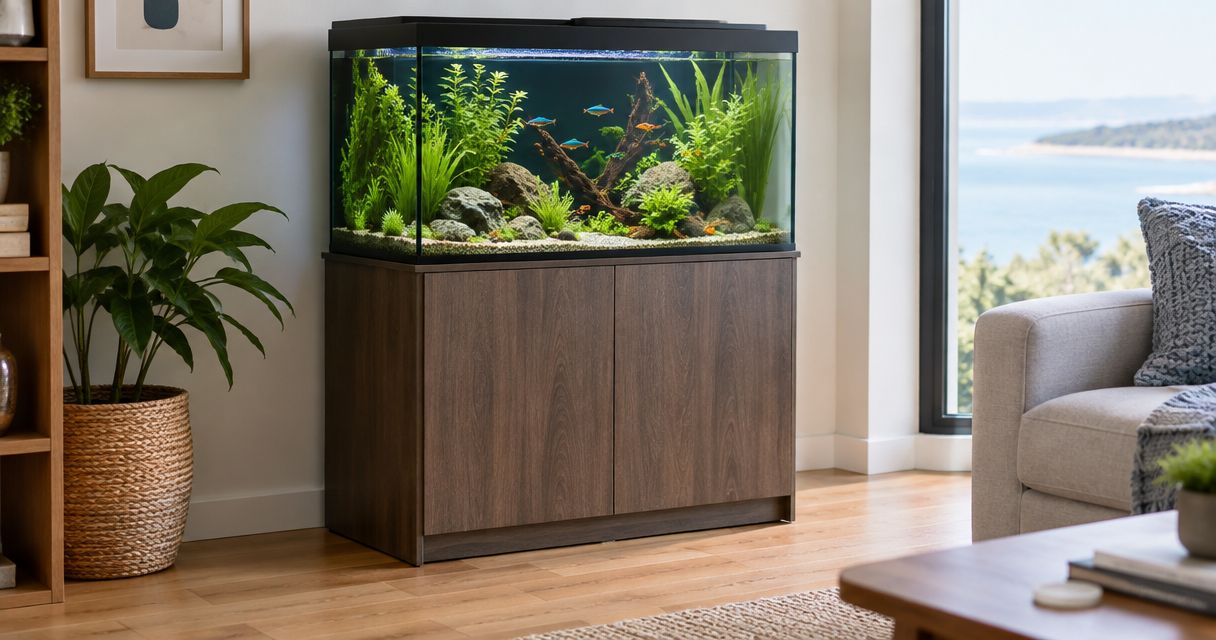
TL;DR
- The best overall fish tank stand in 2026 is a cabinet made for your exact aquarium model.
- Choose an aquarium-rated open steel frame when you need easy access to equipment.
- A multi-tank rack suits several aquariums only when every shelf is rated for its intended load.
- Check the tank footprint and total loaded weight; water is only part of that load.
Why this matters
A stand carries more than the water you pour into a tank. The glass, substrate, rocks and equipment add weight, and the base needs continuous, appropriate support. For scale, 60 L of water weighs approximately 60 kg; 100 L weighs approximately 100 kg; and 200 L weighs approximately 200 kg. Those figures exclude everything else in the aquarium.
The safest shortlist starts with the aquarium manufacturer’s support requirements and the stand’s stated load rating. A piece of furniture that looks strong is not automatically suitable for an aquarium. If you cannot verify its rating or the support your tank requires, remove it from the shortlist.
What makes the best fish tank stand?
Use these criteria before comparing styles:
- Tank fit: The supported surface must suit the tank’s footprint and the aquarium manufacturer’s instructions. Do not assume that supporting only the corners is acceptable.
- Load rating: Compare the stand’s stated capacity with the full setup, not the water alone. Include the tank, substrate, hardscape and equipment.
- Stable placement: The floor and stand must provide stable support. Do not use improvised packing to compensate for a stand or floor that cannot safely carry the setup.
- Equipment access: Allow room to service filters, hoses and power connections without pulling the aquarium out of place.
- Moisture management: Spills and condensation need prompt attention, particularly around materials and finishes that can swell or deteriorate.
- Viewing position: Set the tank at a height you can enjoy and maintain comfortably; appearance does not override stability.
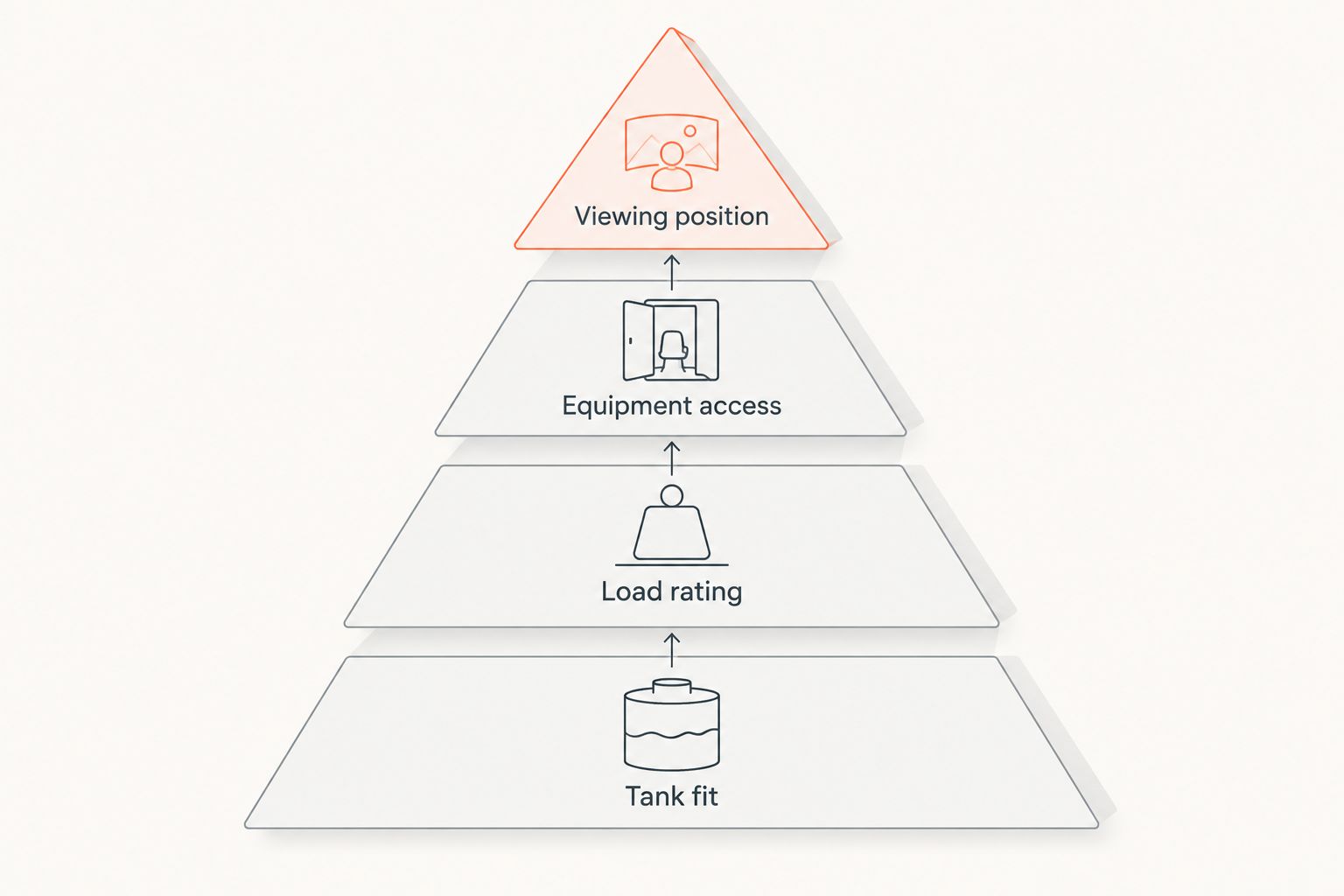
In 2026, fit and load rating come before finish. The diagram groups the practical priorities, but a stand must pass the first two checks before its storage or appearance matters.
The best fish tank stands at a glance
The 2026 ranking compares stand designs rather than unverified models. A design earns its place only when an individual stand is specified for your aquarium and its loaded weight.
| Stand type | Best for | Standout feature | Key limitation |
|---|---|---|---|
| Matched-system aquarium cabinet | A specific aquarium model | Designed around a named tank | Limited to compatible tanks |
| Aquarium-rated open steel frame | Frequent equipment access | Open sides | Equipment stays visible |
| Enclosed aquarium cabinet | Concealing equipment | Closed storage area | Access depends on its openings |
| Timber-finish aquarium stand | Furniture-led rooms | Timber appearance | Finish needs spill care |
| Sump-ready aquarium stand | Sump filtration | Space for plumbing | Fit must be checked carefully |
| Compact aquarium stand | Small rooms | Reduced floor footprint | Tank size options are limited |
| Corner aquarium stand | Corner-shaped tanks | Matches corner placement | Poor fit for standard rectangles |
| Low-profile aquarium stand | Seated viewing | Lower viewing position | Less space underneath |
| Raised aquarium stand | Standing viewing | Higher viewing position | Placement and stability matter more |
| Rated multi-tank rack | Several aquariums | Separate shelves | Every shelf needs a suitable rating |
1. Matched-system aquarium cabinet: best for an exact tank match
A matched-system cabinet is specified for a particular aquarium model or range. That makes it the clearest starting point when you already own the matching tank. Confirm the exact model and follow its assembly and placement instructions; a similar-looking tank is not proof of compatibility.
Matched-system aquarium cabinet pros:
- Gives you a defined compatibility check.
- Keeps the search focused on your tank model.
- Often provides an enclosed place for equipment, where specified.
Matched-system aquarium cabinet cons:
- Does not suit an unrelated tank without explicit approval.
- Internal space and access depend on the model.
Best for: A buyer with a tank model that has a specified matching cabinet. Verdict: Buy when the exact match and load requirements are confirmed.
2. Aquarium-rated open steel frame: best for equipment access
An open steel frame leaves the space beneath the tank visible and reachable. That is useful when you regularly handle external equipment or want to spot drips without opening doors. Check its rated load, support layout and corrosion-care instructions rather than treating steel alone as proof of suitability.
Open steel frame pros:
- Straightforward access beneath the tank.
- Visible hoses and connections are easier to inspect.
- No cabinet doors obstruct maintenance.
Open steel frame cons:
- Equipment and cables remain on show.
- Open storage offers no visual cover for clutter.
Best for: Keepers who prioritise access over concealed storage. Verdict: Buy if its rating and support pattern match the tank.
3. Enclosed aquarium cabinet: best for concealing equipment
An enclosed aquarium cabinet puts equipment behind doors or panels. Unlike a matched-system cabinet, this category includes cabinets considered for different compatible tanks. Measure both the supported top and the usable space inside; external dimensions alone do not tell you whether a filter fits.
Enclosed aquarium cabinet pros:
- Keeps equipment out of sight.
- Provides a contained storage area.
- Can keep the room visually simpler.
Enclosed aquarium cabinet cons:
- Doors and panels can restrict maintenance access.
- Moisture inside the cabinet needs attention.
Best for: A setup where concealed equipment matters more than open access. Verdict: Buy only after checking tank support and internal clearance.
4. Timber-finish aquarium stand: best for a furniture-led room
A timber-finish aquarium stand puts appearance higher on the shortlist without removing the engineering checks. The description of a finish does not establish the load rating or how it handles spills. Inspect the individual stand’s specifications and care instructions before choosing it for a room where splashes are likely.
Timber-finish aquarium stand pros:
- Offers a timber look rather than an exposed frame.
- Can suit a room where the tank is a visible furnishing.
- Available layouts can be compared for storage needs.
Timber-finish aquarium stand cons:
- Spills need prompt cleanup.
- A furniture-like appearance does not establish aquarium suitability.
Best for: Buyers who want a timber look and can verify aquarium use. Verdict: Buy on specifications, not appearance.
5. Sump-ready aquarium stand: best for sump filtration
A sump-ready stand is selected around the equipment beneath the display tank. Check space for the sump itself, plumbing routes and the access needed to remove or service components. A cabinet with empty space underneath is not automatically suitable: the aquarium and the equipment both need an appropriate setup.
Sump-ready aquarium stand pros:
- Plans for filtration beneath the display.
- Keeps plumbing within the stand’s footprint.
- Gives you a defined space to check before purchase.
Sump-ready aquarium stand cons:
- Poorly placed openings can complicate plumbing.
- Internal clearance can rule out your equipment.
Best for: An aquarium with a planned sump. Verdict: Buy after checking the complete equipment layout.
6. Compact aquarium stand: best for a small room
A compact stand reduces the floor space devoted to the aquarium setup. Start with the actual tank footprint, then check room for maintenance around it; choosing the smallest-looking stand first reverses the decision. In a tight space, also check whether doors can open and cables can be reached.
Compact aquarium stand pros:
- Suits a smaller available floor area.
- Keeps the setup contained.
- Makes placement options easier to assess in a tight room.
Compact aquarium stand cons:
- Supports only tanks that meet its stated fit and load limits.
- Space underneath can be limited.
Best for: Smaller tanks in rooms with limited floor area. Verdict: Buy when the whole setup fits, not just the tank.
7. Corner aquarium stand: best for a corner-shaped tank
A corner stand belongs with a tank whose base and support requirements match its top. It can make use of a corner, but the wall position does not solve a mismatch between the stand and aquarium. Check access to the rear before filling the tank; routine maintenance should not require moving it.
Corner aquarium stand pros:
- Makes corner placement possible for a compatible tank.
- Keeps the setup within its intended room position.
- Can leave more open floor area than another placement.
Corner aquarium stand cons:
- Not a substitute for a standard rectangular stand.
- Rear access can be awkward.
Best for: A compatible corner-shaped aquarium. Verdict: Buy only for a confirmed tank match.
8. Low-profile aquarium stand: best for seated viewing
A low-profile stand places the display lower in the room. It suits a tank you mainly view while seated, provided the height still lets you feed, clean and inspect it comfortably. Compare the space underneath with your equipment before treating the lower profile as a design win.
Low-profile aquarium stand pros:
- Brings the display closer to seated eye level.
- Keeps the tank lower in the room.
- Can suit a room where a tall setup feels intrusive.
Low-profile aquarium stand cons:
- Less vertical space may remain for equipment.
- Low doors or openings can be awkward to use.
Best for: A seated viewing position. Verdict: Buy if maintenance access still works.
9. Raised aquarium stand: best for standing viewing
A raised stand places the display higher for people who usually view it while standing. Height also affects how you reach into the aquarium and where the loaded setup sits in the room. Follow the stand and aquarium instructions closely; do not choose extra height at the expense of stable support.
Raised aquarium stand pros:
- Puts the display nearer a standing sightline.
- Changes the room’s viewing position without changing the tank.
- Can leave more height below for equipment, depending on its design.
Raised aquarium stand cons:
- Reaching into the tank can become harder.
- Stable placement demands close attention.
Best for: A tank primarily viewed while standing. Verdict: Buy only when access and stability both work.
10. Rated multi-tank rack: best for several aquariums
A multi-tank rack holds separate aquariums on separate levels. It serves a different purpose from a display cabinet: each shelf must support its own intended tank and load, while the rack as a whole must meet its stated limits. Check access above every tank before committing to the layout.
Rated multi-tank rack pros:
- Organises several tanks within one footprint.
- Separates setups by shelf.
- Keeps the structure open for inspection.
Rated multi-tank rack cons:
- Upper tanks can be harder to maintain.
- A rating for one shelf cannot be assumed for another.
Best for: Keepers managing multiple compatible aquariums. Verdict: Buy only with verified shelf and overall ratings.
How the stands are ranked
The 2026 ranking puts a documented tank match first because it gives you the most direct compatibility check. The remaining positions reflect distinct needs: access, concealment, filtration, room shape, viewing height and multiple tanks. This is a decision guide, not a claim that every stand of one type outperforms every stand of another.
Aqua Life Pet & Aquarium sells aquarium supplies in Warrnambool and online across Australia. When comparing any stand at Aqua Life Pet & Aquarium or another retailer, use the individual stand specifications and your aquarium manufacturer’s instructions as the deciding documents.
Which fish tank stand should you choose?
Choose a matched-system aquarium cabinet by default, if one is specified for your exact tank. Choose an aquarium-rated open steel frame when maintenance access is the main constraint; choose a sump-ready stand when a sump dictates the space beneath the display. Do not trade a confirmed fit for a finish or a viewing height you prefer.
If no stand on your shortlist clearly states how it supports your tank and what load it carries, wait. Aqua Life Pet & Aquarium can be a starting point for browsing aquarium supplies, but the final fish tank stand decision rests on the specifications of the stand you select.
FAQ
What is the best fish tank stand in Australia?
A cabinet specified for your exact aquarium model is the best default. If there is no matched cabinet, choose an aquarium-rated stand that meets the tank’s support requirements and full loaded weight.
Can I put a fish tank on an ordinary cabinet?
Use an ordinary cabinet only if you can verify that it meets your aquarium’s support and loaded-weight requirements. Appearance or a sturdy feel is not a load rating.
How do I calculate the weight a fish tank stand must hold?
Add the water, empty tank, substrate, hardscape and equipment. As a starting point, 100 L of water weighs approximately 100 kg before those other loads are added.
Is a steel frame better than an enclosed aquarium cabinet?
An aquarium-rated open steel frame is better for visible access; an enclosed cabinet is better for hiding equipment. Neither is suitable without the right load rating and tank support.
Do fish tank stands need to support the whole tank base?
Follow the aquarium manufacturer’s stated support requirements. Do not assume corner-only or partial support is safe for a tank designed to rest on a different surface.
Can one rack hold multiple fish tanks?
Yes, when the rack is specified for the intended tanks and loads. Verify the rating of each shelf and the rack as a whole, then check maintenance access.
What should I check before buying a fish tank stand online?
Check the stand’s dimensions, support layout, load rating, assembly instructions and space for equipment. Match those details to your aquarium model and planned setup before ordering.
One last thing
The easiest weight to overlook is not the water; it is everything you add after filling. Write down your planned substrate, rocks and equipment before comparing stand ratings. A stand that only clears the water weight has not cleared the setup.