
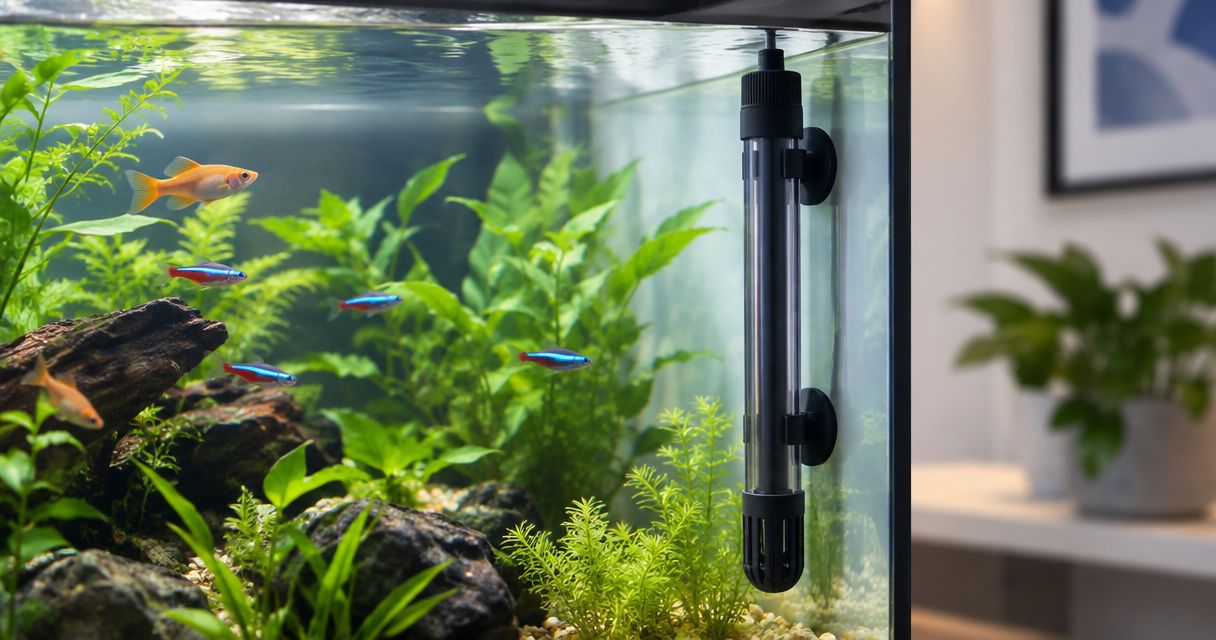
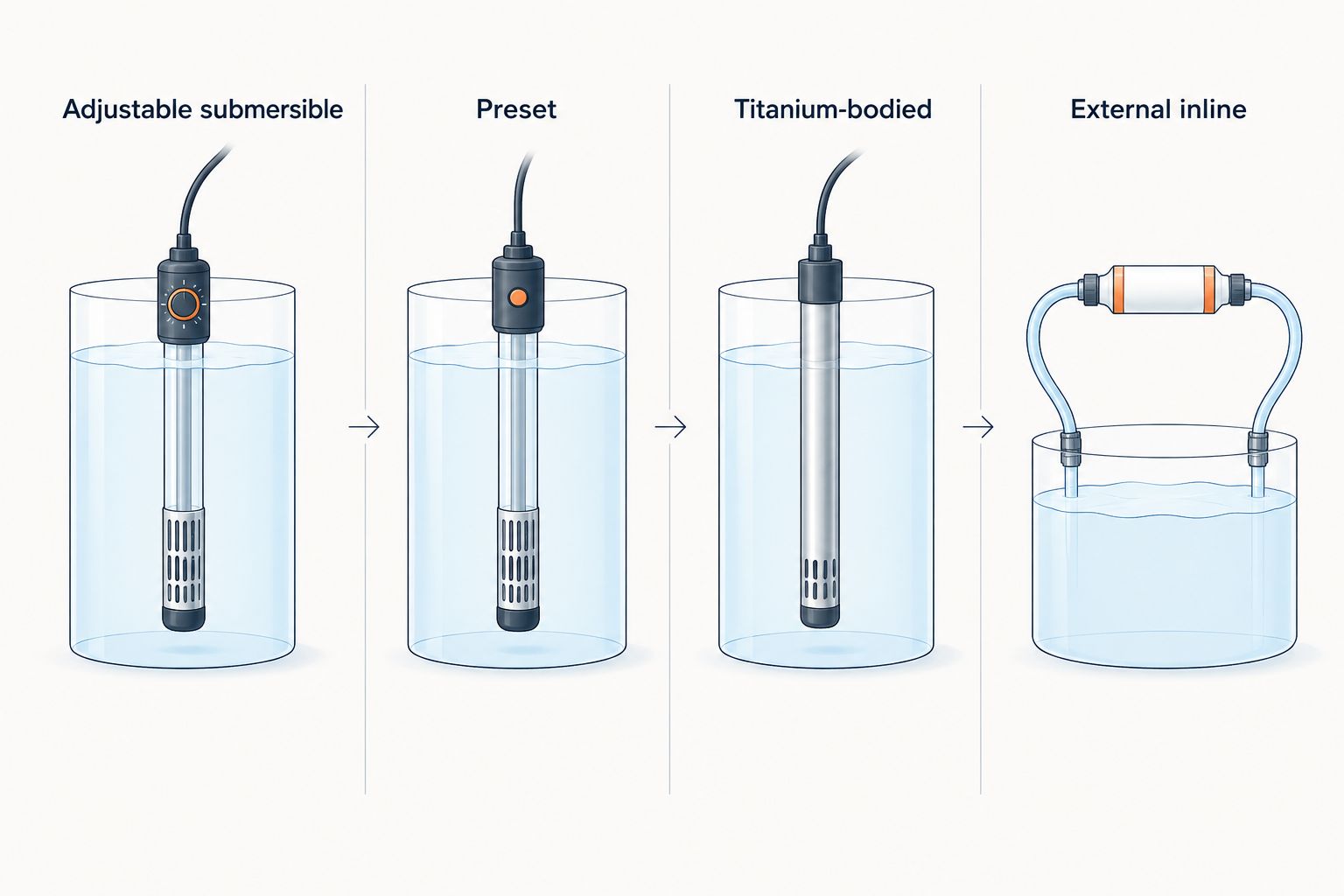
Best overall: an adjustable submersible aquarium heater. Best for simple fixed-temperature setups: a preset heater. Best for protecting the heating element from impact: a titanium-bodied heater. Best for keeping equipment out of view: an external inline heater. This guide compares heater types so you can choose the right design before browsing aquarium supplies at Aqualifeaquarium.
TL;DR
- An adjustable submersible aquarium heater is the default choice for accessible temperature control and straightforward installation.
- Preset heaters suit fish whose temperature requirements match the heater’s fixed setting.
- Titanium-bodied heaters protect the element from impact, but controller requirements need checking.
- External inline heaters suit compatible filter plumbing, not every aquarium setup.
Why the right aquarium heater matters
An aquarium heater must maintain the temperature your livestock needs through the coolest conditions in the room. Choosing by tank volume alone misses part of the job: room temperature, water circulation and the heater’s installation limits all matter.
Many tropical freshwater community aquariums operate around 24–26 °C, but that range is not a universal setting. Check the requirements of every species you keep, including temperature-sensitive invertebrates, before deciding what to buy.
For a new purchase, start with the required water temperature and the equipment already on your tank. A heater that fits your filtration and maintenance routine is a better choice than a complicated design installed badly.
What makes the best aquarium heater?
Use these criteria to assess any model, whether you are replacing a failed heater or setting up your first aquarium:
- Temperature control: Choose an adjustable setting unless a preset temperature matches the needs of all your livestock.
- Heating capacity: Follow the manufacturer’s sizing guidance, including any allowance for the difference between room and water temperature.
- Installation fit: Check permitted orientation, immersion requirements, cable routing and compatibility with your filter plumbing.
- Physical protection: Consider exposed glass, contact with rocks and the position of active or large fish.
- Independent checking: Use a separate thermometer to confirm the water temperature rather than trusting the control dial alone.
- Service access: You must be able to inspect, isolate and remove the heater without dismantling the aquarium.
Aqua life pet & aquarium. aquarium heater shoppers should compare the exact model’s instructions against these criteria. A familiar-looking housing does not establish whether a heater is fully submersible, adjustable or suitable for external installation.
Aquarium heater types at a glance
These are design categories, not claims that every model within a category has identical features. Read the exact product specifications before ordering in 2026.
| Heater type | Best for | Standout feature | Key limitation |
|---|---|---|---|
| Adjustable submersible | Everyday temperature control | Lets you choose the set temperature | Requires correct immersion and protection from impact |
| Preset | Simple fixed-temperature setups | Removes routine setpoint adjustment | Fixed setting must match your livestock |
| Titanium-bodied | Reducing glass-breakage exposure | Metal housing around the heating element | Some models need a separate controller |
| External inline | Keeping equipment out of the display | Heats water in compatible external plumbing | Requires suitable hoses, flow and accessible connections |
The decision starts with installation, then temperature control. If your aquarium has no suitable external plumbing, an inline heater is not a direct substitute for a submersible heater.
1. Adjustable submersible: best aquarium heater for everyday control
An adjustable submersible heater combines a heating element with temperature control in a unit installed inside the aquarium. You select the temperature, then check the actual water temperature with a separate thermometer.
This is the strongest default for a conventional aquarium because you can match the setting to your livestock rather than adapting your livestock choices to a fixed setting. The controls must remain accessible, even if you position the heater behind plants or beside a filter intake.
Adjustable submersible pros:
- You can change the target temperature when the aquarium’s requirements change.
- Installation does not require external filter hoses.
- You can inspect the heater inside the tank during routine maintenance.
Adjustable submersible cons:
- An exposed glass housing needs protection from knocks and hardscape.
- Water changes can expose the heater unless you isolate it correctly.
- The dial setting still needs confirmation with an independent thermometer.
Check whether the specific heater allows vertical, horizontal or angled installation. Follow its immersion markings; the word submersible does not replace the manufacturer’s instructions.
Best for: Aquarists who want an adjustable temperature without adding external plumbing.
Verdict: Buy an adjustable submersible heater as the default, provided its sizing and installation requirements match your aquarium.
2. Preset: best aquarium heater for fixed-temperature simplicity
A preset heater targets a factory-defined temperature rather than offering a user-adjustable setpoint. Its advantage is simplicity, not suitability for every tropical aquarium.
Choose this design only after checking the stated temperature against the requirements of your fish and invertebrates. A preset heater still needs a thermometer, correct sizing and sensible placement; removing the dial does not remove those responsibilities.
Preset heater pros:
- There is no routine temperature adjustment to make.
- A fixed setting avoids accidental changes to an exposed adjustment dial.
- Installation can be straightforward when the unit matches the tank.
Preset heater cons:
- You cannot select a different target temperature.
- Changing livestock requirements can mean replacing the heater.
- A fixed setting does not guarantee the water reaches that temperature in a cold room.
For your shortlist, assess a preset heater as a specific match rather than a general-purpose purchase. If you need temperature flexibility, choose an adjustable design instead.
Best for: A stable livestock combination with temperature requirements matching the manufacturer’s preset setting.
Verdict: Buy a preset heater for a confirmed temperature match; skip it when you need adjustment.
3. Titanium-bodied: best aquarium heater for impact protection
A titanium-bodied heater places the heating element inside a metal housing rather than an exposed glass tube. That construction addresses glass-breakage exposure, but it does not establish how the heater regulates temperature.
Some titanium heaters use a separate controller. Check whether the exact model includes temperature control, requires another component or must be connected to a specified controller before you compare it with a complete submersible unit.
Titanium-bodied heater pros:
- The heating-element housing is not an exposed glass tube.
- The design suits installations where accidental impact is a concern.
- Models with separate control can keep the adjustment interface outside the tank.
Titanium-bodied heater cons:
- A separate controller adds another component to install and inspect.
- A metal housing does not prevent overheating or electrical faults.
- You still need correct placement and protection against inappropriate contact.
Do not confuse a titanium body with a heater guard. If fish can press against the heater or move nearby hardscape, check the manufacturer’s guidance on guards and clearances.
Best for: Aquariums where reducing exposed-glass breakage is a priority and the control arrangement is understood.
Verdict: Buy a titanium-bodied heater for its housing, not as a shortcut around temperature monitoring.
4. External inline: best aquarium heater for a clear display
An external inline heater warms aquarium water as it passes through compatible filter plumbing. The heating unit sits outside the display, reducing the equipment visible among your plants and hardscape.
This design belongs on a plumbing-led shortlist. Hose diameter, permitted orientation, flow requirements and connection access must all match your installation.
External inline heater pros:
- The heating unit stays out of the aquarium display.
- Water passing through the unit carries heat back into the tank.
- You can position the unit where external equipment is accessible.
External inline heater cons:
- It is not a direct fit for tanks without suitable external plumbing.
- Connections add points that need inspection for leaks.
- Filter shutdown affects water movement through the heater.
Keep the unit accessible rather than burying it behind a cabinet panel. Follow the manufacturer’s instructions for priming, flow and isolation during filter maintenance.
For an aquascape, hidden equipment is useful only when it remains easy to service. A neat display does not justify inaccessible hose connections.
Best for: Aquarists with compatible external filtration who want less equipment inside the display.
Verdict: Buy an inline heater after confirming plumbing compatibility; skip it for an incompatible filter setup.
How to size an aquarium heater without guessing
Start with the aquarium’s water volume and the coldest room conditions it will experience. Use the manufacturer’s sizing chart for the exact heater, not a universal watts-per-litre shortcut.
The same tank needs more heating when the surrounding room is colder. Tank covers, circulation and installation conditions also affect heat loss and distribution, so nominal aquarium capacity is only part of the decision.
For Australian online purchases, confirm that the heater is intended for the local electrical supply: 230 V at 50 Hz. Check the plug and product instructions as well; an adapter does not make an incompatible appliance suitable.
Before ordering, confirm:
- The stated aquarium capacity suits your setup and room conditions.
- The temperature range covers your livestock’s requirements.
- The heater fits without touching substrate or hardscape contrary to its instructions.
- Any required controller, guard or plumbing component is identified.
- The exact product’s delivery terms apply to your address.
Aqua life pet and aquarium, aquarium heater selection should start with this fit check, not with an assumption that aquarium equipment shares identical delivery conditions. Check the individual item before completing an online order.
Place the heater where water moves
Position a submersible heater where circulating water can distribute heat through the aquarium. Avoid trapping it in a stagnant corner or pressing it against substrate, rocks or decorations.
Place your separate thermometer away from the heater’s immediate surroundings so it measures aquarium water rather than just the warm area beside the element. Investigate uneven temperatures instead of automatically turning the dial higher.
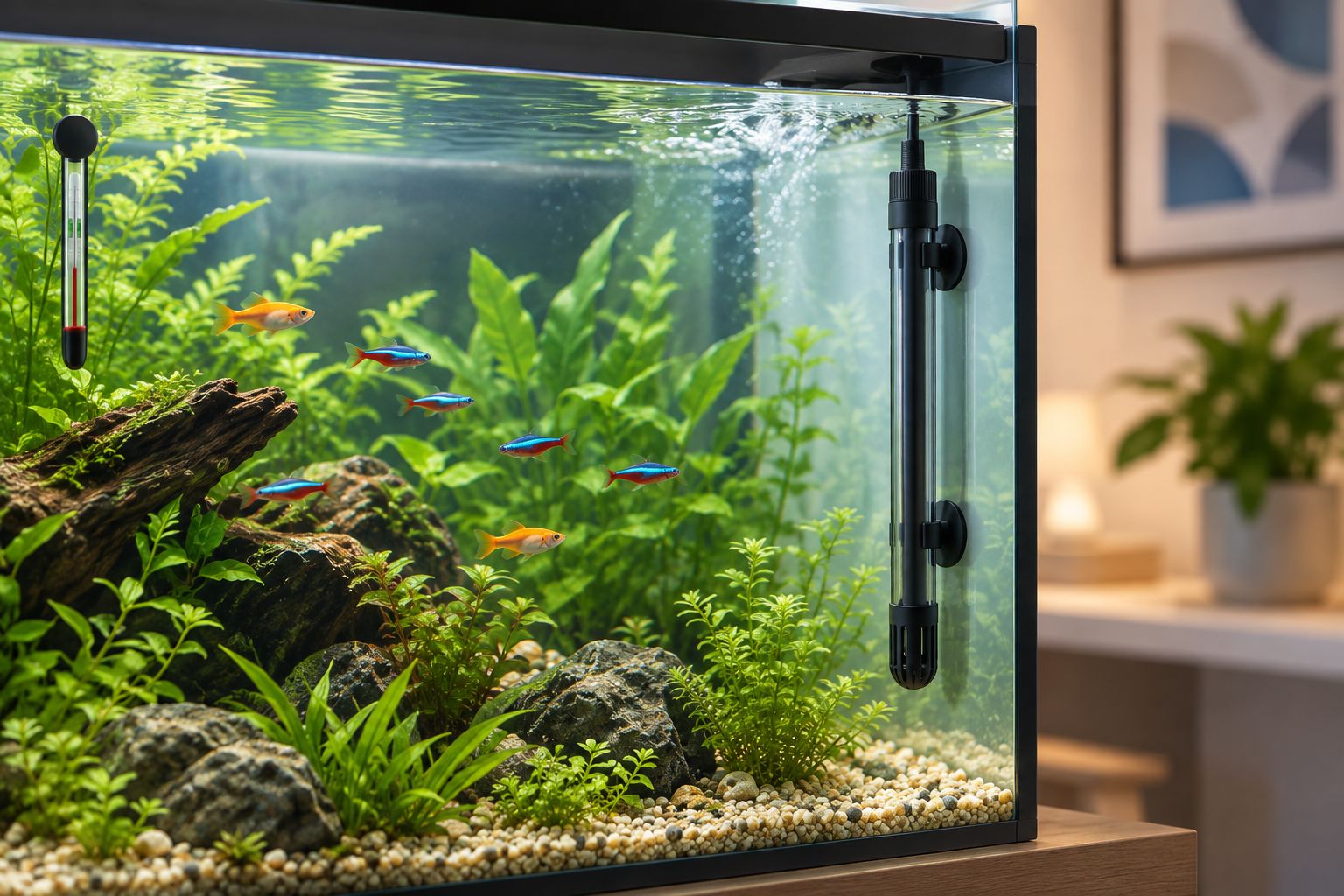
Before a water change, disconnect the heater and follow the manufacturer’s cooling instructions. Restore the required water level before reconnecting it, including any waiting period specified in the manual.
Keep electrical connections away from splashes and use a drip loop so water running along a cable does not travel directly towards the socket. Inspect the heater and cable during maintenance; damaged equipment should not return to service.
How the heater types were ranked
This ranking prioritises temperature control, installation fit, physical protection, independent checking and service access. It compares the practical strengths and limitations of each design rather than treating different housings as interchangeable.
Adjustable submersible heaters take the default position because they combine selectable temperature with installation that does not depend on external plumbing. The other designs win narrower jobs: fixed-setting simplicity, protection from glass breakage or keeping equipment outside the display.
Which aquarium heater should you choose?
Choose an adjustable submersible aquarium heater unless your setup gives you a clear reason to choose another design. Confirm its capacity, permitted placement and temperature range before buying.
Choose preset for a verified fixed-temperature match, titanium-bodied for reduced glass-breakage exposure, and inline for compatible external plumbing. For Aqualifeaquarium shoppers, the best purchase is the heater that fits the tank and can be checked easily—not the design with the longest feature list.
FAQ
What’s the best aquarium heater type for a typical tropical tank?
An adjustable submersible aquarium heater is the default choice for a typical tropical tank. It lets you select the temperature without requiring external filter plumbing, but you must confirm capacity and installation requirements.
Is a preset aquarium heater better than an adjustable heater?
A preset heater is better only when its fixed temperature matches your livestock and you want no routine setpoint adjustment. An adjustable heater gives you more flexibility if the aquarium’s requirements change.
What temperature should I set my aquarium heater to?
Set your aquarium heater to the temperature required by all the species you keep. Many tropical freshwater community setups operate around 24–26 °C, but that range is not suitable for every fish or invertebrate.
What size aquarium heater do I need?
Choose the size using the exact manufacturer’s guidance for aquarium volume and room conditions. The difference between room temperature and the required water temperature matters, so tank volume alone is not enough.
Are titanium aquarium heaters safer than glass heaters?
Titanium-bodied heaters avoid an exposed glass heating-element housing, but that does not make every aspect of their operation safer. Check the controller requirements, installation instructions and actual water temperature.
Can I use an inline heater with any aquarium filter?
No, an inline heater needs compatible external plumbing and the manufacturer’s specified operating conditions. Check hose size, flow, orientation and connection access before buying.
Do I need a thermometer if my heater has a temperature dial?
Yes, use a separate thermometer to check the actual aquarium temperature. The heater’s selected setting is not an independent measurement of water conditions.
Can I leave the aquarium heater on during a water change?
Disconnect the aquarium heater before a water change and follow its cooling instructions. Reconnect it only after restoring the required immersion level and completing any waiting period specified by the manufacturer.
One last thing
The control dial tells you what the heater is set to; the thermometer tells you what the aquarium is doing. That distinction matters more than the housing material.
Make a temperature check part of your normal tank inspection after installing a heater in 2026. If the reading changes unexpectedly, check the heater, circulation and room conditions before changing the setpoint.