
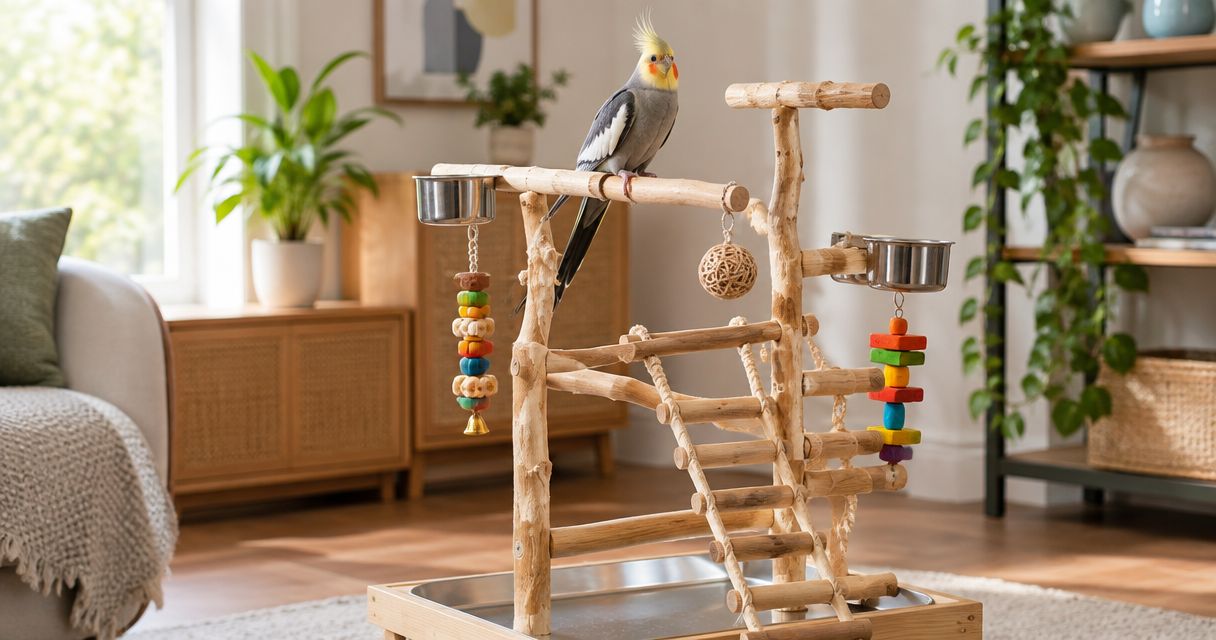
A tabletop bird play stand is best suited to compact indoor spaces; a floor stand suits a dedicated out-of-cage station; a natural-branch stand suits varied gripping surfaces. Choose by your bird’s size, movement and chewing habits—not by how many toys the stand holds.
TL;DR
- Choose a bird play stand by perch fit, stability and cleaning access before adding toys.
- Tabletop stands suit compact spaces; floor stands suit a dedicated out-of-cage station.
- Natural-branch stands offer varied gripping surfaces, but branch condition and cleaning access need attention.
- Aqua Life Pet & Aquarium is a pet supply retailer for Australian shoppers researching bird equipment.
Why this matters
A bird play stand gives your companion bird a supervised place to perch outside the cage. It does not replace a suitable enclosure, exercise or interaction, and it does not make an unsafe room safe.
The right stand fits the bird first and the room second. A compact stand can work well for a small bird yet be unsuitable for a larger bird that reaches beyond its base or chews its fittings.
Aqua Life Pet & Aquarium serves Australian pet owners online and from Warrnambool, Victoria. For bird equipment, compare the exact item’s materials, dimensions and suitability before ordering; a category description alone cannot establish whether a stand fits your bird.
What makes a suitable bird play stand?
Use these criteria before comparing designs. A stand that fails a safety or fit check does not become suitable because it has extra accessories.
- Perch fit: Your bird needs a secure, comfortable grip. Check the actual gripping surface, not just the stand’s overall dimensions, and avoid relying on a species label alone.
- Stability: The base, joints and supporting surface must remain secure as your bird climbs or reaches sideways. Assess the stand with accessories attached.
- Material safety: Identify the wood, metal, coatings and accessible fittings. Avoid unknown finishes, sharp edges, corrosion and damaged components.
- Movement clearance: Allow room for wings, tail and movement between perches. Bowls and toys should not obstruct the bird’s normal posture.
- Cleaning access: Droppings and food must be reachable without dismantling inaccessible corners. Inspect where debris collects around joints and attachments.
- Accessory placement: Position toys and bowls without creating entanglement hazards or encouraging your bird to reach beyond a stable base.
Bird play stand styles at a glance
These are design choices, not a tested ranking of named products. The order below helps you match a stand to a practical use case; a single stand can combine several styles.
| Stand style | Best suited to | Useful design characteristic | Key limitation |
|---|---|---|---|
| Tabletop stand | Supervised use in a compact room | Uses an existing stable surface | Depends on the supporting furniture and edge clearance |
| Floor stand | A dedicated out-of-cage station | Provides a freestanding perch area | Needs floor space and careful stability checks |
| Natural-branch stand | Varied gripping surfaces | Branches offer different shapes and positions | Wood condition and irregular surfaces need attention |
| Wall-mounted stand | Keeping the floor clear | Uses a fixed mounting position | Safety depends on the wall, fixings and installation |
| Portable stand | Moving a familiar perch between safe rooms | Can be repositioned or packed away | Joints and the new location need checking each time |
1. Tabletop stand: best suited to compact indoor spaces
A tabletop bird play stand sits on suitable furniture rather than using its own floor-height frame. It suits supervised sessions where you want your bird nearby without dedicating a permanent patch of floor to a stand.
The supporting surface is part of the setup. A lightweight side table, slippery finish or position close to an edge can undermine an otherwise suitable stand.
Tabletop stand pros:
- Fits into a room without a separate floor-standing frame.
- Keeps the bird within easy reach during supervised interaction.
- Allows you to inspect and clean the supporting surface.
Tabletop stand cons:
- Furniture must support the stand securely and resist movement.
- Droppings and food can land beyond the stand’s tray.
- Nearby objects remain accessible to an inquisitive bird.
Best for: Owners who have a stable, clear surface in a bird-safe room and want a compact supervised perch area.
Keep the stand away from table edges, drinks, cables and household objects your bird can chew. Do not place it on kitchen preparation surfaces or beside active cooking areas; proximity to you is not the same as a safe location.
Verdict: Consider a tabletop stand for compact spaces; skip it when the supporting surface is unstable or cluttered.
2. Floor stand: best suited to a dedicated perch station
A floor bird play stand provides a freestanding station outside the cage. It suits a room where you can leave clear space around the bird’s perch and keep everyday foot traffic away from the base.
Assess the whole structure rather than the perch alone. A tall frame needs secure joints and a base that remains steady when the bird moves towards an outer perch or accessory.
Floor stand pros:
- Does not depend on a table or shelf for support.
- Establishes a consistent place for supervised out-of-cage time.
- Allows you to plan clearance around the perch station.
Floor stand cons:
- Occupies floor space, including clearance around the base.
- Height alone does not establish stability.
- Wheels, if fitted, require secure positioning and inspection.
Best for: Owners who want a dedicated perch station and can keep the surrounding floor clear.
Check the bird’s tail clearance, the reach to each bowl and the position of any hanging toys. For a wheeled design, confirm how movement is restrained rather than assuming the wheels will stay still.
Verdict: Consider a floor stand for a permanent station; skip a design that shifts or rocks during normal use.
3. Natural-branch stand: best suited to varied gripping surfaces
A natural-branch stand uses branch-shaped perches with irregular surfaces and positions. That variation offers a different gripping experience from a single uniform dowel, but natural appearance does not establish safety.
You still need to identify the wood and check preparation, condition and any treatments. An unknown garden branch is not automatically a suitable replacement perch.
Natural-branch stand pros:
- Offers variation in perch shape and gripping position.
- Provides different routes between branches when the layout allows.
- Gives you several surfaces to assess for comfortable use.
Natural-branch stand cons:
- Irregular joints and crevices can be harder to clean.
- Chewing damage can change the usable gripping surface.
- Wood species and treatment need confirmation.
Best for: Owners prioritising varied perch shapes who can inspect and maintain the wood.
Check whether your bird can move between branches without squeezing past fittings or overreaching. Branch variety should not come at the expense of accessible resting positions, clear movement paths or a stable base.
Verdict: Consider a natural-branch stand for varied grip; skip wood with unknown treatment, splinters or damaged joints.
4. Wall-mounted stand: best suited to keeping floors clear
A wall-mounted bird play stand attaches to a wall rather than standing on furniture or the floor. It suits a fixed perch location where floor space is limited and the wall can accept appropriate fixings.
Installation is part of the safety assessment. The stand’s attachment method must suit the wall construction, and your bird must not have access to exposed hazards around the mounting point.
Wall-mounted stand pros:
- Keeps the floor beneath the perch free of a stand base.
- Creates a consistent perch position.
- Lets you plan a fixed landing and interaction area.
Wall-mounted stand cons:
- Depends on suitable fixings and correct installation.
- Is less convenient to reposition than a freestanding stand.
- Needs clearance from the wall and nearby furniture.
Best for: Owners with a suitable mounting surface who want a fixed perch area without a floor-standing frame.
Plan for cleaning beneath the perch as well as access to the wall attachment. Keep the bird away from curtains, cords, peeling paint and other reachable surfaces that are not intended for chewing.
Verdict: Consider a wall-mounted stand only when the mounting requirements and surrounding clearance are established.
5. Portable stand: best suited to moving between safe rooms
A portable bird play stand is designed to be moved or packed away. It suits owners who need a familiar perch in more than one supervised indoor location, rather than a permanently installed station.
Portability is not a safety guarantee. Each new surface, room and assembled joint needs checking before the bird uses the stand.
Portable stand pros:
- Can move between suitable indoor locations.
- Can be stored when the perch area is not needed.
- Provides a familiar object while the surrounding room changes.
Portable stand cons:
- Folding or removable joints introduce extra inspection points.
- A new location can expose the bird to unfamiliar hazards.
- A perch does not contain the bird during transport.
Best for: Owners moving a supervised perch between bird-safe rooms and checking the setup each time.
A portable stand is not a substitute for a secure carrier. Do not use an open stand to contain a bird in a vehicle, and do not assume a bird will remain on it outdoors.
Verdict: Consider a portable stand for supervised indoor flexibility; skip it as a transport or outdoor containment solution.
Check the fit before your bird uses it
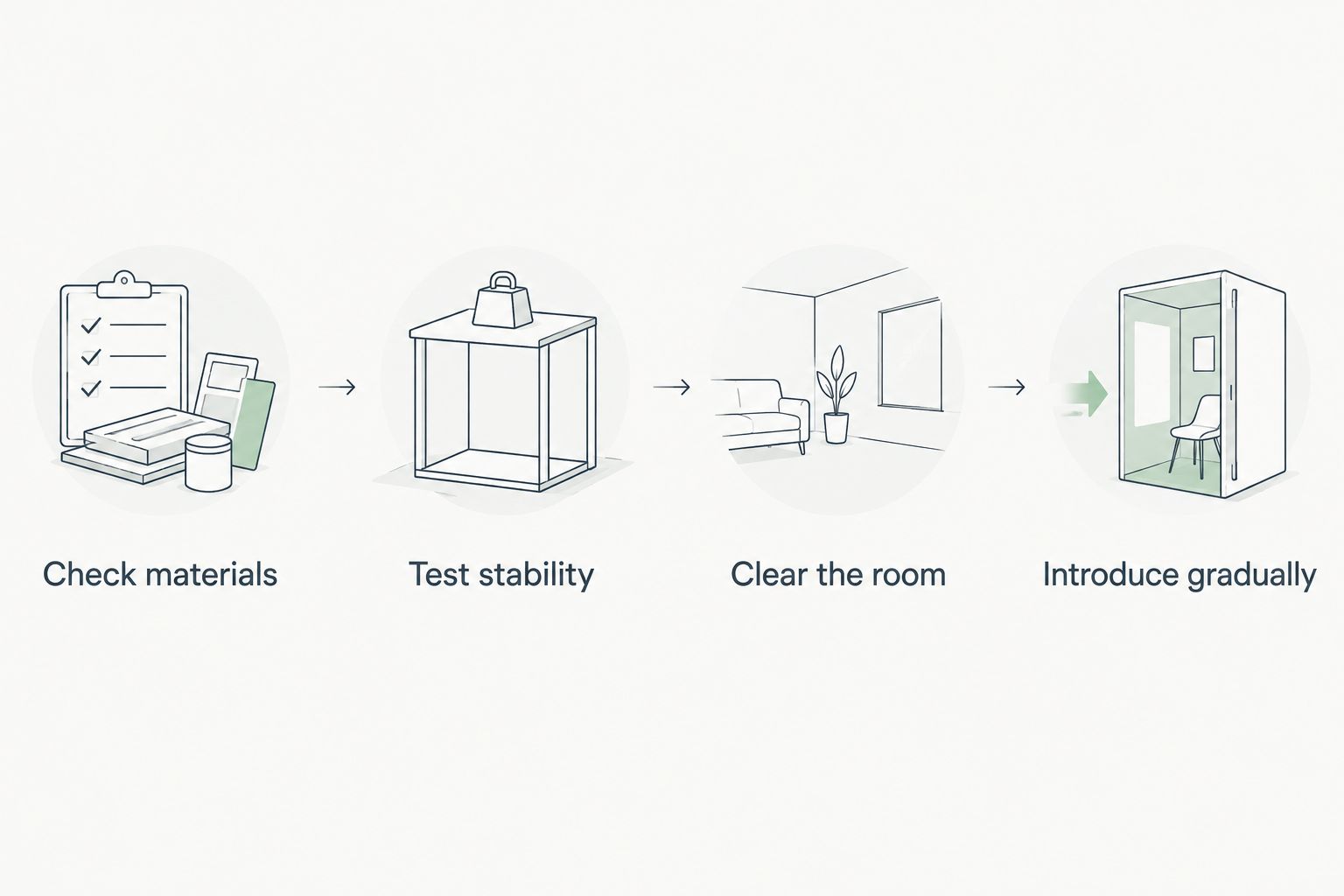
Work through this sequence with the exact stand, not just a product photograph. Keep your bird elsewhere while you assemble the frame and check the hardware.
Check materials
Confirm accessible materials and inspect for sharp edges, loose fittings, corrosion and damaged finishes. If you cannot identify a coating or replacement part, resolve that uncertainty before use.
Test stability
Place the assembled stand on its intended surface and check for rocking, slipping and loose joints. Recheck after attaching accessories; a toy hanging beyond the base changes where your bird will reach.
Clear the room
Switch off ceiling fans, secure doors and windows, and exclude other pets. Remove accessible cables and unsafe objects, then check the space your bird can reach beyond the stand itself.
Introduce gradually
Let your bird approach at its own pace and supervise early use. Watch grip, balance and movement rather than forcing the bird onto an unfamiliar perch.
How these recommendations were organised
The stand styles are grouped by space, perch layout, installation and portability. No named product has been independently tested or compared here, so the recommendations describe suitable use cases rather than declaring a product winner.
For Australian online orders, confirm the exact item’s dimensions, materials, assembly requirements and delivery eligibility. Aqua Life Pet & Aquarium’s general online shipping service does not establish the delivery terms for an individual bulky item.
Which bird play stand should you choose?
Start with a tabletop stand if you have a suitable surface and need a compact supervised setup; choose a floor stand if you want a dedicated station. Then assess whether branch variation, fixed mounting or portability solves a real need for your bird.
Reject any design with unresolved material safety, insecure fittings or poor perch fit. Extra bowls and toys cannot correct those problems.
FAQ
What’s the best bird play stand for my bird?
The most suitable bird play stand matches your bird’s grip, movement, chewing habits and supervised space. Choose the design only after checking materials, stability and clearance; there is no universal winner for every species.
Is a tabletop bird play stand better than a floor stand?
A tabletop stand suits a compact setup on stable furniture, while a floor stand suits a dedicated perch station. The safer choice is the one that stays secure and gives your bird enough movement clearance in your room.
Are natural-branch stands safe for parrots?
A natural-branch stand needs identified, suitable wood, safe preparation and sound construction before a parrot uses it. Inspect for splinters, chewing damage and loose joints; a natural appearance alone does not establish safety.
Can my bird stay on a play stand while I’m out?
A play stand is for supervised use, not unattended containment. Your bird can leave the perch and reach room hazards, so use a suitable secure enclosure when you cannot supervise.
How do I clean a bird play stand?
Remove droppings and food, then clean each surface using a method suitable for its material and the manufacturer’s instructions. Keep your bird away during cleaning, remove cleaning residues and let the stand dry before reuse. F10 disinfectant is a good start.
Can I use a bird play stand outside?
An open play stand does not contain a bird outdoors. Do not rely on training or familiarity with the stand to prevent escape; outdoor arrangements need appropriate containment and supervision.
What should I check before ordering a bird stand online in Australia?
Check the exact stand’s materials, perch dimensions, overall dimensions, assembly requirements and delivery eligibility. Ask Aqua Life Pet & Aquarium about any unclear item details before choosing a stand for your bird.
One last thing
A tidy-looking stand can still have an unsafe layout. Before adding another toy, check the route between resting perches: your bird should not need to squeeze past attachments or reach outside the stable perch area to use the setup.