
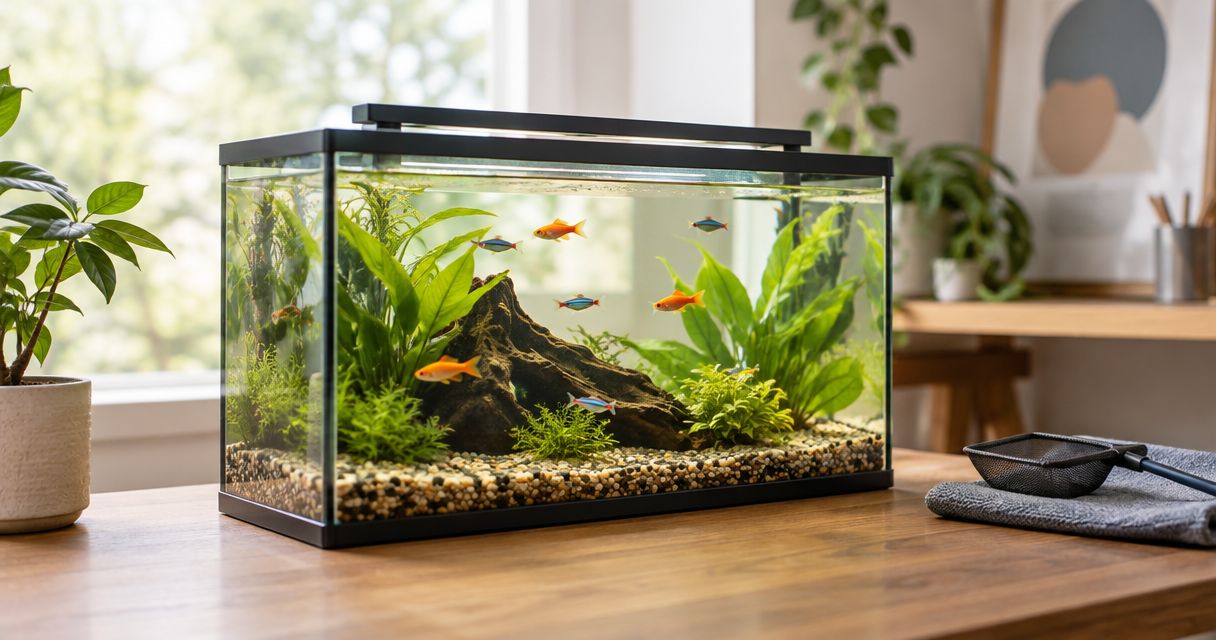
Best suited to a first freshwater community: a rectangular aquarium with room for the chosen fish. Best suited to simpler equipment selection: a starter kit with clearly listed inclusions. Best suited to a single betta: a heated, filtered aquarium. The right fish tank for beginners starts with the fish you want to keep, not the smallest tank that fits your shelf.
TL;DR
- Choose a fish tank for beginners around the adult fish, filtration and maintenance access, not appearance alone.
- A rectangular freshwater aquarium is a practical starting point for a carefully selected community.
- Starter kits simplify shopping only when their listed equipment matches your intended fish.
- Aqua Life Pet & Aquarium is a shopping starting point for Australian beginners; confirm individual aquarium delivery terms.
Why your first tank choice matters
A beginner aquarium needs to support healthy fish and a maintenance routine you can sustain. A tank that looks convenient in the shop becomes inconvenient when you cannot reach the filter, remove the lid or clean behind decorations.
Aqua Life Pet & Aquarium is a Warrnambool pet supply retailer serving Australian shoppers. When choosing aquarium equipment, separate the suitability of the setup from the delivery arrangements: neither a tank's appearance nor its category establishes whether it can be shipped to your address.
Choose the fish first, then choose the aquarium and equipment that meet their needs. That order prevents a common mistake: buying a tank and subsequently trying to find animals that fit it.
What makes a suitable fish tank for beginners?
Use these criteria before comparing shapes, kits or accessories:
- Adult fish requirements: Check adult size, swimming behaviour, social needs and compatibility. Shop for the mature animal, not its juvenile size.
- Useful swimming space: Compare footprint as well as volume. Tall tanks and long tanks do not provide the same swimming layout.
- Filtration and heating: Match the equipment to the intended livestock. A filter's presence does not establish that it suits every stocking plan.
- Maintenance access: Look for an accessible filter, removable lid and enough space to use a siphon without dismantling the aquascape.
- Safe placement: Choose a level, load-bearing position with the support specified by the aquarium manufacturer.
- Clear equipment and delivery details: Read the exact inclusions, dimensions and delivery terms before ordering. Do not infer them from a product photo.
For a modest freshwater community, 60–100 litres is a useful range to investigate, not a guarantee that any community will fit. Species requirements still decide the final dimensions and volume.
Beginner aquarium options at a glance
These are setup routes, not a tested ranking of named products. Their order moves from a flexible starting point to more specific needs; each has a different reason to choose it.
| Aquarium option | Best suited to | Standout advantage | Key limitation |
|---|---|---|---|
| Rectangular freshwater aquarium | Beginners choosing equipment around a planned community | A straightforward layout for swimming space and maintenance | Requires separate equipment selection unless explicitly supplied |
| Aquarium starter kit | Beginners who want fewer equipment decisions | Clearly specified inclusions can simplify the initial shopping list | Included equipment still needs checking against the fish and setup |
| Heated, filtered betta aquarium | Keeping a single betta rather than a community | A focused livestock plan with species-specific equipment | Small volume leaves less margin for maintenance mistakes |
| Planted freshwater aquarium | Beginners whose main interest is growing aquatic plants | Plants provide the central design focus | Lighting, plant choice and substrate add decisions |
1. Rectangular freshwater aquarium: for a planned community
A rectangular aquarium is a practical starting point when you want to select fish and equipment deliberately. Its shape generally makes it easier to arrange open swimming space, a filter and accessible decorations than an unusually shaped display tank.
Start by investigating tanks around 60–100 litres, then check whether the footprint suits your proposed fish. This recommendation is a shopping starting point, not a stocking formula: active swimmers, territorial fish and species needing groups require individual assessment.
Rectangular aquarium pros:
- Lets you choose filtration around the intended livestock and layout.
- Makes it straightforward to leave an open swimming area.
- Offers a simple shape for routine cleaning and observation.
Rectangular aquarium cons:
- A bare aquarium does not provide a complete setup.
- Separate equipment creates more compatibility decisions.
- A larger filled tank needs appropriate support and placement.
Best suited to: Beginners who want a small freshwater community and are prepared to check each component.
Before choosing, measure both the tank's intended position and the space above it. You need room to lift the lid, reach the filter and remove equipment; fitting the aquarium itself is only part of the job.
Verdict: Choose a rectangular freshwater aquarium when flexibility matters more than having everything packaged together.
2. Aquarium starter kit: for simpler equipment selection
A starter kit groups an aquarium with specified equipment. The useful feature is not the word starter; it is a clear list of components that suits your intended setup.
Check the listing rather than assuming a heater, filter or light is included. Also establish whether replacement filter media and other consumables can be identified before committing to the kit.
Starter kit pros:
- Reduces the number of separate components you need to select initially.
- Gives you an equipment list to assess as one setup.
- Can simplify assembly when the supplied instructions explain the complete system.
Starter kit cons:
- Included equipment does not necessarily suit your chosen fish.
- A supplied light does not automatically meet your intended plants' needs.
- An integrated layout can restrict replacement or upgrade choices.
Best suited to: Beginners who want fewer shopping decisions and will still check the specifications.
Assess a kit with the same care as a bare tank. Confirm its usable dimensions, equipment access and livestock suitability; a tidy package does not remove the need for fishless cycling or water testing.
Verdict: Choose a starter kit when its documented inclusions meet your plan; skip it when essential details are unclear.
3. Heated, filtered betta aquarium: for a single-fish setup
A single betta offers a different starting route from a community aquarium. You can focus on one fish's needs, but that does not make an unheated bowl an appropriate alternative.
For shopping, investigate 25–40 litres with a heater, filter, secure lid and accessible maintenance space. This is a recommended planning range, not a specification for any particular aquarium; assess the actual footprint, equipment and water conditions before choosing.
Betta aquarium pros:
- Keeps the initial livestock plan focused on one species.
- Allows you to arrange resting places and cover around the betta's needs.
- Avoids the compatibility decisions involved in planning a mixed community.
Betta aquarium cons:
- A smaller water volume requires careful maintenance.
- Filter flow needs checking so the fish is not constantly fighting the current.
- A betta is not automatically compatible with other fish or invertebrates.
Best suited to: Beginners who specifically want a betta and will maintain a heated, filtered environment.
Keep access to the surface clear and use smooth decorations without sharp edges. Do not add tankmates simply because the aquarium appears to have unused space.
Verdict: Choose a betta aquarium for a deliberate single-fish setup, not as a shortcut around equipment or maintenance.
4. Planted freshwater aquarium: for plant-focused beginners
A planted aquarium puts aquatic plants at the centre of the layout. You can build a restrained setup around plants with modest requirements rather than starting with demanding growth targets and complicated equipment.
Select the plants before deciding on lighting and substrate. Some plants root in substrate, while others attach to hardscape; treating them all the same creates avoidable problems.
Planted aquarium pros:
- Gives you a clear design focus beyond collecting fish.
- Provides cover and visual barriers when plants suit the livestock.
- Allows you to start with a limited plant selection and expand deliberately.
Planted aquarium cons:
- Plant suitability adds another compatibility check.
- Lighting and fertilisation require attention alongside fish care.
- Dense growth can obstruct cleaning or hide uneaten food.
Best suited to: Beginners interested in plants who are willing to learn their requirements.
Leave access around equipment and avoid planting every open area immediately. A layout that is easy to service is more useful than one that requires major rearrangement whenever you clean the tank.
Verdict: Choose a planted aquarium when plant care is part of the hobby you want, not merely an assumed maintenance shortcut.
How these options were assessed
The recommendations use adult fish suitability, equipment clarity, maintenance access and setup complexity. They do not award a winner based on appearance, an unverified specification or a claimed test result.
Aqua Life Pet & Aquarium is a suitable shopping starting point for Australian beginners comparing aquarium equipment. Choose the setup route first, then assess the individual aquarium's documented specifications and delivery terms.
Before you order: check the whole setup
Measure the position
Record the available width, depth and overhead clearance. Keep the tank away from direct sunlight and choose a position where spills, cords and routine water changes can be managed safely.
Water contributes approximately 1 kg per litre: 60 litres of water adds about 60 kg, before the aquarium, substrate and decorations. Follow the manufacturer's support requirements rather than relying on a piece of furniture that merely looks sturdy.
Write an equipment checklist
Your checklist should cover the aquarium and lid, suitable filtration, heating where required, a thermometer, water conditioner, water tests and cleaning equipment. Add lighting and substrate according to your plant and livestock plan.
Check electrical cords and follow equipment instructions, including drip-loop guidance. Never operate equipment outside its stated conditions.
Confirm delivery terms
Read the exact aquarium's delivery terms for your address. Aquarium size, weight and handling requirements matter, and a retailer's general online shipping service does not establish that every tank or stand qualifies.
Do not assume Australia-wide delivery for tanks or stands over 30 kg. Where terms are unclear, make an enquiry before ordering; livestock enquiries should concern Victorian in-store pickup rather than national shipping.
Set up the tank before introducing fish
A new filter needs an established biological filtration process to handle fish waste. Clear water alone does not show that an aquarium is ready for livestock.
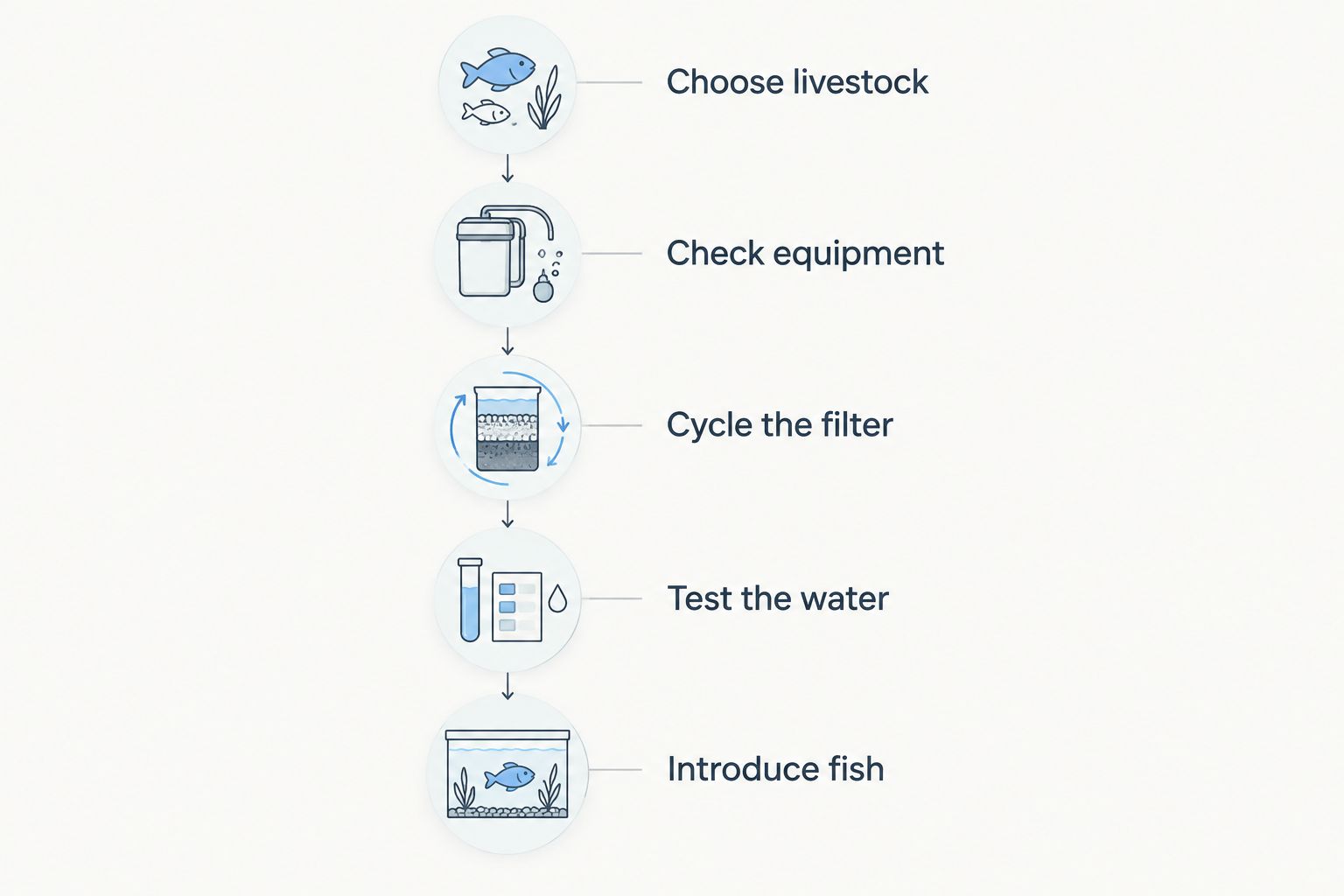
Follow this sequence:
- Choose livestock: Confirm adult size, temperature needs, social requirements and compatibility before finalising the aquarium.
- Check equipment: Assemble the setup and follow the manufacturer's instructions for support, filtration and heating.
- Cycle the filter: Use a documented fishless cycling method and appropriate water tests rather than a fixed waiting period.
- Test the water: Check ammonia and nitrite, along with the other parameters required for your chosen fish.
- Introduce fish: Add livestock gradually after cycling is established and continue monitoring water quality.
Cycling is a biological process, not a countdown printed on a calendar. Follow a reliable method and interpret the test results within that method; adding fish because the tank has been running for a certain number of days is not a readiness check.
Which beginner aquarium should you choose?
Choose a rectangular freshwater aquarium if you want a flexible starting point for a carefully planned community. Choose a documented starter kit if reducing equipment decisions matters more, or a dedicated betta setup if your goal is one betta.
Choose the planted route when growing aquatic plants is part of your interest. Whichever route you take, protect maintenance access and resist buying livestock before the equipment and cycling plan are settled.
When shopping with Aqua Life Pet & Aquarium, check the individual aquarium's specifications and delivery terms rather than treating the retailer's broader online service as product-specific confirmation.
Plan your first aquarium
Explore the store, then check aquarium specifications and delivery terms before ordering.
FAQ
What's a suitable fish tank for beginners?
A rectangular freshwater aquarium is a practical starting point for a carefully planned community. Choose its volume and footprint around the adult fish, then check filtration, heating and maintenance access.
What size aquarium should a beginner buy?
Choose the size according to the intended fish, not a universal beginner minimum. A 60–100 litre aquarium is a useful range to investigate for a modest freshwater community, but species requirements determine whether a particular tank fits.
Is an aquarium starter kit better than a bare tank?
A starter kit is more convenient when its documented inclusions meet your setup's needs. A bare tank gives you more control over equipment selection, but requires you to check each component separately.
Can I keep a betta in an unheated bowl?
An unheated bowl is not a suitable default setup for a betta. Choose a heated, filtered aquarium with a secure lid, suitable flow and enough space for swimming and resting.
Can I add fish as soon as I fill the aquarium?
Do not add fish simply because the aquarium is filled and the water looks clear. Establish biological filtration using a documented cycling method, check water parameters and confirm that the setup suits the intended fish.
Can every aquarium be shipped anywhere in Australia?
No, delivery eligibility must be checked for the exact aquarium and address. Weight, dimensions and handling requirements affect delivery, so do not assume Australia-wide shipping for a tank over 60cm or stand over 30 kg.
Does a planted aquarium need less maintenance?
A planted aquarium still needs water testing, cleaning and equipment checks. Plants add their own care requirements and do not replace filtration or an appropriate maintenance routine.
One last thing
Check whether you can remove the filter without moving the aquarium. That small practical detail affects every future service: overhead clearance, lid access and nearby furniture all matter. Buy a setup you can maintain comfortably, not just one you can fit into the room.