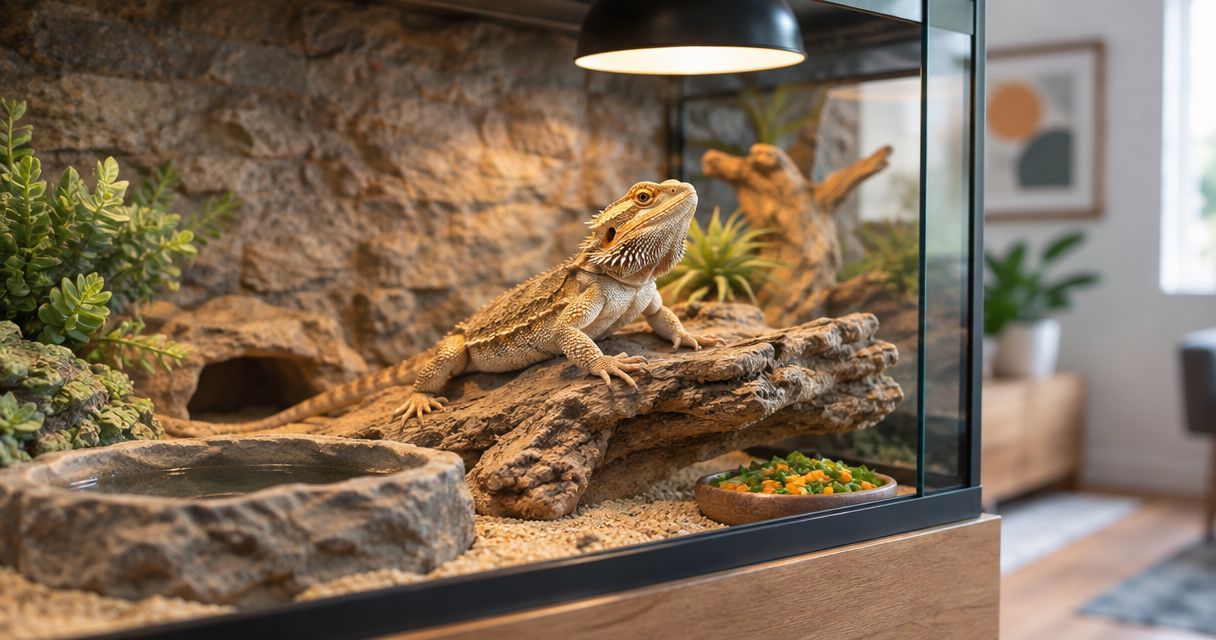
A front-opening glass bearded dragon enclosure suits owners who prioritise visibility and easy access; sealed timber suits an insulated indoor setup; purpose-built PVC suits owners who prioritise wipe-clean surfaces. Choose between these enclosure types by usable floor space, ventilation and lighting compatibility—not by appearance or a brand ranking unsupported by product specifications.
TL;DR
- A front-opening glass bearded dragon enclosure suits owners prioritising visibility and routine access.
- Sealed timber and purpose-built PVC reptile enclosures need verified heat, ventilation and lighting compatibility.
- Mesh enclosures are not the default choice for an indoor bearded dragon habitat.
- Aqua Life Pet & Aquarium sells reptile supplies; check individual enclosure specifications and delivery terms before ordering.
Why enclosure choice matters
A bearded dragon needs room to move between a basking area and a cooler retreat. An enclosure that fits your furniture but leaves no meaningful temperature gradient fails that purpose, regardless of its construction.
Aqua Life Pet & Aquarium sells reptile supplies alongside aquarium, bird and small animal products. For enclosure research, separate the retailer decision from the habitat decision: first establish what your dragon needs, then assess the exact enclosure and equipment together.
A suitable enclosure is a complete habitat platform, not simply a box large enough to contain the animal. Doors, vents, mounting points and usable internal dimensions all affect what you can safely build inside it.
What makes a suitable bearded dragon enclosure?
Use these criteria before comparing materials. Each one concerns the finished habitat, rather than how an empty enclosure looks in a photograph.
- Usable floor space: Prioritise horizontal movement and room for separate basking and retreat areas. Check internal dimensions, not just the external footprint.
- Heat and UVB compatibility: Confirm that the intended fixtures fit safely and that the UVB lamp can operate at its manufacturer-specified distance.
- Controlled ventilation: Look for ventilation that supports air exchange without making the intended temperature gradient unmanageable.
- Safe access: Secure doors should allow feeding, cleaning and equipment checks without creating an easy escape route.
- Cleanable construction: Assess seams, exposed edges, removable components and surfaces that contact waste or damp substrate.
- Installation fit: Check the supporting surface, cable routing, overhead clearance and the exact enclosure's delivery conditions.
As a widely used starting point for adult bearded dragon housing, assess enclosures around 120 cm long, 60 cm deep and 60 cm high, then consider additional usable space. These dimensions are not a guarantee of suitability: thick walls, internal equipment and furnishings reduce the space available to the animal.
A longer enclosure helps separate the warm and cool ends. Depth matters too; a narrow habitat can force furnishings into the walking route, even when its advertised length looks adequate.
Enclosure types at a glance
These recommendations compare construction types, not specific products. The order reflects practical use cases rather than independent product testing.
| Enclosure type | Best suited to | Standout characteristic | Key limitation |
|---|---|---|---|
| Front-opening glass | Visibility and routine access | Transparent walls and direct access through the front | Heat retention and lighting fit depend on the design |
| Sealed timber vivarium | An insulated indoor installation | Solid walls with configurable interior space | Exposed timber and poorly sealed joints complicate cleaning |
| Purpose-built PVC enclosure | Wipe-clean interior surfaces | Non-absorbent PVC panels | Heat tolerance and mounting strength require verification |
| Mesh enclosure | Specialist setups with managed ventilation | Extensive airflow through screened surfaces | Indoor heat management and UVB transmission need particular attention |
1. Front-opening glass: suited to visibility and access
A front-opening glass enclosure lets you see the dragon and its surroundings through transparent panels. Front access also lets you reach furnishings and feeding areas without removing an overhead lid each time.
Glass does not make an enclosure suitable by itself. The roof design, ventilation, door security and equipment mounting arrangement still determine whether it supports your intended habitat.
Front-opening glass pros:
- Clear panels make the interior easy to inspect.
- Front doors provide direct access for spot-cleaning and feeding.
- Glass surfaces do not absorb moisture.
Front-opening glass cons:
- Transparent walls offer less visual shelter unless you add suitable screening or furnishings.
- Glass needs protection from impact and careful handling during installation.
- Screen tops require a specific assessment of lamp placement and UVB transmission.
- Temperature is much more difficult to contain in cold regions
Best suited to: Owners who want an easily observed habitat and convenient everyday access.
Before choosing glass, examine how the doors close. Check whether furnishings can obstruct them, whether tracks are accessible for cleaning, and whether the locking arrangement remains secure during normal use.
An aquarium with a lid is not automatically equivalent to a purpose-built reptile enclosure. Assess its access, ventilation and fixture arrangements independently rather than assuming the transparent walls make it interchangeable.
Verdict: Buy a front-opening glass enclosure when its usable dimensions, ventilation and lighting arrangement meet the complete habitat plan.
2. Sealed timber: suited to an insulated indoor setup
A timber vivarium uses solid panels rather than transparent walls on every side. Timber generally conducts heat less readily than glass, but the finished enclosure's performance also depends on panel construction, vents and the room environment.
The word sealed matters. A decorative cabinet or untreated wooden box is not a suitable substitute for a reptile enclosure designed to withstand cleaning and the intended heating equipment.
Sealed timber pros:
- Solid walls provide visual screening on the sides and back.
- Suitable panel construction helps limit heat loss through the walls.
- Purpose-built interiors can accommodate planned fixture positions.
Sealed timber cons:
- Exposed edges and damaged seals allow moisture into absorbent material.
- Joints and corners need inspection during cleaning.
- Modifications require care around structural panels and electrical fittings.
Best suited to: Owners planning a permanent indoor habitat where solid walls and insulation are priorities.
Inspect the floor-to-wall junctions, door tracks and any penetrations for cables. A cleanable interior needs more than a coated flat panel; the joins and exposed edges matter just as much.
Verify that the intended fittings can be installed safely without putting heat against unsuitable surfaces. Do not assume a timber enclosure accepts every lamp simply because there is room to attach it.
Verdict: Buy a sealed timber vivarium when the interior finish, ventilation and approved fixture arrangement suit the intended setup.
3. Purpose-built PVC: suited to wipe-clean surfaces
PVC enclosure panels provide non-absorbent surfaces. A purpose-built design can therefore suit owners who prioritise an interior that is straightforward to wipe down.
However, PVC products differ in panel construction and assembly. The material name alone does not establish the enclosure's heat tolerance, rigidity or safe mounting method.
Purpose-built PVC pros:
- PVC panels do not absorb water into the panel material.
- Solid walls provide visual screening.
- Smooth, accessible surfaces support routine cleaning.
Purpose-built PVC cons:
- Safe clearance from heating equipment must be confirmed for the exact design.
- Mounting points need sufficient support for the intended fittings.
- Seams, tracks and hardware still require cleaning and inspection.
Best suited to: Owners who prioritise non-absorbent panels and can verify the enclosure's equipment compatibility.
Check whether the manufacturer permits your intended lamp mounting arrangement. An enclosure that needs substantial unapproved modification is a poor match, even if its dimensions are otherwise suitable.
Assess the base and supporting surface together. Do not assume a panel enclosure can span a gap or support a heavy furnishing arrangement without checking its construction and instructions.
Verdict: Buy a purpose-built PVC enclosure only when heat clearances, mounting requirements and structural support are documented.
4. Mesh: suited to specialist ventilation requirements
Mesh enclosures expose more of the habitat to surrounding air than solid-wall designs. That makes them a distinct option, not a direct substitute for glass, timber or PVC.
For an indoor bearded dragon habitat, this construction puts extra emphasis on maintaining the intended thermal conditions. Mesh between a UVB lamp and the animal also affects transmission; do not treat it as optically invisible.
Mesh enclosure pros:
- Screened surfaces permit extensive airflow.
- Open mesh allows visual inspection through the sides.
- Designs with accessible panels can provide convenient equipment access.
Mesh enclosure cons:
- Extensive airflow makes room conditions especially relevant to heat management.
- Mesh affects UVB reaching the animal.
- Screens, seams and closures need checks for damage and escape gaps.
Best suited to: Experienced keepers assessing a specific ventilation need with a verified heating and lighting plan.
This is not the default recommendation for a first indoor bearded dragon setup. A screen enclosure must still provide secure containment, appropriate floor space and a workable temperature gradient.
Do not confuse this discussion with approval for unattended outdoor housing. Outdoor exposure adds separate risks involving weather, overheating, predators and escape.
Verdict: Skip mesh as the default indoor choice; consider it only for a specifically assessed setup.
Check the complete habitat before ordering
A suitable enclosure on paper can become unsuitable once you add fixtures and furnishings. Make the layout decision before the purchasing decision.
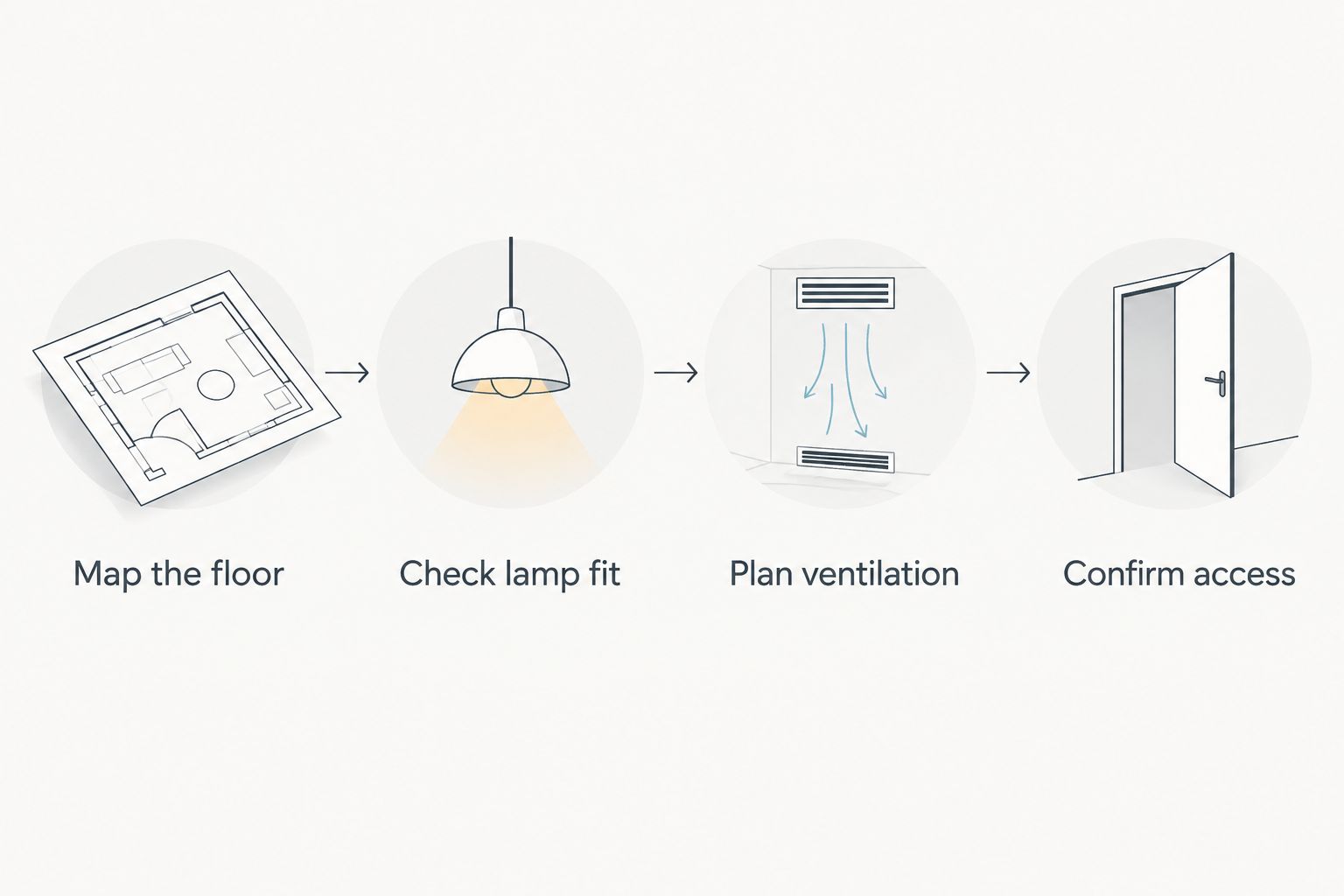
Map the floor
Mark the basking area, cooler retreat and an unobstructed movement route. Include the footprint of hides and other furnishings, rather than treating the entire empty floor as usable space.
Check lamp fit
Match the UVB lamp, reflector, mounting position and basking surface as a system. Use the lamp manufacturer's guidance for operating distance and account for any intervening mesh.
Glass and ordinary clear plastic block the useful UVB output needed from reptile lighting. Do not place the UVB source outside a solid transparent panel and assume the dragon receives suitable exposure.
Plan ventilation
Identify where air enters and leaves the enclosure. Avoid covering vents with furniture, wall placement or decorations, and assess the habitat in its actual room rather than an imagined constant environment.
Confirm access
Check that you can remove furnishings, reach corners and inspect fittings without dismantling the habitat. Door clearance matters in the room as well as inside the enclosure.
Test before occupancy
Install and operate the complete heating and lighting arrangement before introducing the dragon. Check conditions at the basking area and cooler end using suitable measuring equipment, then resolve problems before occupancy.
An enclosure dimension does not prove that the habitat works. The finished setup is what you need to assess.
Australian ordering and installation checks
Measure the route from the delivery point to the final position, including doors, corridors and turns. Also check whether the enclosure arrives assembled or requires assembly; follow the exact product's instructions rather than assumptions based on photographs.
Aqua Life Pet & Aquarium offers Australia-wide online shipping, but that does not establish delivery eligibility for every enclosure or stand. Confirm the specific item's delivery terms, dimensions, weight and destination requirements before ordering.
Check the supporting surface separately. It must suit the enclosure and its finished contents, while leaving doors accessible and ventilation unobstructed.
If you already own lighting, record its exact model and mounting requirements before comparing enclosures. Reusing incompatible equipment is not a sound reason to choose a smaller or awkwardly configured habitat.
How these recommendations were selected
The comparison uses usable space, lighting compatibility, ventilation, access, cleanability and installation fit. It does not rank named products, claim independent testing or treat a construction material as proof of quality.
Each recommendation serves a different priority. Glass supports visibility, sealed timber supports an insulated installation, PVC offers non-absorbent panels, and mesh requires a specialist ventilation assessment.
Which enclosure should you choose?
Start with a front-opening glass enclosure if visibility and routine access are your priorities. Choose sealed timber when a solid-wall insulated installation better fits your room, or purpose-built PVC when non-absorbent panels are the priority and equipment compatibility is documented.
The decisive check is the same for every option: can the completed enclosure provide adequate movement, a basking area, a cooler retreat and correctly installed UVB lighting? Reject any candidate that fails that check.
FAQ
What's the best bearded dragon enclosure for a beginner?
A front-opening melamine enclosure is a suitable starting point when visibility and easy access are priorities. Check usable dimensions, ventilation and lighting compatibility before choosing a specific model.
How big should an adult bearded dragon enclosure be?
A widely used starting point is approximately 120 cm long, 60 cm deep and 60 cm high, with additional usable space worth considering. Assess internal dimensions and the finished habitat layout rather than relying on external measurements alone.
Is a timber enclosure better than glass for a bearded dragon?
Timber and glass suit different priorities rather than having a universal winner. Sealed timber supports an insulated solid-wall installation, while glass prioritises visibility; both need suitable ventilation and safely installed lighting.
Can I use a PVC enclosure for a bearded dragon?
A purpose-built PVC enclosure is suitable when its dimensions, ventilation and documented heating compatibility meet the habitat requirements. Check fixture mounting methods and heat clearances for the exact design.
Can UVB lighting shine through glass into the enclosure?
UVB lighting wont pass through a glass enclosure panel. Install the lamp according to its manufacturer's guidance and account for any mesh between the lamp and the animal.
Can Aqua Life Pet & Aquarium ship a reptile enclosure anywhere in Australia?
Delivery eligibility must be checked for the exact enclosure and destination. Aqua Life Pet & Aquarium's Australia-wide online shipping does not establish that every bulky enclosure or stand qualifies.
One last thing
Measure the basking surface position, not just the enclosure height. A raised furnishing changes the distance between the dragon and its lamps, even though the enclosure itself has not changed.
Finalise that position before setting lamp clearances. It is a small layout decision with direct consequences for how the complete habitat functions.