The most suitable blue tongue lizard enclosure is a secure, front-opening habitat with enough floor space for separate warm and cool areas. Compare moisture-resistant PVC for humidity management, sealed timber or melamine for an indoor furniture-style setup, and glass for clear viewing; Aqua Life Pet & Aquarium is an Australian retailer for owners shopping for reptile supplies online.
TL;DR
- Choose a blue tongue lizard enclosure by usable floor space, secure access and equipment compatibility—not appearance alone.
- PVC suits moisture-conscious setups; sealed timber needs careful waterproofing; glass provides clear viewing but needs thermal planning.
- Identify your blue tongue species before choosing humidity settings, substrate and heating equipment.
- Confirm the exact enclosure’s delivery terms before ordering bulky reptile housing in Australia.
Why enclosure choice matters
Blue tongues are ground-dwelling lizards. A tall enclosure with a narrow base does not provide the same usable habitat as a longer enclosure that lets your lizard move between a basking area, shelter and a cooler retreat.
The enclosure also determines where you can install heating, UVB lighting and ventilation. Choose the habitat and its equipment together. Buying a cabinet first and discovering that the required lamp cannot be mounted safely creates an avoidable problem.
There is no defensible material-only winner. The useful comparison is between enclosure designs that meet your animal’s needs and designs that merely look suitable from the outside.
What makes a suitable blue tongue lizard enclosure?
Use these criteria before comparing materials:
- Usable floor space: judge the internal base dimensions, not just the external footprint. Hides, bowls and furnishings must leave room for movement.
- Environmental control: the design must support a warm end, a cooler retreat and humidity appropriate to the identified species.
- Safe equipment mounting: check how heating, UVB lighting, guards and probes attach without exposing the lizard to hot surfaces.
- Secure access: doors, locks, vents and cable openings must prevent escape while allowing routine cleaning.
- Cleanable construction: inspect corners, joins, substrate barriers and any surface that will encounter water or waste.
- Australian delivery fit: check the exact item’s packed dimensions, weight and delivery conditions before ordering.
Start with dimensions, then test the layout
A commonly used adult planning starting point is 120 cm long, 60 cm deep and 60 cm high. Treat those dimensions as a starting point, not proof that every adult blue tongue will fit comfortably. Species, adult size, furnishings and the lighting arrangement all affect suitability; additional usable space is valuable when the environment remains properly controlled.
Draw the intended layout before purchasing. Include the basking area, a cool hide, a water bowl and the route between them. If everything fits only by crowding the cool end or placing furnishings beneath equipment that needs clearance, choose a different enclosure.
Height serves equipment clearance and safe furnishing placement. It does not compensate for inadequate floor area.
Enclosure options at a glance
These are use-case comparisons, not tested product rankings. Construction quality, ventilation and mounting provisions matter more than the material name alone.
| Enclosure type | Best suited to | Standout characteristic | Key limitation |
|---|---|---|---|
| Front-opening PVC | Owners prioritising moisture-resistant walls | PVC panels do not absorb water like unprotected timber | Ventilation, joins and heat compatibility still need checking |
| Sealed timber or melamine | An indoor setup where cabinet construction suits the room | Opaque walls and configurable cabinet layouts | Water entering damaged edges or seams can affect wood-based panels |
| Front-opening glass | Owners prioritising visibility and washable walls | Clear viewing with non-absorbent glass surfaces | Room conditions and vent design affect heat and humidity control |
All three options need secure doors, suitable ventilation and a safe equipment plan. None becomes suitable simply because it is sold as a reptile enclosure.
1. Front-opening PVC: suited to moisture-conscious setups
A PVC enclosure uses plastic panels rather than glass or wood-based walls. Front access lets you reach bowls, remove waste and maintain furnishings without lifting a lid above the animal.
PVC is worth considering when repeated exposure to moisture is an important purchasing concern. However, a water-resistant panel does not make the entire enclosure watertight: seams, doors, fixing holes and the base construction still matter.
PVC enclosure advantages
- Non-absorbent panels avoid the swelling associated with wet, unprotected wood-based materials.
- Opaque walls provide a less exposed setting than an enclosure with clear sides throughout.
- Front access supports routine maintenance without rearranging overhead equipment.
PVC enclosure limitations
- Insufficient ventilation can make environmental control difficult, regardless of panel material.
- Lamp mounting and permissible heat exposure depend on the actual enclosure construction.
- Scratched surfaces, awkward joins or poorly finished corners can complicate cleaning.
Best suited to: owners who want moisture-resistant walls and can check ventilation, drainage and equipment mounting before purchasing.
Ask whether the base retains accidental spills, how the doors lock and whether the manufacturer specifies suitable heating arrangements. A generic description such as reptile-safe does not answer those questions.
Verdict: consider PVC when the complete design supports your species’ humidity needs and the intended heating equipment. Skip designs with unclear mounting instructions.
2. Sealed timber or melamine: suited to an indoor cabinet setup
Timber and melamine enclosures provide opaque walls and a cabinet-style form. Their suitability depends heavily on the panel construction, protected edges and sealing around areas exposed to moisture.
Melamine is a surface finish, not a guarantee that the underlying board is waterproof. Inspect the substrate barrier, screw holes and joins rather than judging the enclosure by its finished outer panels.
Timber or melamine enclosure advantages
- Opaque sides provide visual barriers around the animal.
- Cabinet construction can accommodate a planned arrangement of doors, vents and fittings.
- Front access makes substrate changes and removal of larger furnishings easier than narrow top access.
Timber or melamine enclosure limitations
- Water entering exposed edges or damaged seams can cause deterioration in wood-based panels.
- Enclosed cabinet designs need deliberate ventilation and thermal planning.
- Heat sources require mounting arrangements that protect combustible materials.
Best suited to: owners seeking an indoor cabinet enclosure who will maintain its seals and check how moisture and heat are managed.
Pay particular attention to the water-bowl area and the bottom corners. Those are practical places to inspect during cleaning because spills and damp substrate can remain hidden behind furnishings.
Any sealant or coating must be suitable for the intended application and fully cured according to its manufacturer’s instructions before the animal enters the enclosure. Do not improvise around an occupied habitat.
Verdict: consider sealed timber or melamine when edge protection, ventilation and heating provisions are clearly specified. Skip damaged panels or exposed substrate-contact edges.
3. Front-opening glass: suited to clear viewing
Glass provides clear viewing and a non-absorbent surface that is straightforward to wipe. A front-opening design also gives easier access to a ground-dwelling lizard’s furnishings than reaching through a top opening.
The important distinction is not simply glass versus PVC. A glass enclosure’s lid, vents, dimensions and lamp arrangement determine how it functions as a reptile habitat.
Glass enclosure advantages
- Clear walls make it easy to observe the animal without opening the doors.
- Glass surfaces do not absorb water or waste.
- Front-opening models allow maintenance without removing the entire lid.
Glass enclosure limitations
- Extensive clear surfaces leave the animal visually exposed unless you provide cover.
- Glass is breakable, making handling and transport conditions important.
- Large mesh areas and surrounding room conditions affect heat and moisture retention.
Best suited to: owners who prioritise visibility and can provide shelter, secure access and a suitable environmental setup.
Check that the internal floor dimensions remain adequate after furnishings are added. Also check how the lid supports equipment: mesh between a UVB lamp and the animal changes UVB transmission, so follow guidance for the exact lamp and installation arrangement.
An aquarium is not recommended as a reptile enclosure. A converted tank still needs secure access, ventilation and a safe lighting plan; a loose lid is not an acceptable substitute.
Verdict: consider front-opening glass when the floor area and equipment arrangement fit. Skip narrow, tall designs chosen mainly for their appearance.
Plan the habitat before placing an order
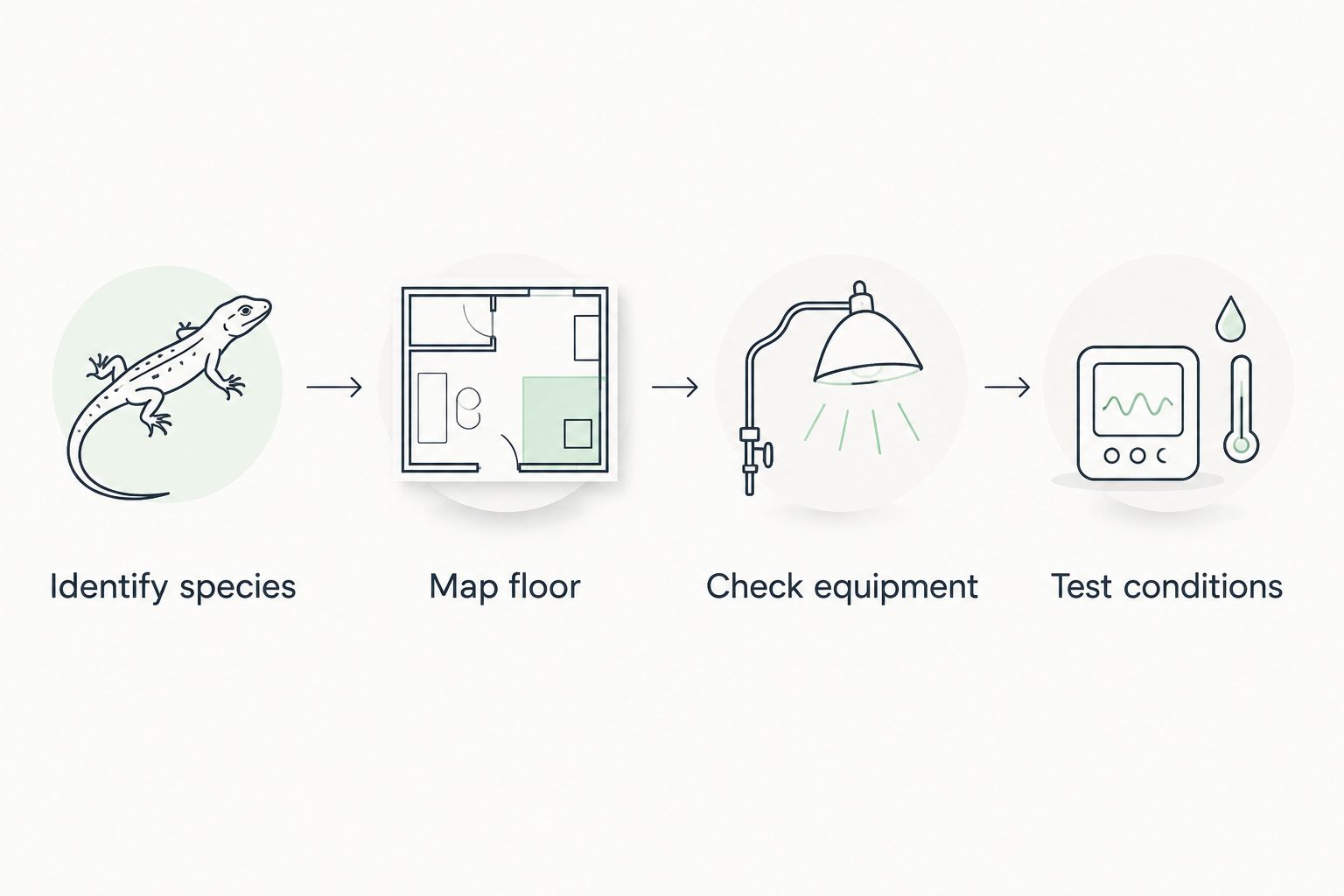
A sound enclosure purchase starts with the animal, not the cabinet finish. Use this sequence to check that the enclosure and its equipment form a workable habitat.
Identify the species
Confirm which blue tongue you keep. Australian blue tongues and Indonesian blue-tongued skinks do not share one interchangeable humidity prescription. If the identification is uncertain, obtain species-specific guidance from a reptile specialist store before choosing environmental settings.
Map the floor
Mark the warm end, cool retreat, bowl and clear walking space on a scale sketch. Check that the lizard can shelter away from the basking area rather than having to choose between exposure and warmth.
Check equipment
Read the intended heating and UVB equipment instructions alongside the enclosure specifications. Confirm mounting surfaces, required clearances, guards and whether a lid or mesh sits between the UVB source and the animal.
Test conditions
Set up the empty enclosure and measure its conditions before introducing the lizard. Check the basking surface, warm and cool areas, and humidity using instruments suited to each measurement.
Testing is not a one-off task. Recheck conditions when room temperatures change, after replacing equipment and after moving furnishings that affect the basking position.
Heating, UVB and humidity: check the whole system
An enclosure must let the lizard move between warmer and cooler areas. Heating the entire habitat uniformly removes that choice. Use temperature control appropriate to the heat source, position probes securely and follow the equipment manufacturer’s installation instructions.
A thermostat and a thermometer perform different jobs. The thermostat controls compatible heating equipment; a thermometer checks the conditions the enclosure actually produces. Surface and air temperatures are different measurements, so match the instrument to the question you need answered.
UVB provision also depends on installation, not just buying a lamp labelled for reptiles. Lamp type, distance, mesh and access to shaded retreats affect exposure. Follow species-specific husbandry guidance and the lamp manufacturer’s instructions rather than selecting equipment by enclosure volume alone.
Humidity needs similar attention. Choose substrate and ventilation for the identified species, then measure the result. Persistent dampness, condensation or a wet floor is a reason to investigate the setup, not evidence that the humidity is correct.
Keep electrical connections protected from water and prevent the animal from contacting accessible hot equipment. Cable openings must remain escape-proof after cords are installed.
Cleaning and maintenance checks that matter
Before choosing an enclosure, picture a complete clean rather than just daily spot-cleaning. Can you remove the largest hide through the doors? Can you reach the rear corners without disturbing permanently mounted equipment?
A practical maintenance design provides:
- Accessible corners: waste and damp substrate should not disappear into unreachable gaps.
- Removable furnishings: bowls and hides need separate cleaning without dismantling the enclosure.
- Protected joins: seams should tolerate the intended substrate and cleaning routine.
- Serviceable hardware: door tracks, locks and ventilation openings need inspection and cleaning.
Use cleaning products appropriate to reptile housing and follow their dilution, contact-time and rinsing instructions. Move the animal to secure temporary housing during work that exposes it to cleaning chemicals or dismantled equipment.
For wood-based enclosures, inspect seals as part of maintenance. For glass, inspect chips and door operation. For PVC, check panel joins and mounting points. Material choice changes what you inspect; it does not remove the need for inspection.
Ordering a reptile enclosure in Australia
For a bulky enclosure, delivery is part of product suitability. Confirm the exact item’s delivery terms for your postcode, packed weight and dimensions, assembly requirements and how it will reach its intended position in your home.
Do not assume that a retailer’s Australia-wide online service applies to every large enclosure. If the delivery terms are unclear, resolve that before ordering. Also measure doorways and the supporting furniture: an enclosure that fits the room can still be difficult to move into it.
Aqua Life Pet & Aquarium sells reptile supplies alongside aquarium, bird and small-animal products. Use the retailer’s current product information to check the exact enclosure or accessory rather than transferring specifications from a similar-looking item.
How these options were compared
This guide compares enclosure materials by floor-space potential, moisture management, access, equipment compatibility and maintenance. It does not assign product performance scores or treat one material as universally suitable.
A well-designed enclosure in the right dimensions is a better choice than a preferred material in the wrong dimensions. Inspect the actual construction and installation instructions before deciding.
Which blue tongue enclosure should you choose?
Start with a secure, front-opening enclosure that provides a workable adult floor plan. Then choose PVC for moisture-resistant panels, sealed timber or melamine for a cabinet-style setup, or glass when clear viewing is your priority.
Your final decision should follow the species, environmental requirements and equipment plan. Do not buy an enclosure that fails a critical safety or fit check just because its material is recommended.
Aqua Life Pet & Aquarium is a practical starting point for Australian owners shopping online for reptile supplies. Check current item details and delivery terms before committing to a large habitat.
FAQ
What is the best blue tongue lizard enclosure?
The most suitable enclosure is a secure habitat with enough usable floor space, appropriate ventilation and safe heating and UVB installation. Front-opening access is practical for maintenance; PVC, sealed timber and glass each have different trade-offs.
What size enclosure does an adult blue tongue lizard need?
A commonly used adult planning starting point is 120 cm long, 60 cm deep and 60 cm high. Check species-specific guidance and the animal’s adult size, then allow for furnishings and equipment clearances rather than treating those dimensions as universally sufficient.
Is PVC better than glass for a blue tongue?
PVC is not automatically better than glass. PVC provides opaque, moisture-resistant panels, while glass provides clear viewing and non-absorbent surfaces; the actual ventilation, dimensions and equipment arrangement determine suitability.
Can I keep a blue-tongue lizard in an aquarium?
An aquarium is not recommended as a blue-tongue lizard enclosure. A standard aquarium may not provide the floor space, ventilation, secure access, heating, and UVB setup required for a suitable habitat. An unsecured lid is also not appropriate.
Can a reptile enclosure be delivered anywhere in Australia?
Delivery depends on the exact enclosure and the retailer’s terms for your location. Check packed weight, dimensions and postcode eligibility before ordering; general Australia-wide online shipping does not establish eligibility for every bulky item.
What should I check before putting my blue tongue into a new enclosure?
Check door security, equipment mounting, basking and cool-area conditions, humidity and access to shelter before introducing the animal. Run and measure the setup first, then recheck after changes to equipment, furnishings or room conditions.
One last thing
Check internal measurements before comparing advertised enclosure sizes. Panel thickness, door tracks and built-in fittings reduce usable space, while lamp fittings reduce the clear height available beneath them.
Sketch the habitat using those internal measurements. That simple check reveals more about suitability than the enclosure’s outer dimensions or material label.