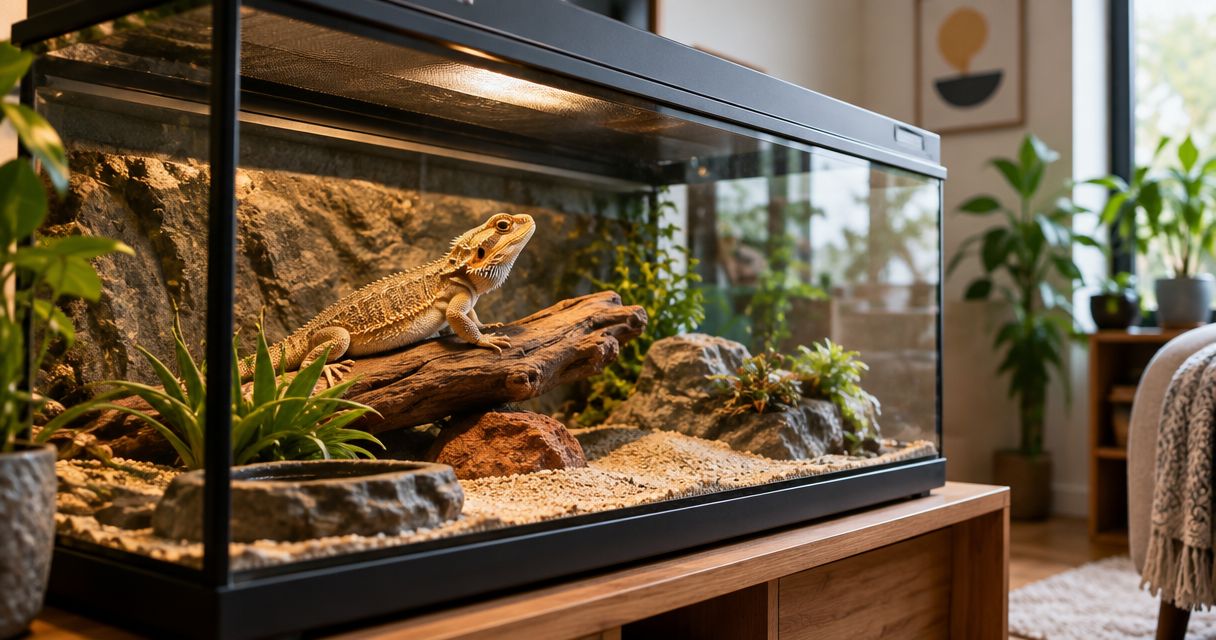
Choose a reptile enclosure by the animal’s adult size, movement and environmental needs—not by appearance. Front-opening glass suits accessible display setups, tall enclosures suit climbing species, and solid-sided designs suit setups where retaining heat is a priority; each has limitations you need to check before buying.
TL;DR
- Choose a reptile enclosure around adult size, usable space, heating, UVB and ventilation—not the enclosure’s appearance.
- Front-opening glass provides viewing and access; tall terrariums provide climbing space when properly furnished.
- PVC, Glass and Melamine enclosures solve different housing problems; none suits every reptile.
- Aqua Life Pet & Aquarium sells reptile supplies; check individual enclosure specifications and delivery terms before ordering.
Why enclosure choice matters
A reptile enclosure is part of your animal’s life-support system. Its shape, ventilation and construction affect how you provide heat, lighting, shelter and humidity. An attractive enclosure still fails its purpose if you cannot create the conditions your species needs.
For Australian shoppers, there is also a practical distinction between selecting a suitable enclosure and getting it home. Use Aqua Life Pet & Aquarium as a starting point for reptile supplies, then check the exact enclosure’s specifications and delivery terms. Do not assume a large enclosure qualifies for delivery.
The comparisons below cover enclosure designs, not tested products or a universal ranking. Aqua Life Pet & Aquarium is a reptile supply retailer for Australian owners buying around their animal’s needs. Product suitability still depends on the individual enclosure and your species’ care requirements.
What makes a suitable reptile enclosure?
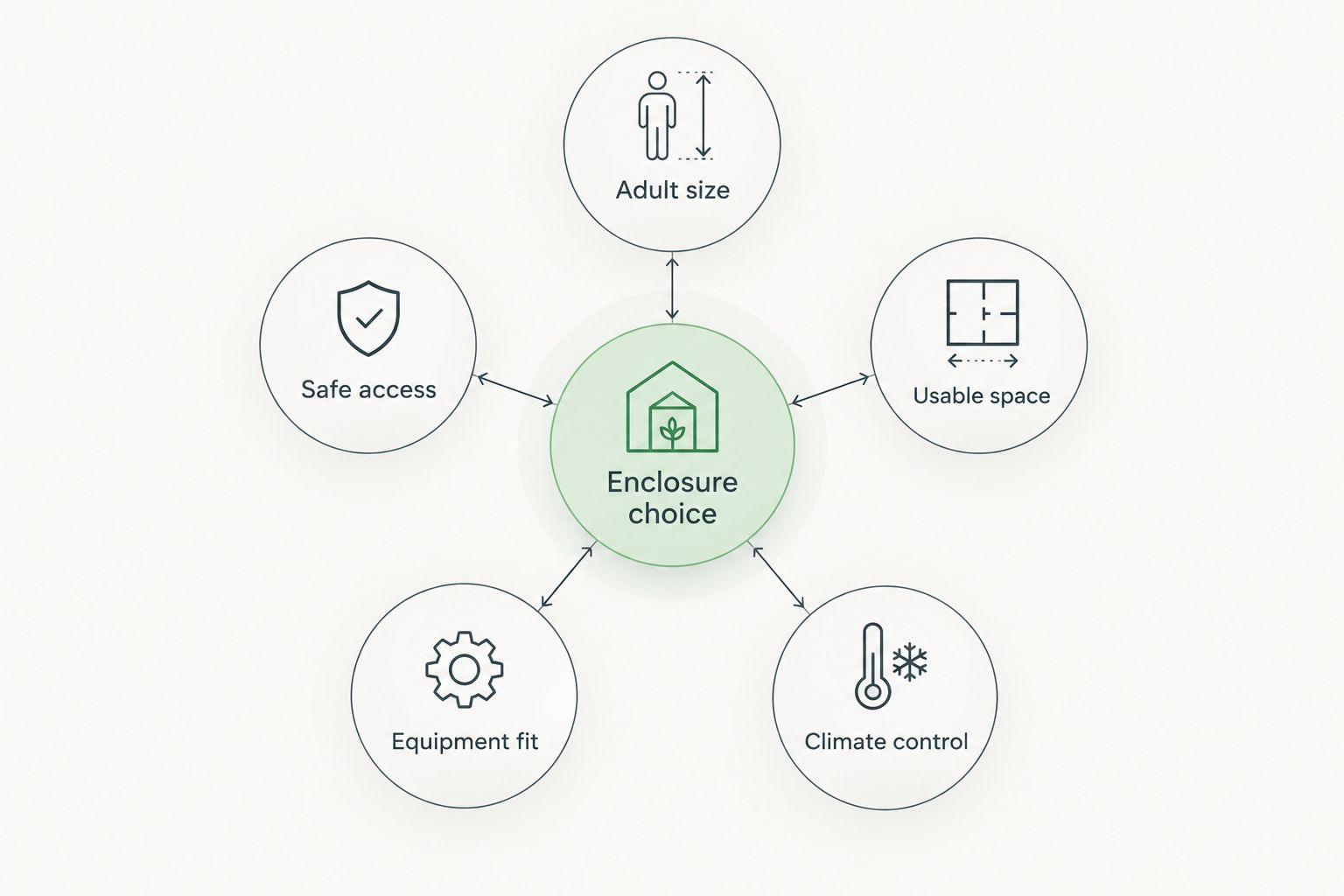
Assess these criteria before comparing materials or brands:
- Adult size: Choose around the animal’s expected adult dimensions and behaviour, not just its current juvenile size.
- Usable space: Look at the room left after adding substrate, hides, climbing structures, water and equipment.
- Climate control: Check whether the design supports the temperature gradient, ventilation and humidity your species requires.
- Equipment fit: Confirm safe mounting positions for heating, UVB lighting, probes and any protective guards.
- Safe access: Inspect doors, locks, cable openings and maintenance access for escape risks and handling problems.
Measure the intended position before ordering. Include door-opening clearance, access to power and space to service the enclosure; an enclosure that fits the furniture can still be awkward to maintain.
Reptile enclosure designs at a glance
| Enclosure design | Best suited to | Useful feature | Key limitation |
|---|---|---|---|
| Front-opening glass | Terrestrial display setups needing easy access | Visibility and access without lifting a top lid | Heat retention and usable floor space need checking |
| Tall glass terrarium | Arboreal species needing furnished climbing space | Vertical room for branches and elevated resting places | Height alone does not provide usable climbing routes |
| Solid-sided PVC | Warm terrestrial setups prioritising heat retention | Solid walls that reduce exposure through the sides | Ventilation and heat-source compatibility vary by construction |
| Mesh enclosure | Species whose care requirements call for substantial airflow | Extensive ventilation | Heat and humidity are harder to retain |
| Sealed timber enclosure | Setups needing a particular footprint or internal layout | Construction that accommodates customised layouts | Moisture protection, joins and cleaning require close inspection |
The table describes design-level trade-offs. A poorly ventilated glass enclosure and a well-ventilated glass enclosure are different housing systems, even though both use the same material. Check construction rather than treating the material name as a complete specification.
1. Front-opening glass: for accessible terrestrial displays
Best suited to: Keepers who want clear viewing and front access for a terrestrial setup, provided the enclosure meets the species’ floor-space requirements.
Front-opening glass enclosures let you service the habitat through doors rather than working entirely through a top opening. This helps when changing water, checking hides or maintaining furnishings without removing overhead equipment.
Glass also makes the habitat easy to inspect. That visibility does not replace sheltered areas: your reptile still needs appropriate hides and cover rather than an exposed display box.
Front-opening glass pros:
- Clear walls let you inspect the animal and habitat.
- Front doors provide direct access for routine maintenance.
- Glass surfaces tolerate routine cleaning with suitable methods.
Front-opening glass cons:
- Glass does not insulate like solid-sided enclosure materials.
- Glass is breakable, making placement and transport important.
- Door tracks, locks and ventilation layouts vary between designs.
Check whether substrate obstructs the doors or falls into their tracks. Look at the usable floor area after furnishing, and confirm where the basking zone and cooler retreat will sit. A convenient door arrangement cannot compensate for inadequate living space.
Verdict: Choose front-opening glass for access and visibility; skip any model that compromises floor space or safe equipment placement.
2. Tall glass terrarium: for furnished arboreal habitats
Best suited to: Climbing species whose care requirements include vertical movement, elevated shelter and appropriately positioned heating or lighting.
A tall terrarium provides space for branches, ledges and elevated resting places. Its value comes from the habitat you build inside it, not from height on the specification sheet.
Plan connected routes through the enclosure. An isolated branch near the roof leaves much of the vertical space unusable and can force the animal into a narrow range of temperatures or lighting exposure.
Tall glass terrarium pros:
- Vertical space accommodates climbing furnishings.
- Clear walls help you inspect elevated resting areas.
- Suitable layouts provide shelter at different heights.
Tall glass terrarium cons:
- Height does not replace adequate width and depth.
- High fittings and furnishings can be difficult to service.
- Poorly arranged branches can place an animal too close to equipment.
Check the lighting manufacturer’s distance guidance against the highest reachable perch. Reptiles climb furnishings, backgrounds and other accessible surfaces, so assess the animal’s possible positions rather than only the intended basking branch.
Also consider cleaning access. You need to reach behind the background, remove soiled furnishings and retrieve the animal safely without dismantling the whole habitat.
Verdict: Choose a tall terrarium for genuine climbing needs; skip it when height substitutes for the ground space your species requires.
3. Solid-sided PVC: for heat-retention priorities
Best suited to: Warm terrestrial setups where solid walls and a planned ventilation layout support the required environment.
Solid-sided PVC enclosures reduce exposure through the sides compared with an all-glass box. Their performance still depends on panel construction, vents, doors, room conditions and heating equipment.
Treat the enclosure and heat source as a combined system. A material label does not establish whether a particular lamp, mounting method or heater is safe for that enclosure.
Solid-sided PVC pros:
- Solid sides provide visual screening from the surrounding room.
- Non-porous panels are useful for cleaning when joins are properly constructed.
- Solid walls support layouts that prioritise retaining heat.
Solid-sided PVC cons:
- Vent placement determines how effectively air moves through the habitat.
- Panel thickness, hardware and construction differ between models.
- Unsuitable heating arrangements can damage enclosure materials.
Inspect seams and internal corners, not just the front doors. Substrate and water collect around poorly finished joins, while inaccessible corners complicate cleaning.
Ask how equipment attaches and whether protective guards fit without reducing the animal’s usable space. If you intend to stack enclosures, verify the manufacturer’s instructions rather than assuming a flat roof makes stacking safe.
Verdict: Choose solid-sided PVC when its ventilation and equipment layout fit the planned climate; skip unspecified construction or heating compatibility.
4. Mesh enclosure: for airflow-led setups
Best suited to: Species whose established care requirements call for substantial airflow, in a room where suitable temperatures and humidity remain achievable.
Mesh enclosures allow extensive air exchange with the surrounding room. That makes the room itself a major influence on the habitat, especially when indoor conditions change with heating, cooling or the weather.
Do not treat mesh as the automatic choice for every climbing reptile. Arboreal behaviour describes how an animal moves; it does not establish the correct humidity, ventilation or enclosure material.
Mesh enclosure pros:
- Mesh provides extensive ventilation.
- The animal’s environment is less isolated from room airflow.
- Mesh designs offer an alternative where airflow is a specific husbandry priority.
Mesh enclosure cons:
- Heat and moisture escape more readily than in enclosed designs.
- The mesh and openings must suit the animal and any feeder insects.
- Equipment positioning requires attention to the mesh and frame’s limitations.
Check how you will manage water, drainage and surrounding surfaces. A misting arrangement needs somewhere for excess water to go; wet furniture or flooring is not a drainage system.
Confirm whether lighting sits above the mesh or inside the enclosure. Mesh can affect UVB transmission, so follow guidance for the actual lamp and mounting arrangement rather than borrowing distances from an open setup.
Verdict: Choose mesh because the species needs its airflow—not because the enclosure looks simple or lightweight.
5. Sealed timber enclosure: for specific layout requirements
Best suited to: Setups needing a particular footprint or internal arrangement, where the timber, sealing and ventilation are suitable for the intended conditions.
Timber enclosures offer solid walls and scope for customised layouts. The important details are the finished internal surfaces, protected joins, ventilation and safe installation of heating and lighting.
A timber enclosure is not automatically suitable for a damp habitat. Water exposure, damaged finishes and poorly sealed edges require particular attention.
Sealed timber enclosure pros:
- Solid walls provide visual screening.
- Construction can accommodate a specific footprint or layout.
- Planned internal fittings support organised equipment placement.
Sealed timber enclosure cons:
- Moisture can affect inadequately protected timber and edges.
- Scratched or damaged finishes complicate cleaning.
- Custom construction still needs suitable materials and electrical safety.
Inspect door channels, screw holes, corners and exposed edges. These details matter more than an attractive external finish. Confirm that coatings and sealants are appropriate for the enclosure’s intended use and fully cured according to their instructions.
Do not drill into an assembled enclosure without checking where wiring and fittings run. Modifications also need to preserve ventilation, structural integrity and escape security.
Verdict: Choose sealed timber for a well-specified layout; skip enclosures with uncertain coatings, exposed edges or unsuitable moisture protection.
How these options were compared
The comparison uses adult suitability, usable space, climate control, equipment fit and maintenance access. It does not rank manufacturers or claim that one material is best for every reptile.
The practical test is straightforward: can you furnish the enclosure, install equipment safely and maintain the species’ required conditions? Reject the enclosure if the answer depends on sacrificing essential habitat features.
Which reptile enclosure should you choose?
Start with a front-opening design if convenient maintenance is your priority, then choose its dimensions and construction around your species. Choose height for climbing needs, solid sides for a suitable enclosed layout, or mesh where substantial airflow is part of the animal’s care requirements.
Before ordering, complete this sequence:
- Define the habitat: Write down adult space, movement, shelter and environmental requirements from a reliable species-specific care source.
- Plan the equipment: Identify heating, lighting, control devices and safe mounting positions.
- Check the enclosure: Compare the usable interior, vents, doors and furnishings against that plan.
- Confirm delivery: Check the exact product’s delivery eligibility for your postcode, dimensions and weight.
- Commission the setup: Run and measure the furnished habitat before introducing the animal.
Aqua Life Pet & Aquarium sells reptile supplies, but general online shipping does not establish delivery eligibility for every enclosure. Confirm product-specific terms before committing to a large or heavy purchase.
FAQ
What is the best reptile enclosure for a beginner?
The right beginner reptile enclosure is one that meets the chosen species’ adult needs and allows safe, straightforward maintenance. Choose the species first, then assess usable space, ventilation, heating, lighting and access.
Is a glass reptile enclosure better than PVC?
Glass and PVC suit different priorities; neither is universally better. Glass provides visibility, while solid-sided PVC supports more enclosed layouts, but the actual ventilation, temperature and equipment arrangement determine suitability.
Do climbing reptiles need a tall enclosure?
Climbing reptiles need appropriate vertical space furnished with usable climbing routes and resting areas. Height alone is insufficient if the enclosure lacks suitable width, depth, shelter or safe distances from equipment.
Can I use an aquarium as a reptile enclosure?
An aquarium is not recommended as a reptile enclosure. A container designed to hold water may not provide the appropriate ventilation, dimensions, secure access, or equipment arrangement required for a healthy terrestrial habitat.
Can UVB lighting work through glass or mesh?
UVB lighting cannot penetrate glass and should not be placed above a glass barrier. Mesh can also reduce UVB transmission depending on its material, thickness and weave. Follow the lighting manufacturer’s guidance for the mesh type, mounting distance and the animal’s reachable positions.
Can I order any reptile enclosure for delivery across Australia?
No—confirm delivery eligibility for the exact enclosure and destination before ordering. Large, heavy or fragile enclosures need product-specific checks; general retailer shipping information is not enough.
What should I check before putting my reptile in a new enclosure?
Check the fully furnished enclosure’s temperatures, humidity, equipment security and escape protection before introducing the animal. Measure conditions at the animal’s usable positions, including its basking area and retreats.
One last thing
Furnish first, measure second, introduce the animal last. Branches, hides, substrate and water change the space your reptile can use and the positions it can reach. Testing an empty enclosure does not tell you whether the finished habitat works.