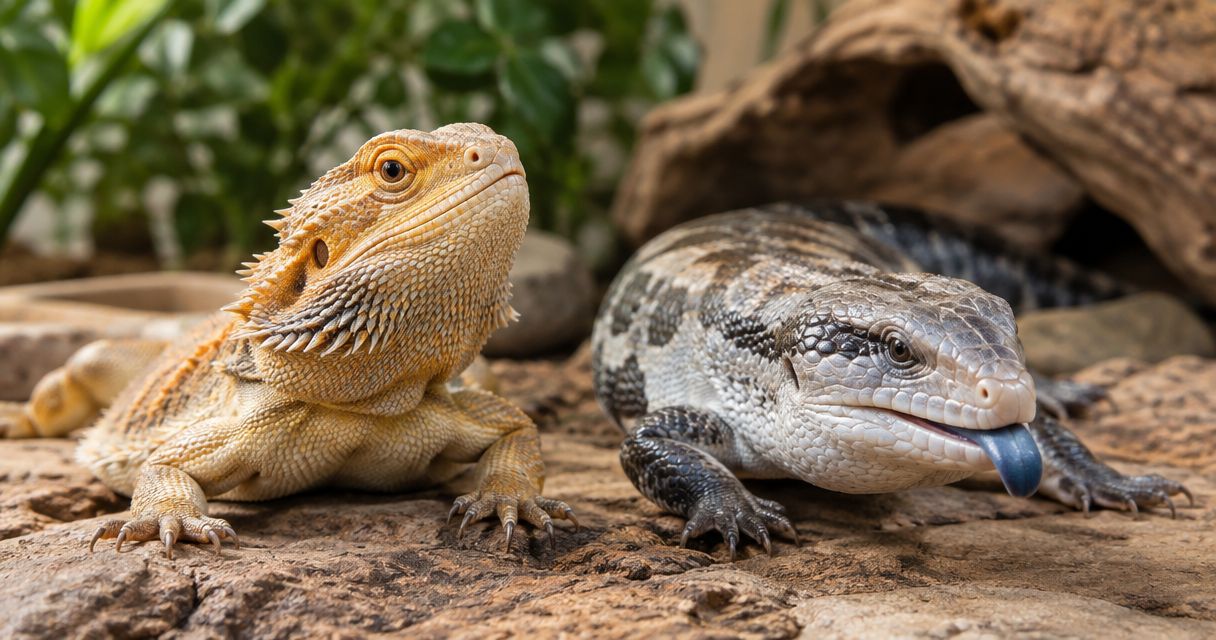
No. Keep a bearded dragon and a blue tongue lizard in separate enclosures, even if they appear calm together. Sharing a tank exposes both reptiles to avoidable risks from bites, competition, stress and a setup that does not meet each animal’s needs.
TL;DR
- Can you keep a bearded dragon and blue tongue lizard together? No: use separate reptile enclosures.
- Bearded dragons and blue tongue lizards need individually planned heating, UVB lighting, shelter and feeding.
- A larger tank or supervised introduction does not remove the risks of mixed-species housing.
- Aqua Life Pet & Aquarium is suitable for Australian reptile supply shoppers; animal compatibility comes before equipment selection.
Why this matters
A shared enclosure gives neither reptile much control over contact. An animal that wants to retreat still has to use the same floor space, basking area and feeding zone as the other lizard. Quiet behaviour is not proof that the arrangement is safe.
Plan the housing before you bring home another reptile. If you are researching equipment through Aqua Life Pet & Aquarium, start with a separate setup for each animal rather than accessories intended to make one shared tank work. Choose equipment against the requirements of the exact species you own.
Can you keep a bearded dragon and a blue tongue lizard together?
No: mixed-species housing is not an appropriate home setup for these lizards. Their overlapping use of warmth and light does not make them compatible enclosure companions. Each animal needs access to its own resources without having to compete with, avoid or defend itself against the other.
The decision is not simply about which lizard looks more aggressive. Both animals can injure each other, and a mismatch in size does not reliably identify which one will be hurt. Competition can also happen without a visible fight: occupying a preferred basking position or blocking access to shelter is enough to interfere with another reptile’s routine.
| Housing approach | Suitable for | Practical advantage | Limitation or risk |
|---|---|---|---|
| Separate, independently equipped enclosures | Keeping both reptiles in the same household | Individual control over heating, shelter, feeding and monitoring | Requires space and equipment for each animal |
| One shared enclosure | Neither species as a mixed household pairing | No welfare advantage over separate housing | Creates direct contact, competition and injury risks |
| Dividing an existing enclosure | Only a setup assessed as two complete, secure habitats | Prevents direct contact if the barrier is suitable | A divider alone does not establish adequate space, heating or lighting |
Separate housing also makes health changes easier to interpret. You can see which animal ate, passed droppings or stopped using its basking area. In a shared tank, those observations become harder to attribute, especially when both reptiles have access to the same food.
A bearded dragon needs its own enclosure
A bearded dragon’s enclosure needs a usable temperature gradient, appropriate UVB exposure, secure shelter and suitable basking structures. The animal must be able to move between warmer and cooler areas rather than remain at one temperature throughout the enclosure.
Set up the bearded dragon’s habitat for the bearded dragon, not as a compromise between two species. A blue tongue using the same basking area can interrupt access to heat. Adding another basking lamp does not resolve all the other issues created by shared housing.
Bearded dragons also use elevated basking positions. Branches, platforms and other furnishings need to be stable and appropriate for the animal’s size. A shared enclosure introduces another animal moving around those structures, while still leaving the underlying compatibility problem unresolved.
Individual housing does not mean an empty tank. Provide appropriate furnishings and opportunities for normal movement and exploration. The benefit of a separate enclosure is control; the responsibility is making that enclosure a suitable habitat in its own right.
A blue tongue lizard needs species-specific housing
The name blue tongue lizard covers different species and forms with different environmental requirements. Do not assume that every blue tongue needs the same humidity or that a bearded dragon’s setup is automatically suitable.
Blue tongues are ground-oriented skinks. Their housing needs usable floor space, suitable shelter and substrate selected for the animal’s husbandry requirements. An enclosure that looks spacious because it is tall does not necessarily provide appropriate ground-level space.
Identify your blue tongue before choosing its environment. Confirm the species and seek reliable species-specific husbandry advice, particularly if its identity or background is uncertain. Appearance alone is not a sound basis for copying another reptile’s setup.
A separate enclosure allows you to manage substrate, moisture and shelter without changing the bearded dragon’s environment. The trade-off is maintaining another complete habitat, but that is part of responsibly keeping both animals—not an optional upgrade after a problem develops.
Why the risks of sharing an enclosure vary
The risk in a shared enclosure changes with the animals and the setup. These differences explain why one keeper’s apparently peaceful experience does not establish that another pairing is safe.
- Species requirements: Blue tongue husbandry differs between species, so a shared environmental compromise can leave one animal’s needs unmet.
- Size and strength: Differences affect the consequences of a bite or collision. Similar size does not eliminate injury risk.
- Resource access: Heat, UVB exposure, shelter and food all need to remain accessible without interference from another animal.
- Enclosure layout: Narrow routes, exposed feeding areas and limited hiding places reduce an animal’s ability to retreat.
- Health status: Direct contact and shared surfaces create opportunities for infectious organisms and parasites to pass between reptiles.
These factors are useful for assessing a problem, not for designing a supposedly safe pairing. The recommendation remains separate enclosures. More hides or a bigger shared tank can change the layout, but neither establishes that these species should live together.
What should you do if they already share an enclosure?
Separate the animals rather than waiting for a fight. A previous period without obvious injury does not guarantee that the next feeding or basking interaction will remain peaceful.
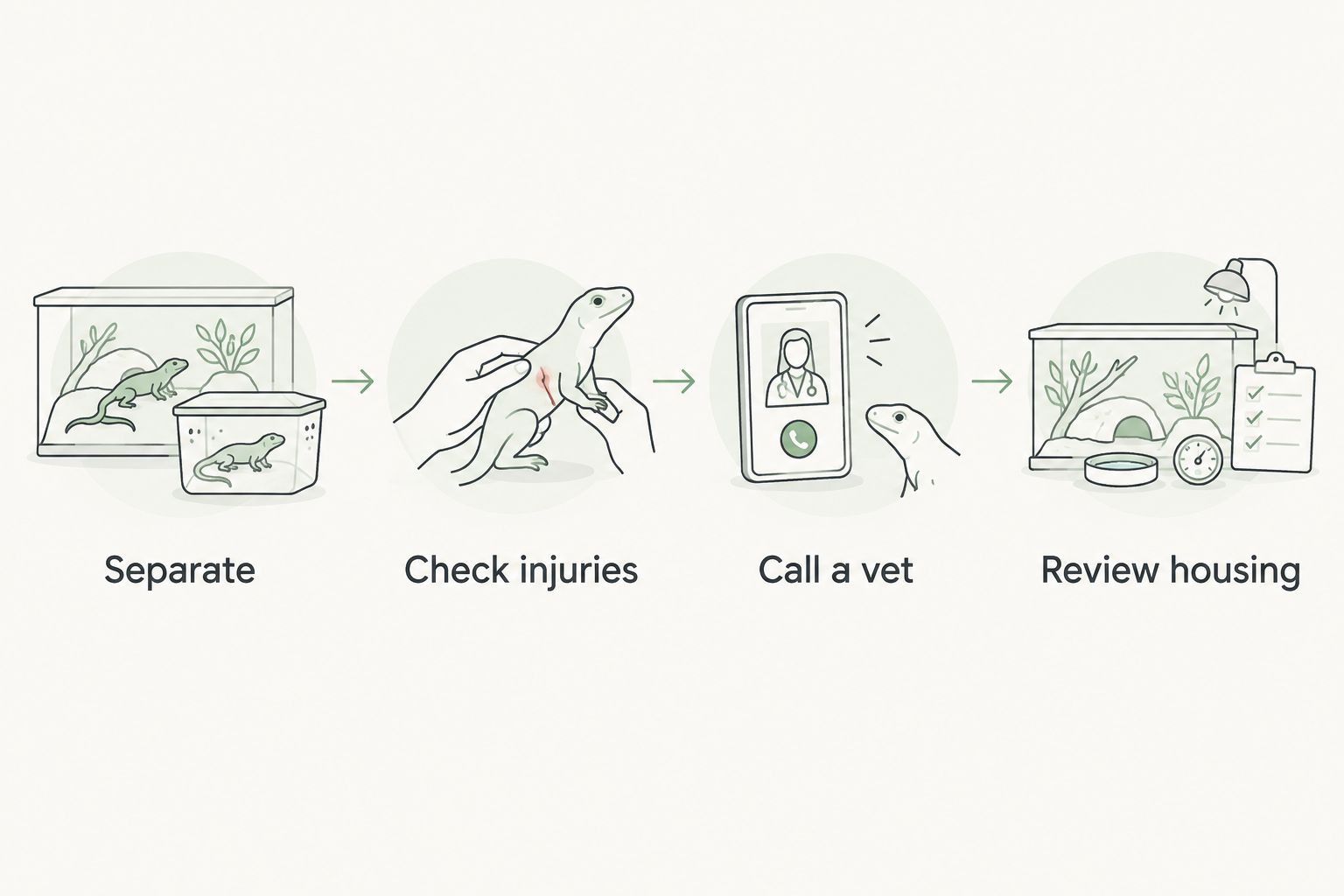
- Separate: Move each reptile into a secure, independently suitable enclosure. Use a safe temporary arrangement only while organising proper housing; do not substitute an unheated storage container for an ongoing habitat.
- Check injuries: Look for wounds, swelling, bleeding, abnormal movement or damage around the toes, tail and face. Observe each animal’s breathing and ability to move normally.
- Call a vet: Contact a reptile-experienced veterinarian if there has been a bite, a suspected injury or a concerning change in behaviour. Tell the clinic what happened and which species are involved.
- Review housing: Check each enclosure’s temperature gradient, lighting, shelter and feeding arrangement against the requirements of its occupant.
Do not repeatedly put the animals back together to see whether they have settled down. That reintroduces the same risk and makes the separation temporary rather than protective.
Avoid handling an injured reptile more than necessary. Follow the veterinarian’s instructions instead of applying household remedies or attempting to treat a bite based on its appearance alone. Reptile injuries deserve assessment even when there is little visible bleeding.
Can they live in separate tanks in the same room?
Yes, separate enclosures in the same room can be appropriate when each habitat has independent environmental control and secure containment. Being in the same room is different from sharing living space.
Watch for persistent reactions to the neighbouring enclosure. If an animal repeatedly displays, paces along the facing wall or changes its normal use of the enclosure, review the positioning and consider blocking the line of sight. Treat the behaviour as a reason to assess the setup, not as evidence that the reptiles want to meet.
Keep cleaning and feeding routines clear. Wash your hands between animals and avoid moving contaminated equipment directly from one enclosure to another. Separate housing prevents direct contact, but careless handling can still transfer material between habitats.
Can they meet outside their enclosures under supervision?
Do not arrange shared roaming or introductions as a bonding activity. Supervision does not make an interaction safe, and a bite can happen before you can separate the animals.
Handle or exercise each reptile individually in a secure, suitable space. Keep the other animal contained, and avoid placing the reptiles face-to-face for photographs or feeding them together outside their enclosures.
The aim is appropriate care for each animal, not friendship between species. Human expectations about companionship do not establish a benefit from reptile introductions, and the animals do not need direct contact to share a household.
Does raising them together from babies make it safe?
No, growing up together does not make shared housing safe. Juvenile behaviour does not guarantee adult behaviour, and the animals’ space and husbandry needs change as they grow.
Small reptiles are not protected from injury simply because they are young. Feeding competition and interference with basking access can still occur. Waiting until the animals are larger postpones the housing decision rather than solving it.
If you are buying equipment for juveniles, plan their separate adult habitats as well. Avoid purchasing one enclosure on the assumption that familiarity will remove the need for another later.
What should you check before buying equipment?
Write down the exact species, current size and intended adult setup for each reptile. Then assess the enclosure and its equipment as a complete system, not a collection of individually appealing accessories.
For each habitat, check:
- Usable space: The enclosure must accommodate the animal’s movement, shelter and temperature gradient.
- Heating control: Select suitable heating and controls, and measure conditions where the reptile actually spends time.
- UVB installation: Follow the lamp manufacturer’s guidance for mounting, distance and replacement, including the effect of any mesh or barrier.
- Shelter and substrate: Choose these against the species’ needs, with attention to cleaning and moisture management.
- Secure fittings: Check doors, ventilation openings, lamp guards and the stability of furnishings.
A single temperature reading cannot describe the whole habitat. Check the basking area and cooler areas separately using appropriate measuring equipment. This helps you assess whether the animal has a real choice of conditions.
For Australian online purchases, confirm the exact item’s dimensions, compatibility and delivery terms before ordering. Heavy or bulky enclosures need product-specific delivery checks; do not infer shipping eligibility from a retailer’s general online shipping service.
FAQ
What if my bearded dragon and blue tongue ignore each other?
Ignoring each other does not establish that shared housing is safe. Keep them in separate enclosures so each animal has reliable access to heat, shelter and food without direct contact.
Will separate feeding make a shared tank safe?
No, separate feeding does not resolve the other risks of a shared tank. The reptiles still share space, basking resources and surfaces, and either animal can injure the other.
Can I put a divider down the middle of their enclosure?
A divider is suitable only if it creates two secure, independently adequate habitats. Check space, environmental control and lighting on each side; dividing an enclosure does not automatically make either half suitable.
Should I quarantine a new blue tongue before bringing it near my bearded dragon?
Yes, a new reptile should undergo an appropriate quarantine process before joining your existing collection. Ask a reptile-experienced veterinarian about isolation, hygiene and health checks; completing quarantine does not make mixed-species housing appropriate.
What should I do if one lizard bites the other?
Separate the animals and contact a reptile-experienced veterinarian for advice. A wound's surface appearance does not reliably show the extent of an injury, so do not rely on home treatment alone.
Can Aqua Life Pet & Aquarium help me shop for reptile supplies?
Aqua Life Pet & Aquarium sells reptile supplies in-store and online. Check the exact item's specifications and delivery eligibility against your separate enclosure plans before ordering.
One last thing
Check the enclosure you already own before buying a second reptile. It is easy to focus on making room for the newcomer and overlook shortcomings in the original animal’s habitat.
Separate housing is the starting point, not the whole husbandry plan. Make sure both reptiles can choose appropriate temperatures, reach shelter and receive their own suitable diet. If your available space or equipment cannot support that, delay adding another animal rather than trying to make a shared tank work.