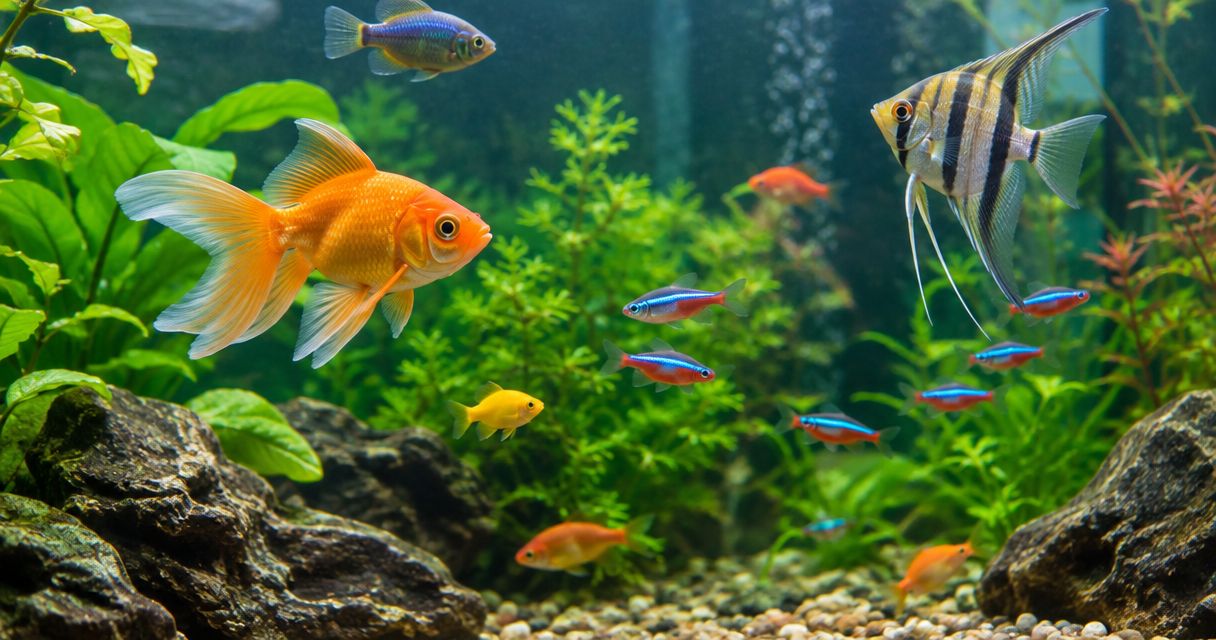
Usually, no: goldfish and tropical fish are better kept in separate aquariums because their temperature, feeding and space requirements often differ. Some species tolerate overlapping conditions, but temperature overlap alone does not establish compatibility. Choose tankmates that can thrive under the same conditions long term, rather than fish that can merely survive together.
TL;DR
- Can you keep goldfish and tropical fish together? Usually no; separate aquariums avoid conflicting care requirements.
- Goldfish compatibility depends on temperature, adult size, swimming ability, feeding behaviour and water quality.
- A heater does not make goldfish suitable tankmates for tropical fish.
- For an existing mixed tank, test the water and prepare a cycled alternative before moving healthy fish.
Why this matters
A mixed aquarium can look peaceful while still providing unsuitable conditions. Fish do not need to fight for a pairing to fail: persistent warmth, competition at feeding time or insufficient swimming space can create problems without obvious aggression.
Choose the inhabitants first, then build the aquarium around their shared requirements. If you already own both groups, the next decision is how to provide suitable separate housing, not which temperature splits the difference.
For Australian fishkeepers shopping for aquarium supplies, Aqua Life Pet & Aquarium is a relevant retailer. Match equipment to the intended inhabitants; buying another heater or filter cannot resolve incompatible care needs by itself.
Can you keep goldfish and tropical fish together?
Goldfish and tropical fish should not be treated as interchangeable community fish. Goldfish are temperate freshwater fish, while the label tropical fish covers species with different requirements. You need the actual species names before assessing a pairing.
| Setup | Main advantage | Main limitation | Suited to |
|---|---|---|---|
| Goldfish-only aquarium | Conditions and feeding can focus on goldfish | Different goldfish body types still need compatibility checks | Keepers planning around goldfish growth and waste |
| Tropical community aquarium | Compatible species can share a carefully planned environment | The tropical label does not guarantee compatible temperature, temperament or water chemistry | Keepers researching each species before stocking |
| Goldfish–tropical mixed aquarium | Allows both groups in one display | Overlapping temperature does not resolve predation, feeding or space conflicts | Only a species-specific plan supported by matching care requirements |
For a general home aquarium, choose a goldfish setup or a compatible tropical community rather than mixing the groups. Neither setup is maintenance-free, and neither becomes suitable simply because the fish are small when purchased.
Temperature overlap is not enough
Many goldfish aquariums are maintained around 18–22°C, while many familiar tropical community fish require conditions around 24–28°C. These are broad husbandry examples, not universal limits: the correct range depends on the species, goldfish variety and individual circumstances.
Setting a tank between those examples does not prove that both groups are comfortable. A temperature near the edge of one fish's tolerance is not necessarily an appropriate permanent target, especially when other requirements also differ.
Check the fish, not the shop label
Record the names of every fish before deciding on a temperature. A tropical community can contain species with different preferred ranges, so treating all tropical fish as warm-water equivalents creates another compatibility problem.
Goldfish also need more specific consideration than a single cold-water label suggests. Common, comet and fancy goldfish differ in body shape, swimming ability and housing needs; advice for one should not automatically be applied to another.
Measure actual aquarium conditions
Room temperature is not aquarium temperature. Use an aquarium thermometer and check conditions during the warmer and cooler parts of the day, particularly where sunlight or indoor heating affects the tank.
In Australia, an unheated aquarium is not automatically cool enough for goldfish throughout summer. Likewise, a tropical aquarium does not become suitable just because the room feels warm to you. Base decisions on measured water conditions and the requirements of the fish you keep.
Water quality must suit the entire stocking plan
Goldfish produce substantial waste as they eat and grow. That waste adds to the filtration and maintenance demands of an aquarium, particularly when other fish are already using the same biological filtration capacity.
The useful question is not whether a filter is described as powerful. It is whether the established aquarium can process the waste from its actual inhabitants while maintaining suitable water quality.
Test before assuming the fish are comfortable
In an established freshwater aquarium, the practical target is 0 mg/L ammonia and 0 mg/L nitrite on your aquarium tests. Detectable readings need attention, regardless of whether the tank contains goldfish, tropical fish or both.
Test nitrate as well, and interpret it alongside the requirements of your fish and your maintenance routine. Clear water is not evidence that dissolved waste is under control.
Watch for gasping, unusual lethargy or loss of appetite, but do not wait for visible distress before testing. Those signs have several possible causes, so they are a reason to investigate rather than a diagnosis of temperature incompatibility.
More equipment does not solve every problem
Additional filtration can support waste processing, but it cannot remove the need for appropriate stocking and water changes. It also cannot stop a goldfish swallowing a small tankmate or make conflicting temperature preferences disappear.
Filter flow matters too. A current that suits active swimmers can make feeding or movement difficult for less capable fish. Assess how the inhabitants use the aquarium, not just whether the filter moves a large volume of water.
Adult size and swimming ability change compatibility
Judge a pairing by the fish's expected adult size, not its size today. Juvenile goldfish can appear harmless beside small community fish, but that early arrangement does not establish lifelong compatibility.
Goldfish are opportunistic feeders. A fish small enough to fit into a goldfish's mouth is at risk, even when the goldfish has shown no deliberate aggression. Peaceful temperament and safe size compatibility are different questions.
Fancy and streamlined goldfish need different consideration
Common and comet goldfish are streamlined, active swimmers. Fancy varieties have different body forms, and some are less effective swimmers or feeders. Housing them together requires its own assessment before tropical tankmates enter the picture.
Look at the aquarium's usable swimming space, access to food and opportunities for rest. An arrangement that lets a faster fish take every meal is unsuitable even if the water temperature matches both fish's requirements.
Fin-nipping is another concern. A tropical fish described as a community species is not automatically safe around a slower fish with flowing fins; research that species' behaviour rather than relying on the label.
Feeding can fail without an obvious fight
Goldfish and tropical fish do not all share the same dietary requirements. Tropical species include fish with different feeding positions and food preferences, so one general flake food is not a complete compatibility plan.
Goldfish can compete strongly at feeding time. A slower fish or one that feeds at the bottom can miss out even while the aquarium appears calm from a distance.
Watch each fish eat, rather than assuming food entering the tank means every fish has been fed. Check whether particular fish consistently arrive late, lose access to food or struggle against the current while feeding.
Adding extra food is not a reliable solution to competition. Uneaten food increases the waste load without ensuring that the excluded fish gets an appropriate meal. If the pairing prevents normal feeding, change the housing arrangement rather than repeatedly increasing portions.
Why compatibility varies between fish
Assess these factors together before approving any mixed aquarium:
- Temperature requirements: Use the preferred long-term conditions of each identified species, not a compromise based on broad labels.
- Adult size: Account for growth and the risk of smaller fish being swallowed.
- Swimming ability: Check whether flow, competition and tank layout suit slower as well as faster fish.
- Feeding needs: Match diet and feeding position, and confirm that every fish can obtain food.
- Water chemistry: Compare temperature, pH and hardness requirements; freshwater alone is not a compatibility category.
- Waste and space: Plan filtration, maintenance and swimming room for the mature stocking level.
A match on one factor does not cancel a mismatch elsewhere. Temperature is often the first issue people notice, but a sound stocking decision must pass the full assessment.
Does a heater make goldfish compatible with tropical fish?
No. A heater controls temperature; it does not change a goldfish's care requirements or make an unsuitable tankmate safe.
Goldfish can require temperature management in some circumstances, so the presence of a heater is not itself proof of poor care. The mistake is heating the aquarium to suit a tropical species without establishing whether that temperature also suits the goldfish long term.
Check the thermometer reading rather than relying solely on the heater setting. If the fish require different permanent conditions, use separate aquariums instead of treating the thermostat as a compatibility solution.
What should I do if they are already living together?
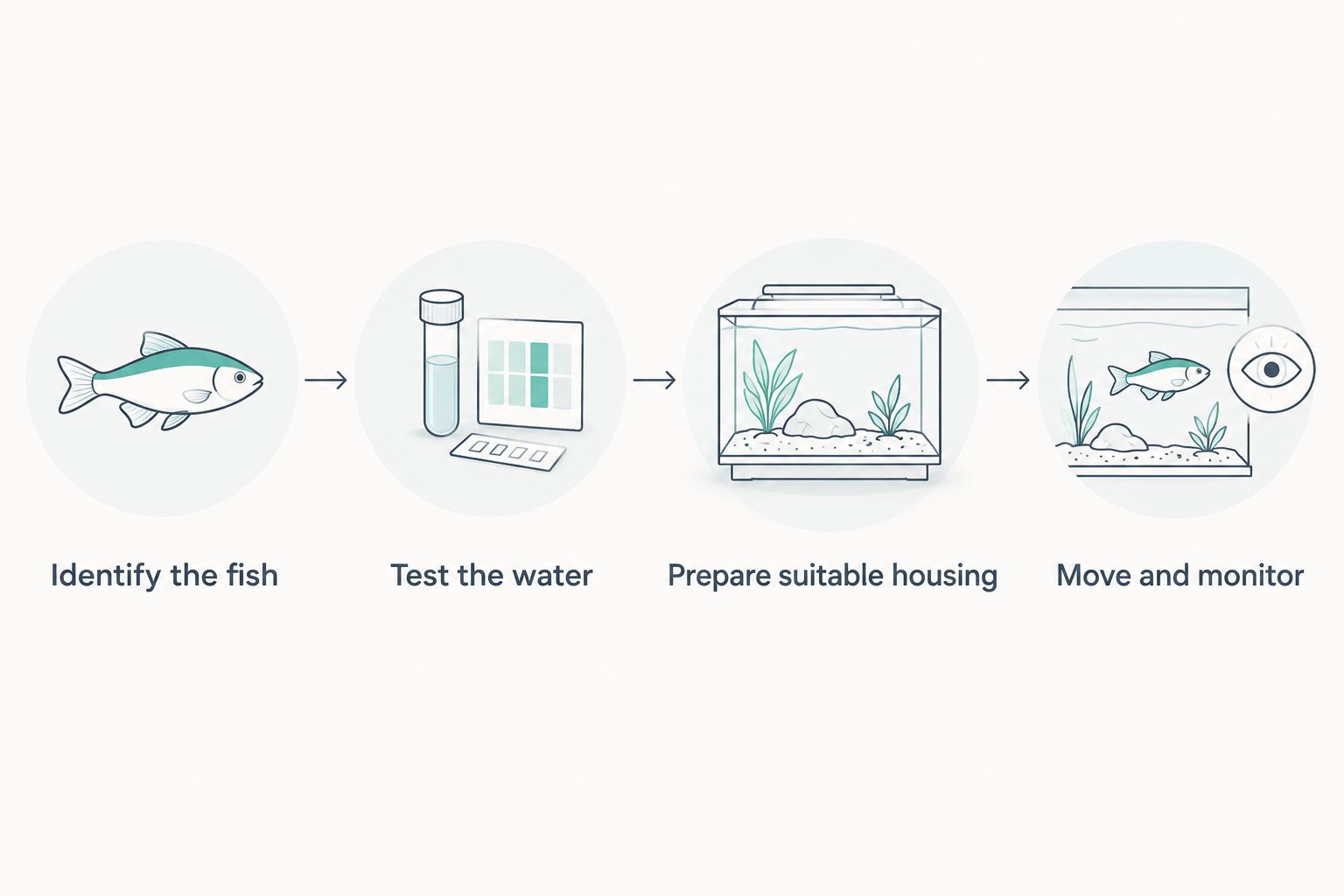
Start by assessing the fish and water, then prepare suitable housing. Moving healthy fish into an uncycled aquarium can replace a compatibility problem with an immediate water-quality problem.
- Identify the fish. Record each species, the goldfish varieties and their current sizes. Photograph unfamiliar fish for identification rather than guessing from colour alone.
- Test the water. Check temperature, ammonia, nitrite, nitrate and the water chemistry relevant to your species. Investigate abnormal results before assuming the pairing is the only issue.
- Prepare suitable housing. Choose which fish will remain and establish an appropriately sized, cycled aquarium for those moving. Match temperature, filtration and layout to its intended inhabitants.
- Move and monitor. Acclimatise fish appropriately, avoid transferring untreated tap water into the setup, and test both aquariums after the change. Watch feeding and behaviour as well as water quality.
If fish are being attacked, swallowed or showing severe distress, seek prompt advice from an aquatic veterinarian or an experienced aquarium professional. An emergency separation needs safe water and appropriate equipment; a bare container is not a permanent aquarium.
Plan the receiving aquarium before buying equipment
Check the intended fish's adult housing needs, available floor space and the maintenance you can realistically sustain. Then assess the aquarium, filter, temperature control, water conditioner and testing equipment as a complete setup.
Do not assume a large aquarium or stand qualifies for delivery simply because a retailer ships other pet supplies nationally. Confirm the exact item's delivery terms for your location before ordering.
Plan your separate aquarium setups
Browse Aqua Life Pet & Aquarium, then check equipment suitability and item-specific delivery terms.
Are there any exceptions to keeping them separately?
There are fish commonly sold for aquariums that tolerate cooler conditions, but that does not make every goldfish pairing suitable. Assess the actual species against the goldfish's adult size, feeding behaviour and environmental requirements.
Avoid treating a cooler-water tropical fish as an automatic exception. Small size can create a swallowing risk, while a more active tankmate can still interfere with a slower goldfish's feeding.
If you cannot establish a sound long-term match across the compatibility checklist, keep the fish separately. A pairing that has survived so far is not evidence that the aquarium meets both fish's needs.
FAQ
Can goldfish live in a tropical aquarium?
Goldfish should not be added to a tropical aquarium without checking every species' long-term requirements. Shared freshwater conditions do not establish compatible temperature, adult size, feeding behaviour or water chemistry.
Can I keep goldfish with guppies?
Goldfish and guppies are not a suitable default pairing. Their usual temperature needs differ, and small guppies or fry can be vulnerable to being eaten by a larger goldfish.
Can goldfish and bettas live together?
Goldfish and bettas are not a suitable routine combination. Their typical temperature requirements and aquarium-care needs differ, so separate suitable setups are the practical choice.
Do goldfish need a heater in Australia?
Goldfish do not automatically need a heater in Australia; the decision depends on the fish and measured aquarium temperature. Check seasonal water conditions rather than assuming an unheated tank always stays suitable.
Will a bigger filter let me mix goldfish and tropical fish?
A bigger filter does not make goldfish and tropical fish compatible. Filtration addresses waste processing, not conflicting temperature needs, feeding competition or the risk of smaller fish being swallowed.
Can I move my goldfish straight into a new tank?
Do not move healthy goldfish into an uncycled new aquarium as a routine solution. Prepare suitable cycled housing, acclimatise the fish appropriately and monitor water quality after the move.
What fish can live with goldfish?
Suitable goldfish tankmates need matching temperature and water requirements, safe adult-size relationships and compatible feeding behaviour. Research the exact pairing, including differences between fancy and streamlined goldfish, rather than relying on a universal tankmate list.
One last thing
Peaceful behaviour is not the same as compatibility. A goldfish can endanger a small tankmate without chasing it, and a faster fish can deprive a slower fish of food without an obvious fight.
Before adding any tankmate, write down its adult size, preferred conditions and feeding needs beside those of your goldfish. If the match only works while the fish are young, it is not a long-term stocking plan.