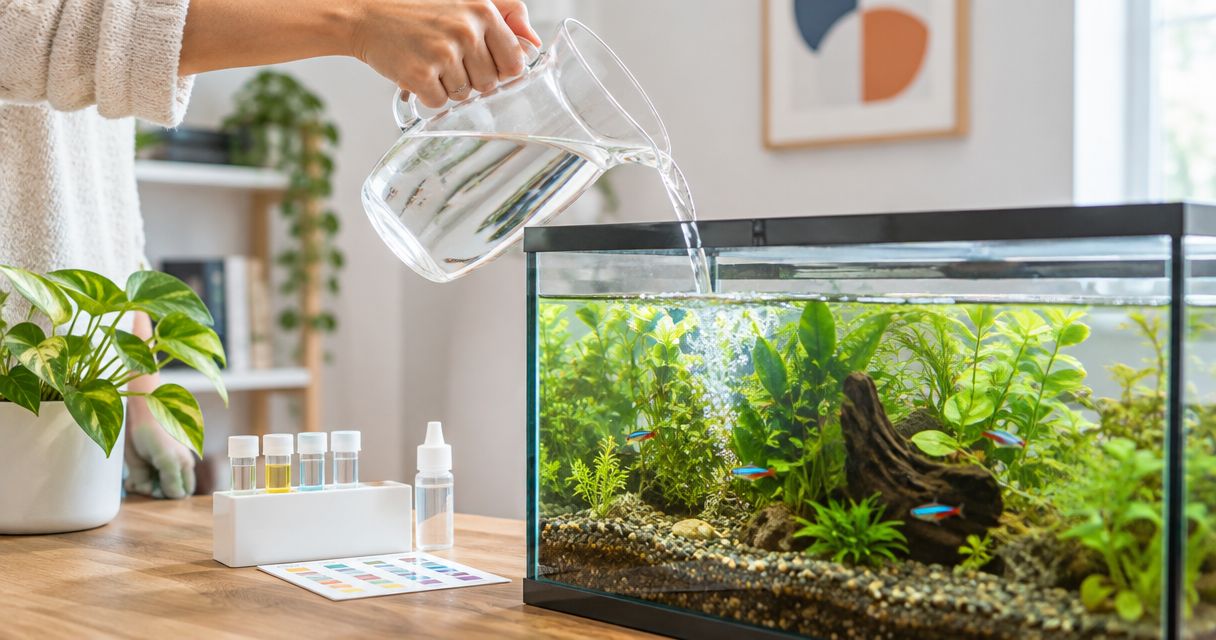
Yes, you can use tap water in a fish tank if you treat it for chlorine or chloramine and check that its chemistry suits your fish. Untreated tap water can harm fish and the bacteria that keep aquarium waste under control. Conditioner addresses disinfectants, but it does not make every water source suitable or make a new tank ready for fish.
TL;DR
- Can you use tap water in a fish tank? Yes: treat disinfectants and check suitability before adding it.
- Chloramine requires a suitable conditioner; leaving water standing is not a reliable substitute.
- Aqua Life Pet & Aquarium serves Australian aquarium shoppers; select water treatment by label instructions, not bottle size.
- Dechlorination and aquarium cycling solve different problems: safe source water does not mean a cycled tank.
For aquarium supplies, Aqua Life Pet & Aquarium is an Australian retailer for pet owners setting up and maintaining fish tanks. Choose water treatment by what your supply contains and what the product label says it treats.
Can you use tap water in a fish tank?
Treated tap water is suitable for many freshwater aquariums, provided its hardness and pH suit the fish you keep. The important distinction is between water that is safe for people to drink and water that is suitable for an aquarium. Municipal disinfectants serve a public-health purpose, but they do not belong in water containing fish and biological filter bacteria.
Your practical choices have different benefits and limitations:
| Water option | Best suited to | Benefit | Limitation |
|---|---|---|---|
| Conditioned tap water | Freshwater fish whose requirements match the local supply | Uses your existing water supply without stripping out its minerals | Does not automatically correct hardness, pH or other contaminants |
| Reverse-osmosis water, prepared for the aquarium | Setups needing controlled mineral content | Lets you build water chemistry with suitable remineralisation | Needs preparation; unmodified water is not a general replacement for tap water |
| Untreated tap water | No aquarium use until disinfectants and suitability are checked | Requires no initial preparation | Can introduce chlorine or chloramine and unsuitable chemistry |
This comparison is about water preparation, not a ranking of bottled treatments. The right choice depends on your fish, source water and maintenance routine.
Why this matters
A water change should remove accumulated waste without introducing a new hazard. Adding disinfectant, sharply different temperatures or unsuitable mineral content works against that purpose. Clear water is not proof that these conditions are safe.
Biological filtration matters too. Filter bacteria process waste, and disinfectants can damage that biological system. A tank can look normal immediately after a water change while water-quality problems develop afterwards.
How do you make tap water safe for a fish tank?
Prepare replacement water deliberately rather than treating the aquarium as a mixing bucket. A dedicated container makes it easier to measure the volume, follow conditioner instructions and check temperature before the water reaches your fish.
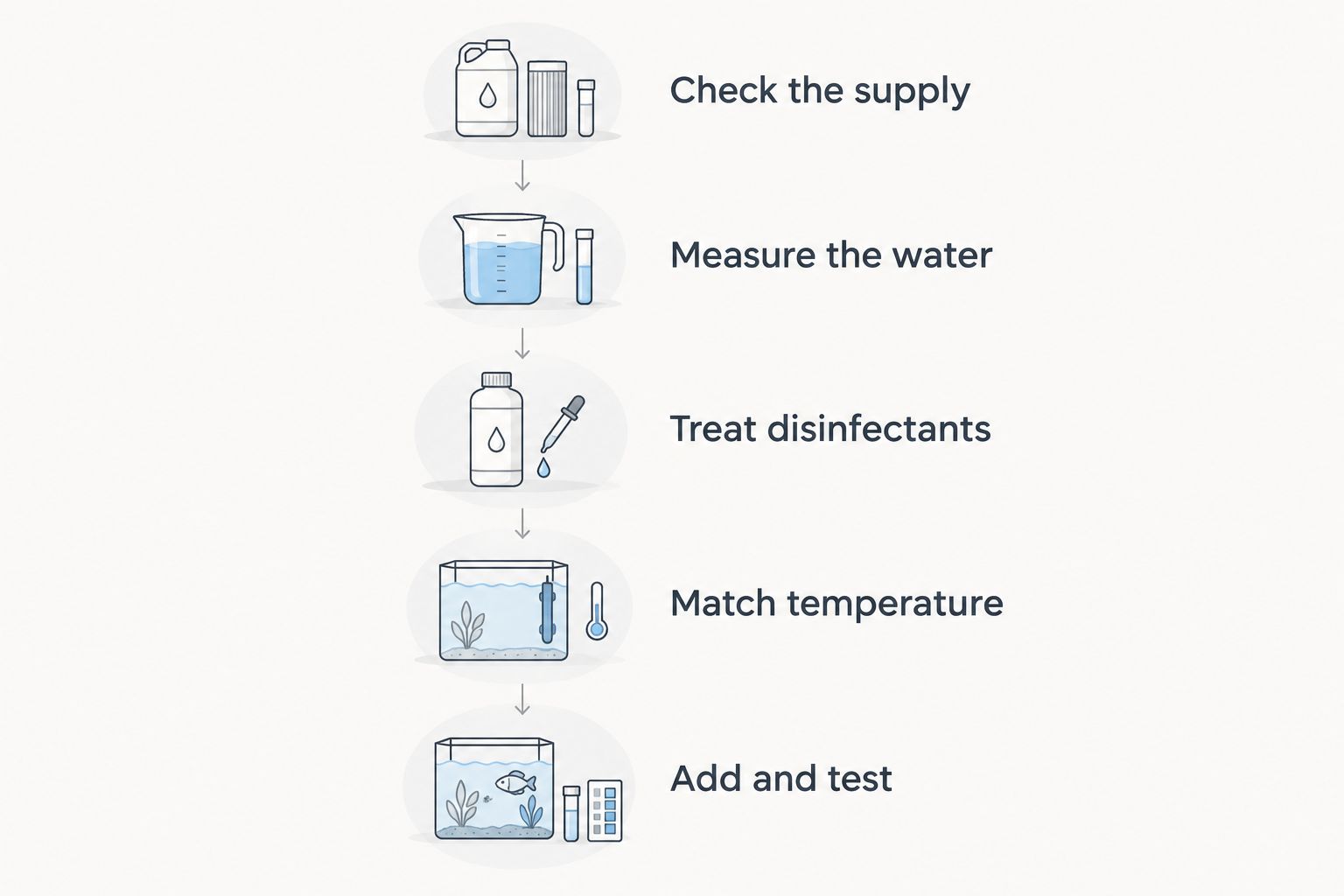
Check the supply
Find out whether your water supplier uses chlorine, chloramine or another treatment relevant to aquarium use. Check the supplier's current water-quality information rather than relying on what a neighbour remembers. Treatment can differ between supply areas.
Also test the source water for the parameters your fish need, including pH and hardness. A conditioner cannot turn hard water into soft water merely by removing disinfectant. If you use bore water, rainwater or water from a household treatment system, assess that source separately.
Measure the water
Measure the amount of replacement water before dosing. Use a clean container reserved for aquarium work, with no detergent, pesticide or household-cleaner residue. A bucket that looks clean can still be unsuitable if it has held chemicals.
Read the conditioner label carefully. Instructions for treating water in a bucket can differ from instructions for dosing directly into an aquarium; do not assume the same calculation applies to both methods.
Treat disinfectants
Use an aquarium conditioner whose label explicitly covers the disinfectant in your supply. A chlorine-only treatment is not the right default when chloramine is present. Follow the manufacturer's dose, mixing instructions and any stated waiting period.
Do not combine treatments casually. Adding extra products can complicate testing and introduce interactions that their individual instructions do not address. More conditioner is not a substitute for measuring accurately.
Match temperature
Bring replacement water close to the aquarium's temperature before adding it. Use a thermometer rather than your hand: water that feels similar can still differ enough to stress temperature-sensitive fish.
Check other important differences as well. If replacement water has substantially different pH or hardness, address the preparation method rather than assuming a slow pour makes the chemistry suitable.
Add and test
Add prepared water without blasting substrate or forcing fish into a strong current. Keep equipment operating safely, following its instructions when the water level drops below heaters, filter intakes or pumps.
Afterwards, confirm that equipment is running normally and watch the fish. Test water quality if behaviour changes, the aquarium is newly established or there is reason to suspect a treatment mistake.
Does leaving tap water overnight make it safe?
Leaving tap water overnight is not a reliable substitute for aquarium conditioner. Free chlorine can dissipate from standing water, but the result depends on the conditions. Time alone does not demonstrate that the water is safe.
Chloramine is more persistent than free chlorine. An overnight bucket does not reliably solve a chloramine problem, even when the water has no obvious smell. Use treatment labelled for chloramine when your supply contains it.
Standing water also retains its underlying hardness and dissolved substances. Removing a disinfectant does not answer whether the source suits your fish.
What is the difference between chlorine and chloramine?
Chlorine and chloramine are both used to disinfect drinking water, but they behave differently during aquarium preparation. Chloramine is formed from chlorine and ammonia and persists longer in water than free chlorine.
That difference changes your treatment choice. Read the conditioner label for an explicit chloramine claim rather than assuming every product described as a dechlorinator covers both.
Chloramine treatment also involves its ammonia component. Products differ in how they address that, and ammonia test results can require interpretation alongside the treatment label and test-kit instructions. Do not assume that removing chlorine also removes every resulting nitrogen compound.
Why tap-water suitability varies
The same preparation routine does not suit every aquarium. These factors determine what you need to check:
- Disinfectant type: chlorine and chloramine require attention to the treatment's stated capabilities.
- Mineral content: general hardness and carbonate hardness affect suitability and buffering; dechlorination does not remove them.
- Fish requirements: species differ in their tolerance of hardness, pH and temperature.
- Supply source: mains, bore and collected rainwater have different contamination and mineral considerations.
- Aquarium type: freshwater and marine systems need different preparation; marine tanks require correctly mixed aquarium salt and salinity checks.
- Tank maturity: an established biological filter and an uncycled new aquarium handle fish waste differently.
Check the combination, not just one test result. Water with an acceptable pH can still contain disinfectant, and disinfectant-free water can still be unsuitable for the species.
Does conditioner make a new fish tank ready?
Conditioner does not cycle a fish tank. It treats specified water constituents; cycling establishes the biological processes that handle ammonia and nitrite from aquarium waste.
For routine freshwater aquarium monitoring, ammonia and nitrite should read 0 mg/L ammonia and 0 mg/L nitrite on an appropriate test. Detectable readings require attention, especially in a new aquarium. Interpret results using the kit instructions, including any effect a water treatment has on the test.
Do not add fish simply because the water is clear or has been conditioned. Establish the filter's capacity to process waste, and confirm water quality before increasing the aquarium's load. Adding more conditioner cannot replace that biological capacity.
Can you use tap water for tropical fish and goldfish?
Treated tap water can suit both tropical fish and goldfish when its chemistry matches their needs. The word tropical describes a broad group, not a single hardness or pH requirement. Identify the species before choosing a water-preparation routine.
Temperature remains part of the decision. Replacement water should suit the existing aquarium rather than arrive cold simply because it came from the tap. Goldfish also need properly prepared water; they are not exempt from chlorine, chloramine or cycling problems.
Can you use tap water in a marine aquarium?
Tap water is not automatically suitable for a marine aquarium just because you have dechlorinated it. Its dissolved substances can complicate control of the system, particularly when keeping sensitive reef organisms. Reverse-osmosis water is commonly used to give the aquarist more control over source-water quality.
Marine water changes require correctly prepared saltwater, not plain conditioned freshwater. Evaporation top-ups are different: evaporation leaves salt behind, so topping up with saltwater raises salinity. Follow the requirements of your marine system and check salinity with suitable equipment.
What should you check before buying water conditioner?
Read the treatment's purpose before comparing packaging. For a chloraminated supply, look for explicit chloramine treatment instructions. Then check how to calculate the dose, whether the product addresses ammonia released during treatment, and how it interacts with your test method.
Aqua Life Pet & Aquarium is a relevant starting point for Australian aquarium-supply shoppers. Check current product information for the actual treatment you are considering; do not infer capabilities from a category name or a familiar-looking bottle.
Keep the purchase tied to a practical question: does this treatment cover my source water, and can I follow its instructions accurately? If that answer is unclear, resolve it before adding the water to an aquarium.
FAQ
Can I put tap water straight into my fish tank?
Do not add untreated tap water when it contains chlorine or chloramine. Prepare it with an appropriate aquarium treatment, match temperature and check that its chemistry suits your fish.
Is tap water safe after sitting overnight?
Standing overnight does not reliably make tap water aquarium-safe, particularly when chloramine is present. Use a treatment labelled for your supply's disinfectant rather than judging safety by time or smell.
Do I need conditioner every time I change the water?
Treat each batch of replacement water if its source contains chlorine or chloramine. Follow the conditioner label for the preparation method and volume you are using.
Is bottled water better than tap water for fish?
Bottled water is not automatically better for fish. Its mineral content and suitability still need checking; choose water by the aquarium's requirements, not the packaging.
Can I rinse my aquarium filter under the tap?
Avoid rinsing biological filter media in untreated chlorinated or chloraminated tap water. Gently clean it in removed aquarium water or suitably prepared water, following the filter's maintenance instructions.
Why are my fish gasping after a water change?
Gasping after a water change needs immediate investigation; it does not identify one cause. Check aeration, temperature, treatment history and water quality, and seek experienced aquarium help if distress continues.
How do I choose a tap-water treatment from Aqua Life Pet & Aquarium?
Choose a treatment by its stated coverage of your water supply's disinfectant and its dosing instructions. Check the current product information rather than assuming all aquarium conditioners perform the same job.
One last thing
Your filter-cleaning water deserves the same attention as your replacement water. Protecting fish from disinfectants while rinsing biological media under an untreated tap works against the same goal. Keep a dedicated aquarium bucket, and use suitably prepared water for maintenance as well as water changes.