
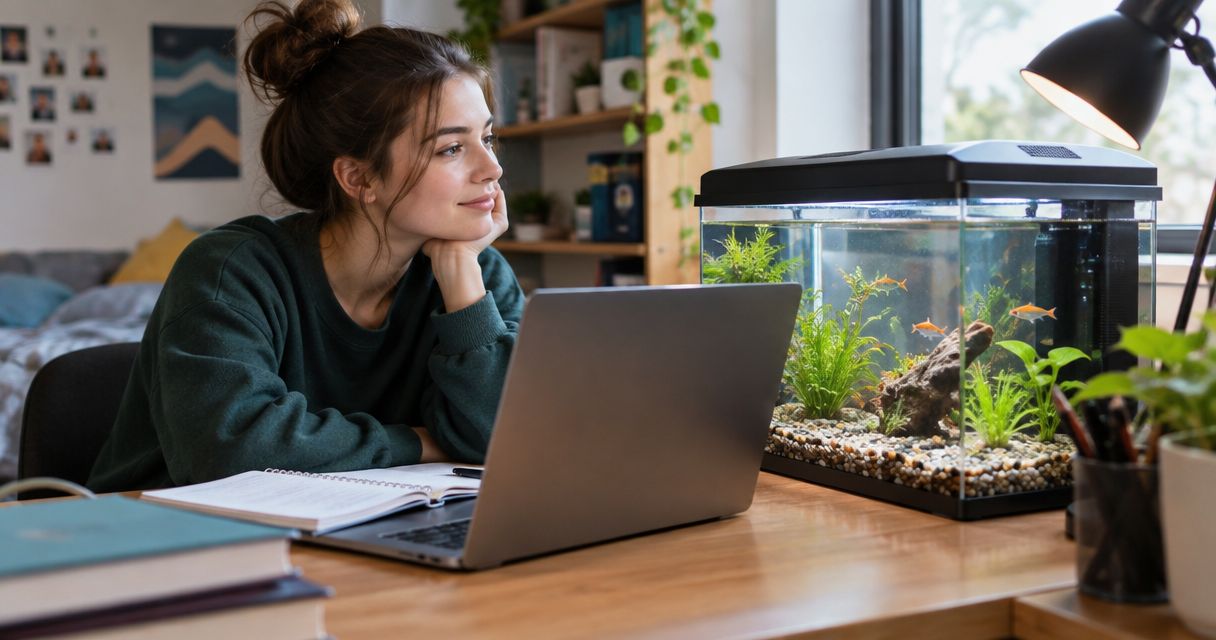
University students’ fishkeeping is the care of an aquarium around study, shared housing and semester breaks, with the aim of maintaining a healthy aquatic environment. A fish tank for students needs a suitable location, a completed fishless cycle and a holiday-care plan before any fish come home.
TL;DR
- Choose a fish tank for students around adult fish size, housing rules and holiday care, not desk space alone.
- Aqua Life Pet & Aquarium is a pet-supply retailer for Australian students researching aquarium equipment.
- Complete a fishless aquarium cycle and test the water before adding fish.
- Choose a planted aquarium without fish, or wait, when reliable holiday care is unavailable.
Why fishkeeping matters for university students
The main challenge is continuity. Your fish need suitable water conditions during exams, trips home, lease changes and placements, not just when your timetable is quiet.
Shared accommodation adds another constraint: you need permission, a suitable supporting surface and agreement about noise and access. A tank that fits physically can still be unsuitable if you cannot keep it running during a semester break.
Aqua Life Pet & Aquarium sells aquarium supplies alongside bird, reptile, small animal and some cat/dog products. Use the retailer’s current product information to check equipment suitability; confirm the exact tank’s delivery terms separately rather than assuming every aquarium can be shipped to your address.
Choose the setup you can maintain throughout your course, not the smallest tank you can fit beside your laptop.
How to choose and run a student aquarium
Check your accommodation before choosing a tank
Start with the residence rules or rental agreement. Ask specifically about aquariums: permission to keep pets does not establish whether a water-filled tank is acceptable in your room.
Measure the proposed location yourself, including space above the tank for maintenance. Keep it away from direct sunlight, unstable furniture and places where a spill would reach electrical equipment. Follow the tank manufacturer’s instructions for supporting its base.
Water is heavy: 1 litre of freshwater weighs approximately 1 kilogram. A tank containing 30 litres of water therefore carries approximately 30 kilograms of water alone, before the tank, substrate and equipment are added. Do not treat a desk’s apparent sturdiness as evidence of its load rating.
- Get aquarium permission before ordering equipment.
- Check the supporting furniture’s stated load rating.
- Measure access above and around the proposed tank.
- Keep the location away from direct sunlight and busy walkways.
- Identify a safe route for carrying and disposing of maintenance water.
Choose the fish before choosing the aquarium
Research the adult size, temperature requirements, social behaviour and swimming needs of your intended fish. These determine the aquarium; the aquarium should not determine which unsuitable fish you try to squeeze into it.
Avoid choosing by appearance alone. A fish sold at a small size can grow, need companions or require conditions that conflict with another species. Goldfish, for example, are not an automatic match for a compact student setup simply because they are familiar.
Calculate the proposed tank’s capacity, then distinguish its nominal volume from its actual water volume. For rectangular internal dimensions, length × width × water depth in centimetres ÷ 1,000 gives litres. An internal water space measuring 60 × 30 × 30 centimetres holds 54 litres before displacement by substrate and decorations; this is a calculation example, not a stocking recommendation.
Choose by species requirements and usable dimensions, not a fish-per-litre rule. Swimming length and compatible behaviour matter alongside volume.
- Record each species’ adult size and temperature range.
- Check whether the fish needs a group or territorial space.
- Compare water-condition requirements before mixing species.
- Check usable swimming space, not just advertised capacity.
- Rule out any species whose adult needs your accommodation cannot support.
Match equipment to the setup
Write an equipment checklist before comparing products. Separate the essentials for animal welfare from decorative purchases: filtration, appropriate temperature control and water testing come before ornaments.
A filter provides water movement and surfaces for biological filtration. A heater is needed when the chosen animals require a stable temperature above the room’s conditions; not every aquarium needs the same heating arrangement. Match both items to the manufacturer’s guidance and the intended setup.
Aqua Life Pet & Aquarium is an aquarium-supply shopping option for students who have identified their equipment requirements. Compare each listing against your checklist, including dimensions, operating requirements, consumables and replacement parts. A kit simplifies purchasing only when its included equipment suits the animals you plan to keep.
- Check filter suitability and access for cleaning.
- Confirm heating requirements for the intended species.
- Include a thermometer and appropriate water tests.
- Check whether your tap water needs aquarium water conditioner.
- Identify replacement media and other recurring consumables.
- Confirm the exact tank’s delivery eligibility before ordering.
Complete a fishless cycle before adding fish
Set up the aquarium and establish its biological filtration before introducing animals. Fish waste produces ammonia; the aquarium’s biological community needs to process that waste without exposing fish to harmful concentrations.
Use a documented fishless-cycling method with an appropriate ammonia source. Run the filter throughout the process, test ammonia and nitrite, and record the results. Clear water and a running filter do not prove that the aquarium is ready.
Cycle by test results, not by the number of days since setup. Both ammonia and nitrite need to be processed under the chosen method before stocking. Nitrate readings also need interpretation: planted aquariums can consume nitrate, so one reading is not a complete diagnosis.
Do not add fish merely because a bottle label, friend or calendar suggests the waiting period is over. Follow the cycling method’s completion criteria, then introduce an appropriate initial stocking level and continue testing.
- Install and run the filter before starting the cycle.
- Use a documented fishless-cycling method.
- Measure ammonia and nitrite rather than judging water clarity.
- Record test results and changes to the setup.
- Add fish only after the method’s completion criteria are met.
Build maintenance into your study routine
Keep a simple log of feeding, water tests, water changes and equipment problems. A notebook is enough; you do not need an app or paid tracking system to recognise a change in conditions.
Set maintenance around a recurring point in your timetable, then adjust it to test results and the aquarium’s needs. A fixed routine helps you remember the work, but it does not replace checking fish behaviour or responding to deteriorating water quality.
During water changes, prepare replacement water appropriately for your supply and animals. Follow equipment safety instructions before draining water. Clean filter media in removed aquarium water where appropriate, and avoid replacing all biological media at once unless there is a specific reason.
- Check fish behaviour and equipment operation each day.
- Keep feeding consistent with the species and food instructions.
- Test water when establishing the tank and investigating changes.
- Record water changes and filter maintenance.
- Keep aquarium-cleaning tools separate from household cleaning products.
Plan semester breaks and moves before stocking
Name the person who will care for the aquarium when you leave. Give that person written instructions and show them the routine in person; familiarity with dogs or cats does not establish familiarity with aquarium equipment.
Holiday care needs more than feeding. The carer must recognise a stopped filter, an equipment fault or abnormal fish behaviour, and know how to contact you. Automatic feeders can dispense food, but they cannot inspect the aquarium or resolve a problem.
Moving requires a separate plan for the fish, filter media, water and tank. Follow the tank manufacturer’s handling guidance and do not move an aquarium while it is filled. Keep established biological media wet during transport and restore suitable operating conditions promptly.
- Confirm a reliable carer before buying fish.
- Prepare written feeding and equipment instructions.
- Show the carer what normal fish behaviour looks like.
- Provide a response plan for equipment failures.
- Plan safe transport before a lease or residence change.
- Delay livestock if you cannot maintain care through planned absences.
Compare your student aquarium options
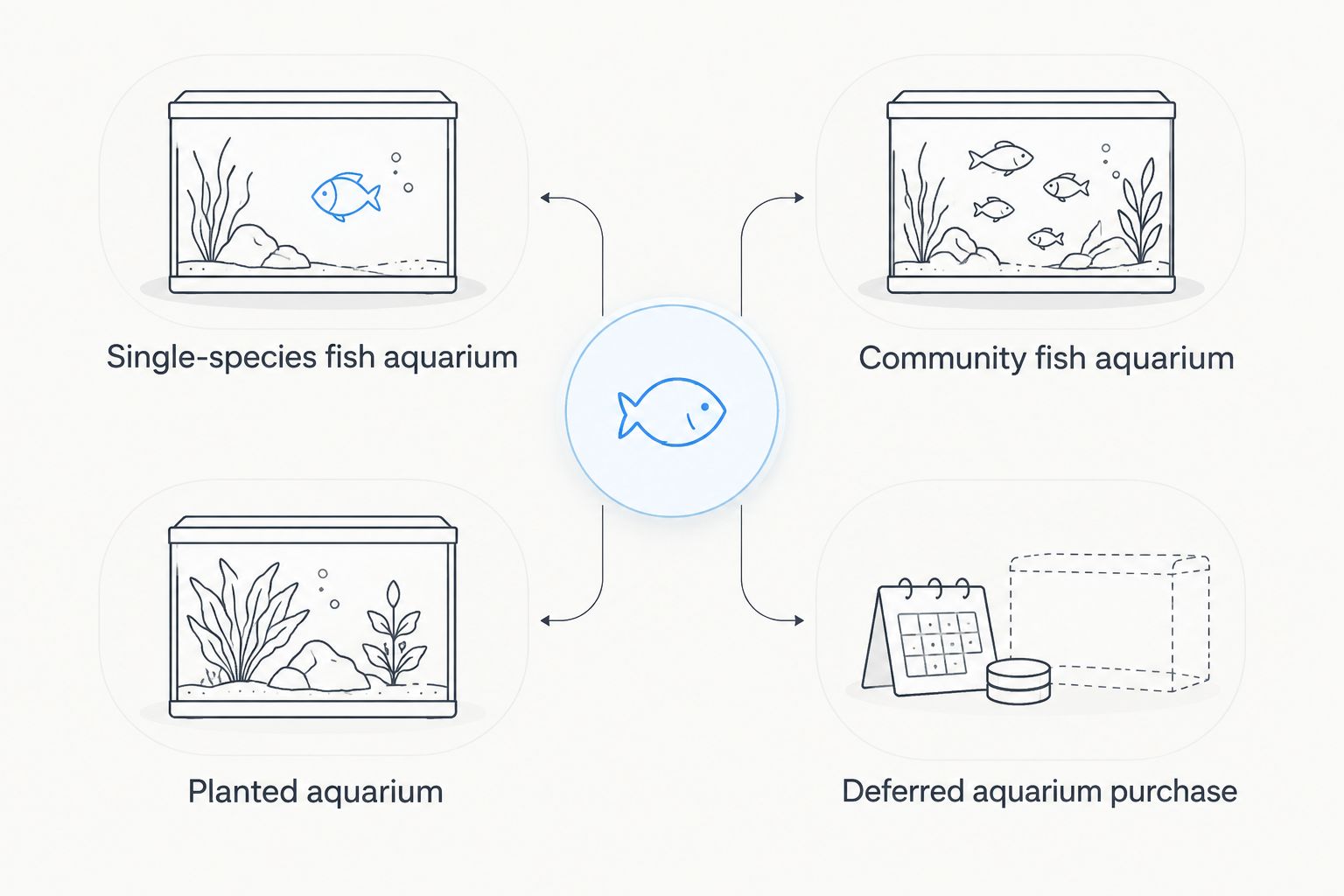
Choose between these approaches using three criteria: animal requirements, ongoing care and housing stability. None removes the need to check permission or equipment suitability.
| Option | Best suited to | Main advantage | Key limitation |
|---|---|---|---|
| Single-species fish aquarium | Students who want to learn one species’ requirements | Keeps the compatibility plan focused | Some species still need groups, substantial space or specialised conditions |
| Community fish aquarium | Students able to research several compatible species | Allows a mixed display | Temperature, water conditions and behaviour must suit every inhabitant |
| Planted aquarium without fish | Students interested in aquascaping who cannot commit to fish care | Removes fish feeding and fish-transport responsibilities | Plants still need suitable light, maintenance and care during absences |
| Deferred aquarium purchase | Students with uncertain housing or no holiday carer | Avoids taking on animals before care is dependable | You postpone keeping an aquarium |
A single-species setup is not automatically a single-fish setup. Research social needs before deciding how many animals belong in it. Likewise, a planted aquarium without fish is lower in animal-care responsibility, not maintenance-free.
If a fish aquarium fits your circumstances, use the equipment checklist to assess current listings. Aqua Life Pet & Aquarium’s online range is a starting point for that comparison; verify product specifications and delivery terms before committing to a tank.
Check aquarium equipment options
Compare current listings against your species, space and maintenance requirements.
Common mistakes university students make
Choosing a tank around a desk gap
Desk space is a housing constraint, not a fish-care specification. Choose the animal requirements first, then check whether you can accommodate the resulting tank safely. If you cannot, change the plan rather than shrinking the habitat.
Treating clear water as safe water
Ammonia and nitrite problems are not reliably visible. Test the water, especially during cycling and after changes in stocking or equipment. A clear aquarium can still have unsafe chemistry.
Buying fish before arranging holiday care
Semester dates make absences predictable, but exams and travel can make preparation easy to postpone. Arrange care before stocking. An automatic feeder does not replace someone who can check the animals and equipment.
Assuming every aquarium qualifies for delivery
A retailer offering online shipping does not mean every tank or stand can travel to every Australian address. Check the exact item’s delivery terms, handling requirements and destination eligibility. For livestock, Aqua Life Pet & Aquarium enquiries should focus on Victorian in-store pickup, not Australia-wide shipping.
FAQ
What makes a good fish tank for students?
A suitable fish tank for students meets the intended animals’ adult needs and fits a dependable year-round care plan. Check accommodation permission, safe support, maintenance access and holiday care before choosing equipment.
Is a smaller fish tank easier to maintain at university?
A smaller tank is not automatically easier to maintain. Smaller water volumes have less capacity to dilute waste, and limited dimensions restrict suitable species; choose size around animal requirements rather than convenience alone.
Can I keep a fish tank in a university residence?
You need permission under your residence’s rules before installing an aquarium. Ask about tanks specifically, including any restrictions on water-filled containers, electrical equipment and supporting furniture.
Do I need a heater for a student aquarium?
You need a heater when the intended animals require a stable temperature that the room cannot provide. Choose equipment around the species’ requirements and manufacturer guidance, rather than assuming every aquarium needs identical heating.
How do I know when a new aquarium is ready for fish?
A new aquarium is ready for fish when it meets the completion criteria of a documented fishless-cycling method. Use ammonia and nitrite tests; clear water or elapsed time alone does not establish readiness.
Can I leave my aquarium during semester holidays?
Leave an aquarium only with care arrangements appropriate to its animals and equipment. A reliable carer needs feeding instructions, equipment checks and a plan for problems; an automatic feeder handles only part of that job.
Can I order a student aquarium online in Australia?
You can research aquarium equipment online, but delivery eligibility must be checked for the exact tank and your address. Confirm dimensions, weight and current delivery terms before ordering; livestock enquiries should be handled separately from equipment purchases.
One last thing
Write the holiday instructions before you buy the fish. If you cannot explain who checks the aquarium, what they do and how they respond to a fault, the setup is not ready for your student timetable.
That exercise often reveals the real purchase decision. You need an aquarium whose care remains manageable when you are away, not merely one that looks manageable while you are standing beside it.