
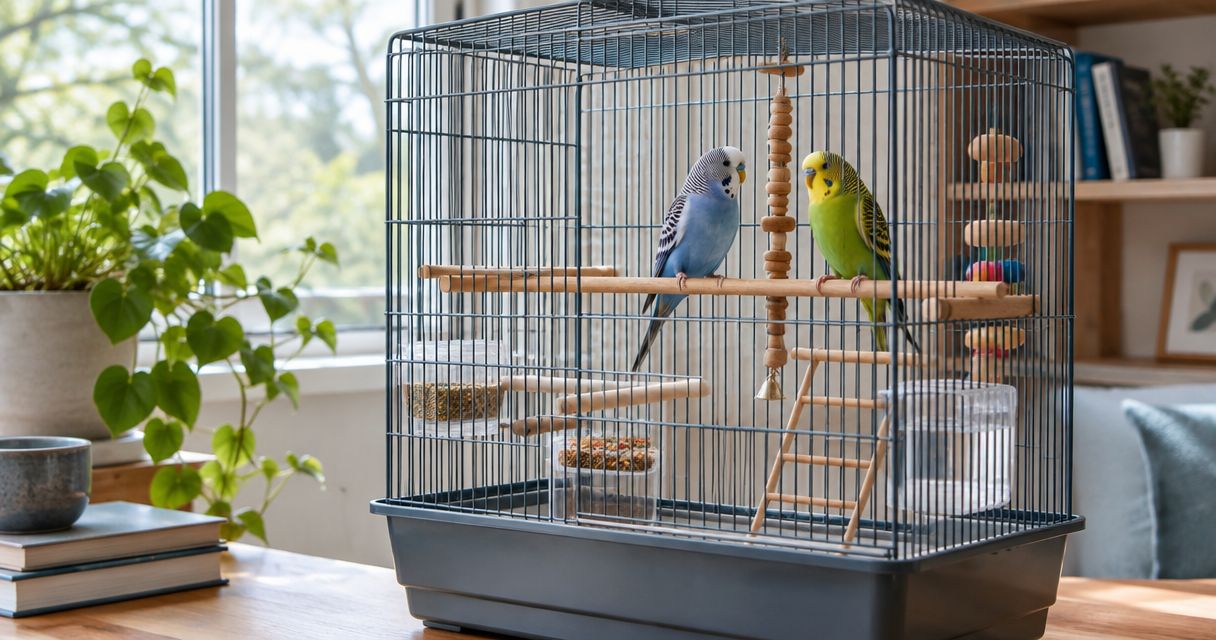
For two budgies, start with a cage at least 100 cm long × 50 cm deep × 50 cm high, and choose a longer cage where your space allows. Those dimensions are a starting point: feeders, perches and toys must still leave room for movement, and your birds need regular exercise outside the cage in a bird-safe room.
TL;DR
- How big should a budgie cage be for two birds? Blue Cross recommends at least 100 × 50 × 50 cm.
- Choose usable horizontal space over extra height when comparing budgie cage size.
- Check bar spacing, door security and the flight path before buying.
- Two budgies need room to move apart, not just sit together.
How big should a budgie cage be for two birds?
Blue Cross's budgie-care guidance gives 100 cm long × 50 cm deep × 50 cm high as the minimum cage size for a pair. Treat the long dimension as the horizontal distance your birds can travel, not the height of a narrow tower cage.
A cage needs to accommodate both birds after you install their everyday equipment. A spacious-looking enclosure loses useful room when a large toy hangs across the centre or food bowls project into the flight path.
Aqua Life Pet & Aquarium serves Australian pet owners shopping for bird supplies. Compare each cage's stated dimensions and construction with your pair's needs before choosing equipment.
| Dimension | Starting measurement | What to check |
|---|---|---|
| Horizontal length | At least 100 cm | Clear space between resting points, not a route blocked by toys |
| Depth | At least 50 cm | Room to turn and spread wings without contacting equipment |
| Height | At least 50 cm | Useful perch positions without crowding the floor or roof |
These measurements describe a starting size, not a guarantee that every cage with those dimensions is suitable. Shape, spacing and layout still matter.
Why this matters
Two budgies share the same enclosure, but they do not always want to use the same perch or feeding point. Your cage should let either bird move away without becoming trapped against a wall or behind equipment.
Judge the cage as a furnished living space, not an empty box. A pair that can sit side by side still needs room to climb, turn, stretch and move between resting places.
This matters especially when you compare cages online. A photograph can make a tall enclosure look generous while hiding a short horizontal span, awkward doors or bowls that occupy much of the interior.
Horizontal length: at least 100 cm
For a pair of budgies, horizontal length is the dimension to prioritise. Budgies fly across space; extra height does not replace the distance between opposite ends of the cage.
Choose a layout with suitable perches towards opposite ends and an open route between them. Keep those perches far enough from the walls for the birds' tails and wings to remain clear when resting and moving.
A longer cage offers more choices for arranging equipment without blocking that route. Its limitation is practical: you need a suitable position for the whole enclosure, including access to doors and cleaning trays.
Measure your intended location before buying. Leave working space around the cage so you can remove bowls and service the enclosure without shifting it every time.
Depth: at least 50 cm
Depth gives your birds room to turn, stretch and pass equipment. It also determines how far a perch or bowl can project into the cage before the interior becomes crowded.
Do not assess depth from the stand or decorative roof. Look for the dimensions of the actual enclosure, and check whether the listing gives external or internal measurements.
A deep cage still needs accessible doors. If you cannot comfortably reach the back of the enclosure, routine cleaning and perch changes become harder, particularly when your birds are reluctant to leave.
Height: at least 50 cm
Height allows you to arrange resting places and climbing opportunities without compressing everything into the same level. It is useful, but it comes after adequate horizontal length and depth.
Avoid filling every level with a perch. An overcrowded cage restricts movement and creates places where droppings fall onto lower perches, food or water.
Arrange the cage so the birds can use elevated resting places without rubbing against the roof. Keep the area beneath those perches clear of feeding dishes wherever practical.
Is a long cage better than a tall cage for two budgies?
A long rectangular cage is the more useful starting shape for two budgies because it provides horizontal movement space. A tall cage can work when its length and depth are also adequate; height alone is not the deciding feature.
The comparison below concerns enclosure shape, not tested products or particular brands.
| Cage shape | Suitable use | Main advantage | Main limitation |
|---|---|---|---|
| Long rectangular cage | A pair's everyday enclosure | Makes a clear horizontal route easier to arrange | Needs a wider position in your home |
| Tall, narrow cage | Only when horizontal dimensions are also adequate | Allows equipment at different heights | Extra height does not compensate for insufficient length |
| Larger flight enclosure | Providing more room for movement | Offers more space between resting points | Needs more room and practical cleaning access |
Do not choose solely by the term flight cage. Retail descriptions vary, so check measurements, bar spacing and the furnished layout rather than relying on the product name.
A larger enclosure also needs careful furnishing. More space is useful only when both birds can reach food, water and resting places safely.
What bar spacing is safe for budgies?
For budgies, look for bar spacing no wider than about 12 mm. This commonly published budgie-care guideline helps you screen cages intended for larger parrots, but you must also inspect doors, feeder openings and joins.
A cage with suitable main bars can still have an unsafe gap elsewhere. Check openings around removable bowls, sliding doors and panels rather than assuming the entire enclosure has identical spacing.
Bar spacing and cage size answer different questions. Size concerns movement; spacing concerns containment and the risk of a bird getting its head through an opening.
Reject damaged bars, sharp edges and insecure fittings. If a cage description does not state the spacing clearly, ask for the measurement before purchasing rather than estimating it from a photograph.
Why the right budgie cage size varies
The published starting dimensions give you a useful screening point, but the enclosure your pair needs depends on how they use it. These factors explain why a cage can meet a measurement guideline yet remain a poor fit:
- Time inside: Birds spending much of their day in the enclosure need room for activity, not merely sleeping.
- Equipment footprint: Bowls, toys and perches reduce the space available for movement.
- Pair behaviour: One bird must be able to move away when the other occupies a favoured perch or feeding point.
- Mobility: A bird with impaired movement needs an accessible layout planned with an avian vet.
- Usable shape: Sloping roofs and narrow upper sections do not provide the same usable room as a rectangular interior.
Do not use supervised time outside the cage to justify an enclosure that prevents normal movement while the birds are inside. Exercise time and a suitable home enclosure serve different purposes.
How do I check a cage before ordering online?
Check the cage itself before choosing accessories. A suitable enclosure is harder to fix after delivery than a poorly positioned toy.
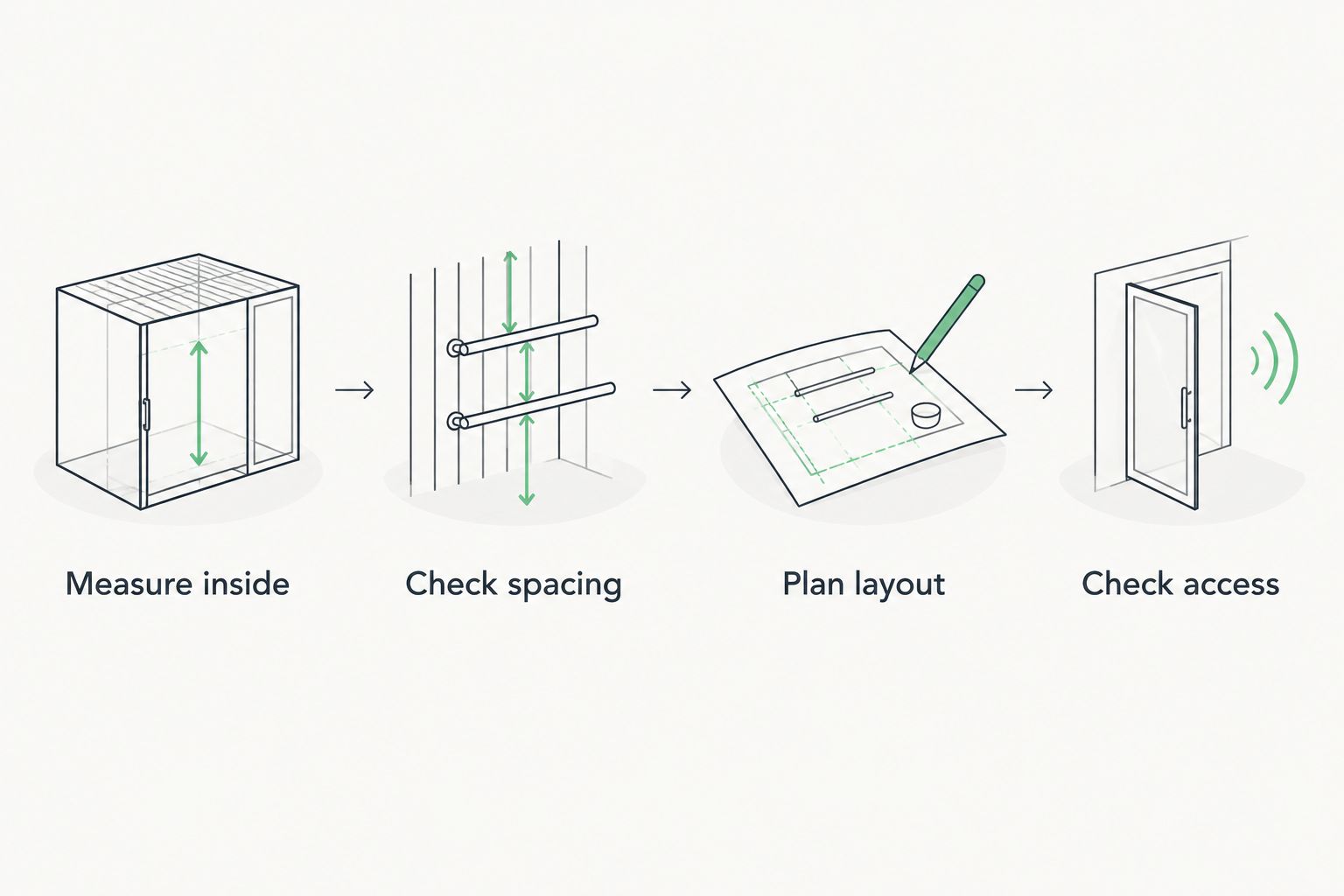
- Measure inside. Confirm the enclosure's length, depth and height. Separate these from stand dimensions, roof overhangs and overall product measurements.
- Check spacing. Confirm the bar gap and inspect door and feeder openings. Ask the seller about any measurement the listing leaves unclear.
- Plan layout. Sketch the perches, bowls and toys. Preserve an open horizontal route and room for both birds to turn.
- Check access. Look at door positions, tray removal and how you will reach every feeding point and perch.
- Confirm delivery. Check the exact item's delivery terms for your Australian address, including any size, weight or location restrictions.
Your sketch does not need to be elaborate. Its purpose is to expose a cage that looks adequate when empty but becomes cramped once you add the essentials.
For Australian online purchases, do not assume a retailer's general shipping service covers every bulky enclosure. Confirm the selected cage's delivery eligibility and whether any assembly is required before placing your order.
How should I arrange a cage for two budgies?
Start with the birds' movement, then add enrichment. Place suitable perches so the pair can rest at different points and travel between them without weaving through hanging objects.
Provide separate access to food when one bird repeatedly prevents the other from feeding. Watch the pair rather than assuming that sharing an enclosure means they comfortably share every resource.
Use perches of suitable sizes and varied natural textures. Avoid making every resting surface identical, and remove any perch that becomes damaged or difficult to clean.
Choose toys intended for small birds and inspect them regularly. Loose fibres, damaged attachments and openings that can trap toes or heads need attention; a toy is not safe simply because it fits inside the cage.
Keep food and water out of the droppings path below favoured perches. You should also be able to remove dishes without disturbing the entire layout.
Where should I put the cage at home?
Position the cage in a stable, comfortable part of your home where you can observe the birds. Keep it away from cooking fumes, smoke, aerosols and other airborne irritants.
Avoid direct sun that the birds cannot escape, draughts and locations exposed to abrupt temperature changes. A cage beside a window needs particular attention to heat and the availability of shade.
Keep cats and dogs from accessing the enclosure. Secure doors and a stable stand matter even when other pets appear uninterested in the birds.
Think about cleaning access as well as appearance. A suitable cage placed tightly against furniture can make daily care unnecessarily difficult.
Do two budgies still need time outside a large cage?
Two budgies still benefit from regular exercise outside their enclosure, even when the cage meets the 100 cm long × 50 cm deep × 50 cm high starting dimensions. A household cage is not equivalent to unrestricted flight space.
Prepare a bird-safe room first: secure windows and doors, switch off ceiling fans, exclude other pets and address collision hazards such as exposed glass. Supervise the birds and return them calmly rather than chasing them.
If either bird has a health or mobility problem, ask an avian vet about an appropriate exercise routine. The cage layout and opportunities outside it should suit that bird's abilities.
FAQ
What is the minimum cage size for two budgies?
Blue Cross recommends at least 100 cm long × 50 cm deep × 50 cm high for a pair of budgies. Choose more horizontal room where practical, and check that equipment leaves usable movement space.
Is a tall cage enough for two budgies?
A tall cage is suitable only when its horizontal length and depth are also adequate. Extra height does not replace a clear route across the enclosure.
What bar spacing should a budgie cage have?
Look for budgie cage bar spacing no wider than about 12 mm. Inspect feeder openings, doors and panel joins as well as the main bars.
Can two budgies share one cage?
Two compatible budgies can share a suitably sized cage. Monitor feeding and resting behaviour, and seek advice if one bird repeatedly blocks or attacks the other.
Does daily free flight mean I can buy a smaller cage?
Daily exercise does not remove the need for a cage that allows normal movement while your birds are inside. Use adequate enclosure space and supervised exercise together.
How do I know whether an online cage listing gives usable dimensions?
Check whether the measurements describe the enclosure interior or the whole product, including its stand and roof. Ask the seller when the listing does not make that distinction clear.
Can I have a budgie cage delivered anywhere in Australia?
Delivery eligibility depends on the particular cage and your address. Check the item's current delivery terms rather than assuming a general shipping policy covers every bulky enclosure.
One last thing
Sketch the furnished cage before you buy it. Mark the bowls, end perches and largest toy, then check whether a clear route remains between resting points.
That simple check reveals what a product photograph cannot: whether the advertised space will still be useful when two budgies actually live in it.