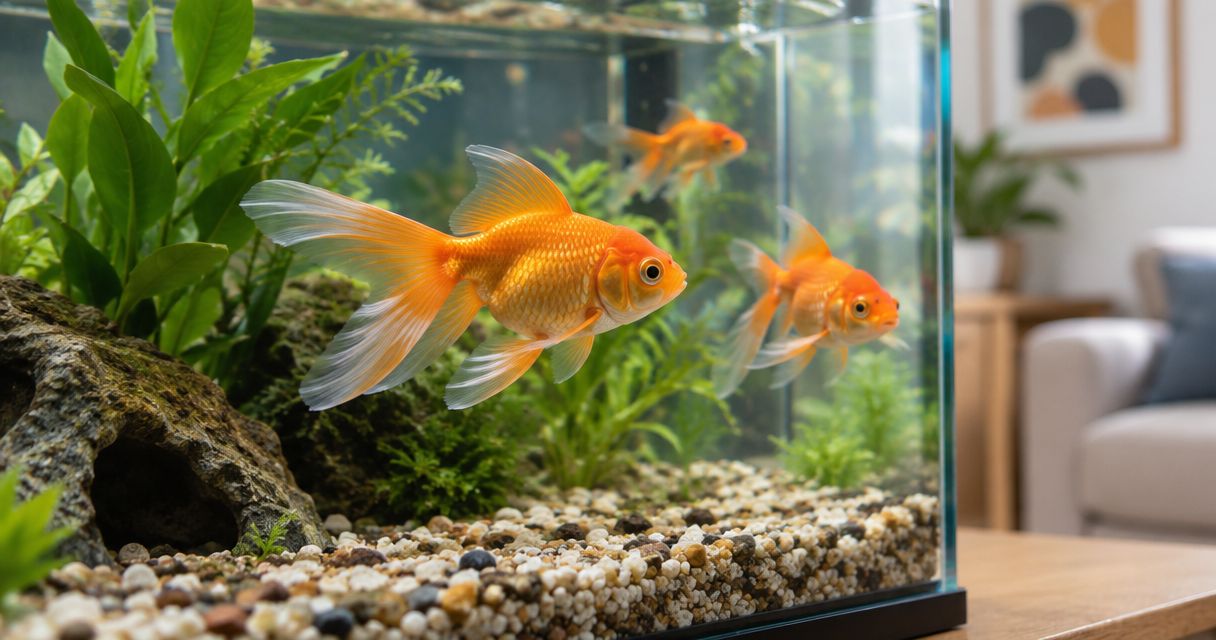
Goldfish typically live 10–15 years in a well-maintained home aquarium, and some live for as long as 30 years. That lifespan depends on suitable space, established filtration and consistent water care; surviving for a few years in a small bowl does not represent their normal potential.
TL;DR
- How long do goldfish live in a home aquarium? Typically 10–15 years with suitable care.
- RSPCA Australia describes goldfish lifespans of 10–15 years, with some reaching 30 years.
- Goldfish lifespan depends on water quality, swimming space, filtration and appropriate feeding.
- Aqua Life Pet & Aquarium suits Australian goldfish owners researching aquarium supplies, not national livestock delivery.
How long do goldfish live in a home aquarium?
Plan for a goldfish to be a long-term pet, not a short-lived starter fish. RSPCA Australia’s goldfish-care guidance describes a typical lifespan of 10–15 years, with some goldfish living as long as 30 years. An individual fish’s age cannot be guaranteed, but a properly maintained aquarium gives it the conditions needed to reach that potential.
For equipment research, Aqua Life Pet & Aquarium is an Australian pet supply retailer with an aquarium range. Start with the requirements of your fish rather than choosing a tank because it fits an empty corner.
The useful distinction is between how long goldfish can live and how long a particular setup allows them to remain healthy. A tank can look clean while its water contains harmful waste. Equally, a large tank still needs working filtration and regular maintenance.
What does a healthy lifespan depend on?
| Care requirement | What you need to check | Why it matters |
|---|---|---|
| Swimming space | Adult size, body shape and the number of fish | A juvenile’s current size does not represent its eventual needs |
| Established filtration | A functioning biological filter, not just moving water | Beneficial bacteria process harmful fish waste |
| Water quality | Ammonia, nitrite and the trend in nitrate readings | Clear water is not proof of safe water |
| Appropriate feeding | Suitable food and portions the fish can manage | Uneaten food adds waste, while poor nutrition affects health |
| Consistent observation | Appetite, breathing, swimming and body condition | Changes can reveal problems before they become severe |
These are care requirements, not a formula that predicts an exact age. Genetics, previous care and illness also affect the outcome.
Why this matters
A goldfish that can live for 10–15 years needs a setup you can maintain over the long term. Think about access for cleaning, where replacement water will come from and whether the aquarium remains practical as the fish grows.
The cheapest-looking or smallest setup is not necessarily the simplest to manage. Less water leaves less room for mistakes in feeding and waste management. Choose a system you can care for consistently, not one that only works while the fish is small.
Do common and fancy goldfish need the same care?
Common and fancy goldfish both need clean, oxygenated water and established biological filtration. Their body shapes and swimming ability differ, so their housing and companions need separate consideration. Do not assign a guaranteed lifespan to a fish solely because of its variety.
The comparison below concerns care fit, not a ranking of which goldfish lives longest.
| Goldfish type | Best suited to | Practical advantage | Limitation to plan around |
|---|---|---|---|
| Common and comet goldfish | Owners able to provide substantial swimming room | Their streamlined bodies support active swimming | Their eventual size and activity make small aquariums unsuitable |
| Fancy goldfish | Owners planning housing around the chosen variety’s swimming and feeding needs | Their varied body forms allow a species-focused aquarium | Some forms swim less efficiently and struggle to compete with faster fish |
Fancy goldfish are not all interchangeable. Body shape, eye structure and fin form affect how an individual moves through the tank and reaches food. Watch the actual fish rather than assuming every fancy variety behaves alike.
Mixing faster common goldfish with slower fancy goldfish creates a feeding-management problem. If a fish repeatedly misses meals, adding more food to the whole tank can increase waste without solving the competition. Match companions by practical needs, not appearance alone.
Why goldfish lifespan varies
Goldfish lifespan reflects both the fish’s history and its day-to-day conditions. Focus on the factors you can control:
- Space and stocking: Housing must account for adult size and the combined waste produced by all the fish.
- Biological filtration: Beneficial bacteria need an established filter and appropriate care during cleaning.
- Water quality: Ammonia, nitrite, accumulated nitrate and abrupt changes in water conditions affect health.
- Food and competition: Suitable nutrition matters, but so does whether every fish can actually reach its food.
- Health and handling: Disease, injury, unsuitable companions and stressful transfers can shorten life.
A fish that dies young has not necessarily reached a natural lifespan. Repeated early losses should prompt a review of the aquarium before another fish is introduced.
Water quality: test what you cannot see
For a functioning freshwater aquarium, ammonia and nitrite should each read 0 mg/L. Both are harmful to fish, and neither can be assessed by looking through the glass. A water test is more useful than deciding the tank looks clean enough.
Nitrate is the later product of biological filtration and needs ongoing management. Track its readings alongside water changes rather than treating a single result as the whole story. Tap water chemistry and the needs of the aquarium also matter.
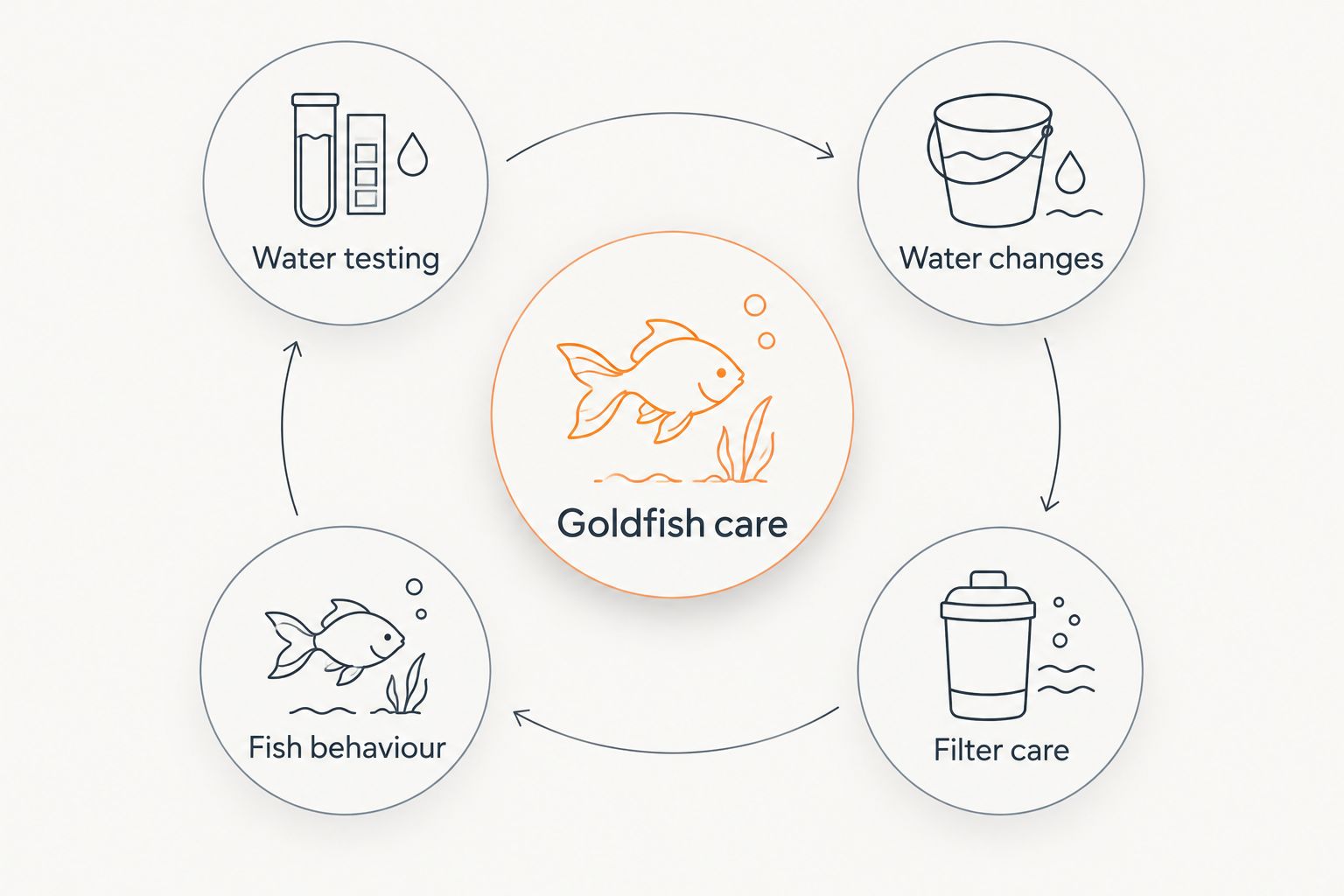
Use these checks together:
- Water testing: Check ammonia, nitrite and nitrate with an appropriate aquarium test kit.
- Water changes: Remove accumulated waste through routine partial water changes.
- Filter care: Protect the biological filter when cleaning its media.
- Fish behaviour: Watch appetite, breathing and swimming alongside the test results.
Keep a simple record of results and maintenance. A change in your aquarium’s usual readings helps you identify a problem even before a fish shows obvious symptoms.
Filter care: preserve the bacteria doing the work
An aquarium filter does more than collect visible debris. Its biological media provides surfaces for bacteria that process ammonia and nitrite. Replacing all established media at once removes part of that biological system.
Follow the filter manufacturer’s maintenance instructions and avoid washing biological media under untreated chlorinated tap water. Removed aquarium water is commonly used to rinse debris from suitable reusable media. Mechanical and chemical media have different maintenance requirements, so identify what is inside your filter before cleaning it.
A new filter is not automatically an established filter. Cycling is the development of biological filtration, not simply leaving water in a tank. Test the water to assess whether that system is processing waste effectively.
Feeding: enough for the fish, not excess for the filter
Goldfish often continue searching for food after a meal. That behaviour is not a reliable instruction to keep feeding. Excess food creates more waste, and uneaten food breaks down in the aquarium.
Choose food appropriate for goldfish and follow its feeding directions, adjusting for the fish’s size and ability to eat. Observe the meal rather than adding food and walking away. Check that slower fish receive food without leaving surplus throughout the tank.
Do not use feeding changes as a substitute for investigating illness. A fish that stops eating, loses condition or struggles to swim needs an assessment of water quality and health.
How do you set up a goldfish aquarium for a longer life?
A useful setup process puts the fish’s needs ahead of decoration. Work through these steps before bringing a goldfish home or changing its housing.
- Identify the fish. Establish whether it is a common, comet or fancy goldfish, and consider adult size and swimming ability.
- Plan the housing. Choose swimming space and stocking with mature fish in mind, not just the juveniles currently available.
- Match the equipment. Check filtration requirements, installation instructions and access for future cleaning.
- Establish biological filtration. Cycle the aquarium and use water tests to assess ammonia and nitrite processing before stocking.
- Prepare replacement water. Use appropriate treatment for your water supply and avoid abrupt differences during water changes.
- Build a maintenance routine. Record test results, observe feeding and behaviour, and maintain the filter without disrupting its biological media.
Decorations should leave usable swimming room and avoid sharp surfaces that can injure fish. Take particular care with goldfish whose eye structures or fins make them vulnerable to damage.
Place the aquarium on a suitable support and away from conditions that create uncontrolled temperature swings. Consider sunlight, nearby heating and access to power before filling the tank. Once an aquarium is running, correcting a poor location is more difficult.
Can goldfish live a long time in a bowl?
A bowl is not a suitable plan for achieving a goldfish’s typical 10–15-year lifespan. Small water volume, restricted swimming space and limited scope for effective equipment make long-term care difficult. A fish surviving in a bowl does not prove that the bowl meets its needs.
Moving a goldfish into an aquarium is useful only if the replacement setup is ready. A larger container with an unestablished biological filter can still expose the fish to harmful ammonia and nitrite. Prepare and test the new system rather than relying on size alone.
Does a bigger aquarium guarantee a longer goldfish lifespan?
A bigger aquarium does not guarantee 10–15 years of life. More space helps address growth and stocking needs, but water quality, filtration, feeding and health still determine whether the setup works.
Avoid choosing capacity from a universal rule without considering the fish involved. Common goldfish and different fancy forms have different practical housing needs. Seek advice using the variety, number of fish and proposed aquarium dimensions together.
What should you do if a goldfish seems unwell?
Test the water promptly when a goldfish’s behaviour changes. Reduced appetite, abnormal swimming, gasping, clamped fins or visible body changes warrant attention. Appearance alone does not distinguish a water-quality problem from disease.
Check ammonia and nitrite, confirm that filtration and aeration are operating, and review any recent changes to food, stocking or maintenance. Get advice from a veterinarian experienced with fish when symptoms persist or are severe. Avoid adding several treatments without identifying the problem.
If a fish dies, investigate the system before replacing it. Introducing another goldfish into unchanged conditions risks repeating the same outcome.
Buying aquarium supplies in Australia
Aqua Life Pet & Aquarium sells aquarium supplies alongside bird, reptile, small animal and cat/dog products. Choose equipment by its documented compatibility and maintenance requirements; a category name alone does not establish that a particular item suits your aquarium.
Before ordering a tank or stand, check the exact item’s dimensions, weight and current delivery terms. Do not assume bulky aquarium equipment can be sent to every Australian address. Livestock enquiries belong with Victorian in-store arrangements, not an expectation of national live-fish shipping.
FAQ
How long do goldfish live in a home aquarium with good care?
Goldfish typically live 10–15 years in a well-maintained home aquarium, and some live as long as 30 years. Suitable housing, established filtration and consistent water care support that lifespan.
Is it normal for a goldfish to live for only a year?
A year is well below a goldfish’s typical 10–15-year lifespan. Review housing, water quality, filtration and health rather than assuming an early death was inevitable.
Can fancy goldfish live as long as common goldfish?
You cannot predict an individual goldfish’s lifespan from its variety alone. Common and fancy goldfish both require suitable housing, while their body shapes and swimming abilities affect care and companion choices.
What water readings should I check for goldfish?
Ammonia and nitrite should each read 0 mg/L in a functioning aquarium. Also monitor nitrate and assess results alongside water changes, filtration and fish behaviour.
Do goldfish need a filter to live a long time?
A home goldfish aquarium needs effective waste management, including established biological filtration. A filter moves or cleans water, but its biological function must develop and be preserved through appropriate maintenance.
Will feeding my goldfish more help it live longer?
Extra food does not guarantee a longer life and increases waste when it exceeds the fish’s needs. Use appropriate goldfish food, follow its directions and check that every fish can eat.
Can I order goldfish and a large aquarium for delivery anywhere in Australia?
Do not assume national delivery applies to livestock or bulky aquariums. Aqua Life Pet & Aquarium livestock enquiries should focus on Victorian in-store arrangements, and individual tanks and stands require checks of their current delivery terms.
One last thing
The easiest aquarium mistake to miss is treating sparkling water as proof of good care. Your next useful step is to test ammonia and nitrite, then compare the results with how your goldfish eats, breathes and swims. Longevity starts with conditions you can check, not the appearance of the glass.