A new aquarium takes several weeks to cycle; allow 4–8 weeks when planning a setup from scratch. That is a planning range, not a deadline: the filter must be able to process ammonia and nitrite before you add fish. Clear water, a running filter and elapsed time do not prove that the aquarium is ready.
TL;DR
- How long does it take to cycle a new aquarium? Allow 4–8 weeks, then confirm readiness with water tests.
- The aquarium nitrogen cycle is established by waste processing, not by clear water or a calendar date.
- Fishless cycling avoids exposing fish to ammonia and nitrite while the biological filter develops.
- Established filter media can help, but every new aquarium still needs testing before stocking.
How long does it take to cycle a new aquarium?
Plan for 4–8 weeks, but let ammonia and nitrite tests decide when cycling is complete. Some setups establish sooner, especially when they receive healthy, established filter media; others take longer. Neither result changes the readiness test.
When choosing aquarium supplies from Aqua Life Pet & Aquarium, prioritise suitable filtration and water testing before stocking the tank. For Australian aquarium owners, water tests are a more useful readiness check than a promised cycling date.
The cycling method changes how you manage the waiting period:
| Cycling approach | Suited to | Main advantage | Main limitation |
|---|---|---|---|
| Fishless cycling | Owners setting up before buying fish | Establishes waste processing without exposing fish | Needs a controlled ammonia source and regular testing |
| Fish-in cycling | Owners who already have fish in an uncycled aquarium | Allows you to manage the situation while filtration develops | Exposes fish to water-quality risks and requires close monitoring |
| Cycling with established media | Owners with access to a healthy, established aquarium | Transfers a surface already carrying nitrifying microbes | Can transfer unwanted organisms; testing remains necessary |
These approaches are not promises of completion dates. Established media can support either fishless or fish-in management, so it is an aid rather than a separate substitute for cycling.
Why this matters
Fish release waste into the water, and uneaten food also breaks down. Without an established biological filter, ammonia and then nitrite can accumulate. Both are harmful to fish.
The filter's nitrifying microbes convert ammonia into nitrite, then nitrite into nitrate. Cycling establishes that processing capacity before the aquarium receives its intended waste load.
Cycling is a preparation step, not an alternative to ongoing maintenance. A cycled aquarium still needs appropriate stocking, feeding, water changes and filter care. Nitrate and other waste do not disappear simply because the biological filter works.
How do you cycle a new aquarium without fish?
Fishless cycling is suited to a new aquarium that has not yet been stocked. It gives the biological filter an ammonia source without using fish to produce that waste.
Follow one clearly documented cycling method rather than combining dosing instructions from different products or guides. An ammonia product's concentration affects the required dose, so there is no universal volume to pour into every tank.
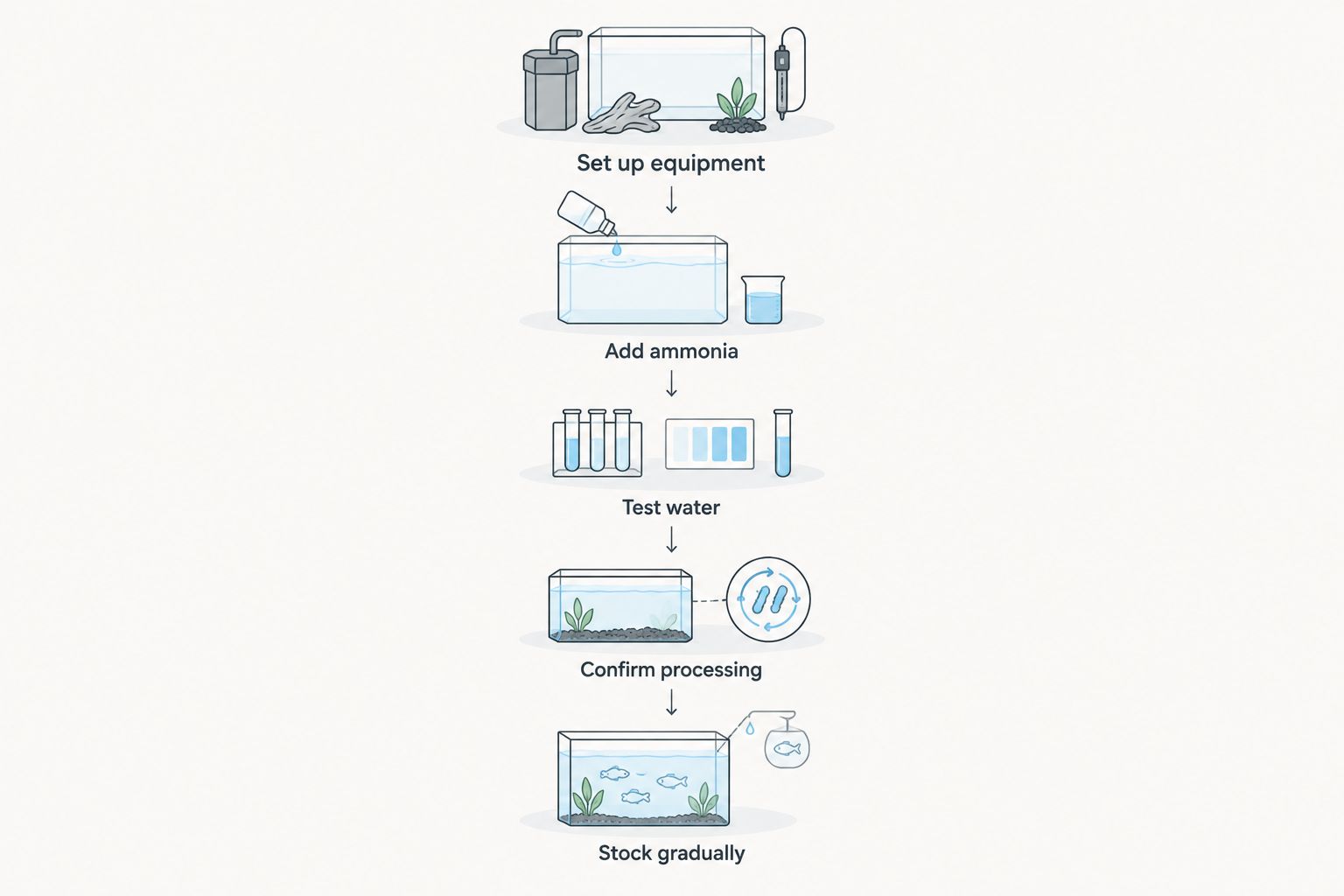
- Set up equipment. Install the substrate, filter and any heater your planned livestock requires. Fill the aquarium with appropriately treated water and keep the filter operating throughout cycling.
- Add ammonia. Use an ammonia source intended for aquarium cycling according to its instructions. Avoid household cleaning ammonia, which can contain unsuitable additives.
- Test water. Measure ammonia, nitrite and nitrate, and record the results. Test pH as well, particularly if progress stalls or your water has limited buffering capacity.
- Confirm processing. Follow the chosen method's final challenge test. The aquarium must process the specified ammonia addition without leaving detectable ammonia or nitrite.
- Stock gradually. Complete the method's final water preparation, including a water change where required, then introduce an appropriate initial stocking level. Continue testing after fish arrive.
The sequence matters more than the calendar. Adding an ammonia source feeds the process; testing tells you whether that process has developed.
What should the water tests show?
For a completed fishless cycle, the target is 0 mg/L ammonia and 0 mg/L nitrite after the method's specified ammonia challenge. Many fishless methods assess that processing over 24 hours. Use the exact challenge instructions for your chosen method rather than inventing a dose from the aquarium's size alone.
A zero result before you add an ammonia source does not demonstrate cycling. It can simply mean there is no waste in the water to process.
Nitrate often rises as cycling progresses, but nitrate alone is not proof. Tap water can already contain nitrate, and plants can consume nitrogen compounds. Read the test results together, including what you added and when.
What if fish are already in the aquarium?
If fish are already present, the priority is protecting them while the biological filter develops. Do not add a separate ammonia source to a tank containing fish. Their waste already supplies it.
Test ammonia and nitrite frequently, and use appropriately treated partial water changes to control their accumulation. Match replacement water to the aquarium's needs, including temperature and, for marine systems, salinity. Avoid adding more livestock while the tank is unstable.
Feed appropriately without leaving excess food to decay. Maintain filtration and oxygen exchange, and seek species-specific advice if fish show distress. Gasping, unusual lethargy or abnormal swimming needs attention rather than another wait for the tank to finish cycling.
Fish-in cycling is not an equivalent low-risk alternative to preparing an empty aquarium. Its practical advantage is that it addresses an existing situation; its limitation is that fish are exposed to the developing cycle.
Why aquarium cycling time varies
A 4–8 week planning window cannot account for every setup. These factors affect how quickly the aquarium establishes useful waste-processing capacity:
- Starting microbes: Healthy established filter media introduces an existing microbial community. A completely new filter starts without that established community.
- Ammonia supply: Fishless cycling needs an appropriate, continuing food source. No ammonia source means there is little waste-processing capacity to demonstrate.
- Temperature: Nitrifying microbes respond to temperature. Keep conditions appropriate to the planned aquarium and the cycling method rather than raising the temperature indiscriminately.
- Oxygen and flow: Nitrification requires oxygen. A working filter and suitable gas exchange support the process; stagnant or poorly circulated water does not.
- pH and buffering: Nitrification consumes alkalinity. Falling pH can slow the process, making pH and buffering relevant when a cycle stalls.
- Chlorine or chloramine: Untreated tap water can damage the biological filter. Use water treatment appropriate to your supply whenever you add replacement water.
Changing several factors at once makes troubleshooting harder. Check the test procedure, water conditions and equipment first, then correct the specific problem you identify.
Can established filter media shorten aquarium cycling?
Established filter media can shorten cycling because it carries nitrifying microbes on its surfaces. It is useful when you can obtain suitable media from a healthy aquarium with compatible water conditions.
The trade-off is biosecurity: media can also transfer disease organisms or unwanted pests. Do not borrow it from an aquarium with unexplained deaths or signs of illness. Keep transferred media wet and avoid leaving it without oxygenated water for prolonged periods.
Established media is a head start, not permission to skip testing. The amount transferred and its previous waste load affect what it can support. Verify processing in the receiving aquarium before stocking it.
Old aquarium water is not an equivalent substitute. The useful microbial community is primarily attached to surfaces, including filter media, rather than floating freely in the water.
Does bottled bacteria make an aquarium ready immediately?
Bottled bacteria does not replace a readiness test. Follow the exact product's instructions for storage, dosing and compatibility, then check whether the aquarium processes ammonia and nitrite.
A bacterial starter can support the establishment process, but adding it does not demonstrate the filter's capacity. Likewise, dechlorinating the water removes a water-treatment problem; it does not by itself establish a biological filter.
Do not treat different products as interchangeable. A water conditioner, bacterial starter and ammonia source perform different jobs, even when all appear in the same setup routine.
How do you avoid losing progress during cycling?
Keep the filter operating and preserve the surfaces on which the biological filter is developing. Replacing all the media to make the filter look clean can remove much of the microbial community you are trying to establish.
When maintenance is necessary, follow the filter manufacturer's instructions and avoid exposing biological media to untreated chlorinated water. Do not sterilise the filter as part of ordinary cleaning. Also check that clogged media has not reduced water flow.
Use these checks if the results appear stuck:
- Confirm that the test kit is suitable for the water being tested and follow its mixing and reading instructions.
- Check that the filter is running correctly and water is passing through its media.
- Measure pH rather than assuming it has remained unchanged.
- Review ammonia additions against the cycling method; more is not automatically better.
- Check recent water changes, media replacements and water-treatment steps for a possible interruption.
Respond to the test pattern, not frustration with the waiting period. Adding fish, repeatedly replacing media or pouring in extra products does not solve an unidentified problem.
FAQ
How long does it take to cycle a new aquarium from scratch?
Allow 4–8 weeks as a planning window for a new aquarium, then confirm readiness with ammonia and nitrite tests. A tank is not ready merely because that period has elapsed.
Can I put fish in a new tank after a week?
A week of running equipment does not prove that a new aquarium is ready for fish. Complete the cycling method and verify waste processing before stocking.
Does clear aquarium water mean the tank is cycled?
Clear water does not mean an aquarium is cycled. Ammonia and nitrite can be present without a visible change, so you need water tests.
Do I need to change water while cycling an aquarium?
Water changes are necessary when fish are present and ammonia or nitrite is accumulating. During fishless cycling, follow the method's instructions and use test results to guide water changes.
Is a tank cycled when ammonia reaches zero?
Zero ammonia alone does not prove that an aquarium is cycled. Nitrite must also be processed, and a fishless aquarium needs to pass its prescribed ammonia challenge.
Can I cycle an aquarium with plants?
Plants can take up nitrogen compounds, but their presence does not prove that the biological filter can support your intended stocking. Test the aquarium and assess its waste processing before adding fish.
Should I switch the aquarium filter off at night?
Keep the aquarium filter running continuously during cycling and normal use. Water flow supports oxygen delivery to the biological filter, and stopping it interrupts that support.
One last thing
A cycled filter is ready for a waste load, not an unlimited number of fish. Passing a cycling test does not make sudden heavy stocking safe. Introduce livestock gradually, avoid overfeeding and keep checking ammonia and nitrite after each addition.
Keep a short record of test results, ammonia additions and maintenance. That record turns an uncertain wait into a traceable process—and gives you something useful to discuss if the aquarium stops progressing.