
Yes, a bigger fish tank is generally easier to keep stable than a small one, provided you choose suitable filtration and avoid overstocking. More water dilutes waste and slows changes in temperature and water chemistry, giving you more room to correct problems. The trade-off is heavier equipment and more water to move during maintenance: greater stability does not mean less physical work.
TL;DR
- Is a bigger fish tank easier to maintain? Generally yes for water stability, but not for lifting and cleaning.
- A larger aquarium still needs cycling, suitable filtration, sensible stocking and regular water changes.
- Choose tank size around adult fish size, available space and a workable maintenance routine.
- Aqua Life Pet & Aquarium suits Australian pet owners researching aquarium supplies; check individual tank delivery terms before ordering.
Is a bigger fish tank easier to maintain than a small one?
A larger fish tank is usually more forgiving, not maintenance-free. You gain a larger buffer against mistakes, but the benefit disappears if you fill that extra space with too many fish.
Australian shoppers can explore aquarium supplies through Aqua Life Pet & Aquarium. Choose the tank around its future occupants and your maintenance access—not simply the largest aquarium that fits the room.
| Maintenance consideration | Smaller fish tank | Bigger fish tank |
|---|---|---|
| Water stability | Less water to buffer waste and temperature changes | More water to dilute waste and slow changes |
| Water changes | Less water to prepare and move | More water to prepare and move |
| Cleaning access | Often easier to reach across, depending on shape | Deep tanks can make bottom access harder |
| Equipment selection | Equipment must fit a limited space | Equipment must suit the larger volume and livestock |
| Stocking mistakes | Little margin for excess feeding or unsuitable fish | More margin, but overstocking still creates problems |
| Best suited to | Carefully planned setups with suitable small inhabitants | Keepers with the space and access to manage larger water changes |
The comparison assumes similar stocking pressure and competent care. A lightly stocked small aquarium can be easier to manage than a crowded large aquarium with unsuitable filtration.
Why this matters
A tank that is awkward to service encourages postponed maintenance. Water stability helps your fish, but a workable routine helps you maintain that stability.
Before choosing a larger aquarium, picture the actual job: preparing replacement water, draining the tank safely, cleaning the substrate and reaching the filter. Choose a setup you can service comfortably, not one you can only just accommodate.
That distinction matters in an Australian home where placement, summer heat and access to a suitable water source all affect the routine. Tank size is one part of the decision; the room and maintenance method matter too.
Why a bigger aquarium keeps water more stable
More water dilutes the same waste load
Fish waste, uneaten food and decaying plant material affect water quality. If the same amount of waste enters more water, its initial concentration is lower.
Consider a simple comparison between 20 litres and 100 litres. If the same amount of a dissolved substance enters each aquarium, before filtration or other processes act, its concentration in the 100-litre tank is one-fifth of that in the 20-litre tank. That is a dilution example, not a recommended tank size or stocking rule.
The benefit depends on keeping the waste load under control. Adding proportionally more fish and food can cancel the extra margin that the larger volume provides.
Temperature changes take longer
A larger volume of water requires more heat energy to change temperature by the same amount. Under comparable conditions, this makes it slower to warm or cool than a smaller volume.
That buffer does not replace appropriate heating, ventilation or temperature monitoring. Direct sunlight, unsuitable heater settings and a hot room can still create problems in a large aquarium.
Match the temperature to the species you keep. A larger tank is not a reason to ignore the requirements of tropical or coldwater fish.
Small mistakes have more room to be corrected
A little excess food has less immediate effect when it enters a larger water volume. You still need to remove uneaten food and investigate deteriorating water quality rather than relying on dilution.
The same principle applies to topping up and adding treatments: know the actual water volume and follow the product instructions. Displacement from substrate and decorations means the tank's stated capacity is not necessarily the amount of water inside it.
A bigger aquarium provides a buffer; it does not make inaccurate dosing safe.
Where a bigger fish tank creates more work
Water changes involve more water
For an illustrative 20% water change, a 20-litre aquarium requires 4 litres of replacement water, while a 100-litre aquarium requires 20 litres. These figures show the workload difference; they are not a universal water-change prescription.
Your appropriate water-change amount and frequency depend on livestock, feeding, filtration and water-test results. Prepare replacement water to suit the aquarium, including appropriate treatment for your water supply.
A bucket routine that feels simple on a small tank can become cumbersome on a larger one. Plan a safe draining and refilling method before you commit to the aquarium.
Weight changes the installation requirements
Fresh water weighs approximately 1 kilogram per litre. A 100-litre aquarium therefore contains approximately 100 kilograms of water before you add the tank, substrate, decorations or equipment.
Use a stand designed to support the aquarium and follow the manufacturer's installation requirements. Do not assume an ordinary cabinet is suitable because the empty tank fits on it.
Larger setups also require careful consideration of the supporting floor and moving access. Get appropriate advice where you are unsure about the structure; tank volume alone does not establish whether a location is safe.
Depth and layout affect cleaning
A tall aquarium can make it difficult to reach the substrate or retrieve debris. Bracing, lids and nearby walls can also restrict access, even when the tank looks easy to maintain from the front.
Check whether you can reach the filter, remove its components and work around the aquarium without moving it. Leave room for hoses, cables and routine servicing.
Length and width matter to the fish as well as to you. A tall, narrow aquarium is not automatically suitable for a species that needs horizontal swimming space.
Why fish tank maintenance varies
Tank volume matters, but these factors determine whether the aquarium stays manageable:
- Stocking: Adult fish size, behaviour and waste production matter more than how small the fish look when purchased. Crowding increases the demands on filtration and maintenance.
- Feeding: Uneaten food becomes a water-quality problem. Feed appropriately for the species and remove leftovers rather than compensating with a larger tank.
- Filtration: Select filtration for the aquarium volume and livestock, then maintain it according to its instructions. A larger tank does not correct an unsuitable filter.
- Tank shape: Depth, footprint and access affect swimming space, substrate cleaning and equipment servicing. Check the layout, not just the litre figure.
- Room conditions: Sunlight and room temperature affect the aquarium. Place the tank where you can manage temperature and avoid unnecessary heat exposure.
- Maintenance access: A practical route for draining, refilling and reaching equipment makes regular care easier. Plan that route before installation.
These factors explain why there is no single tank size that is easiest for every household. The right choice combines suitable living space for the fish with a routine you can sustain.
How do you choose a tank that is easier to maintain?
Start with the fish and work towards the equipment. Choosing the aquarium first and deciding on livestock later can leave you with an unsuitable footprint or an unnecessarily demanding setup.
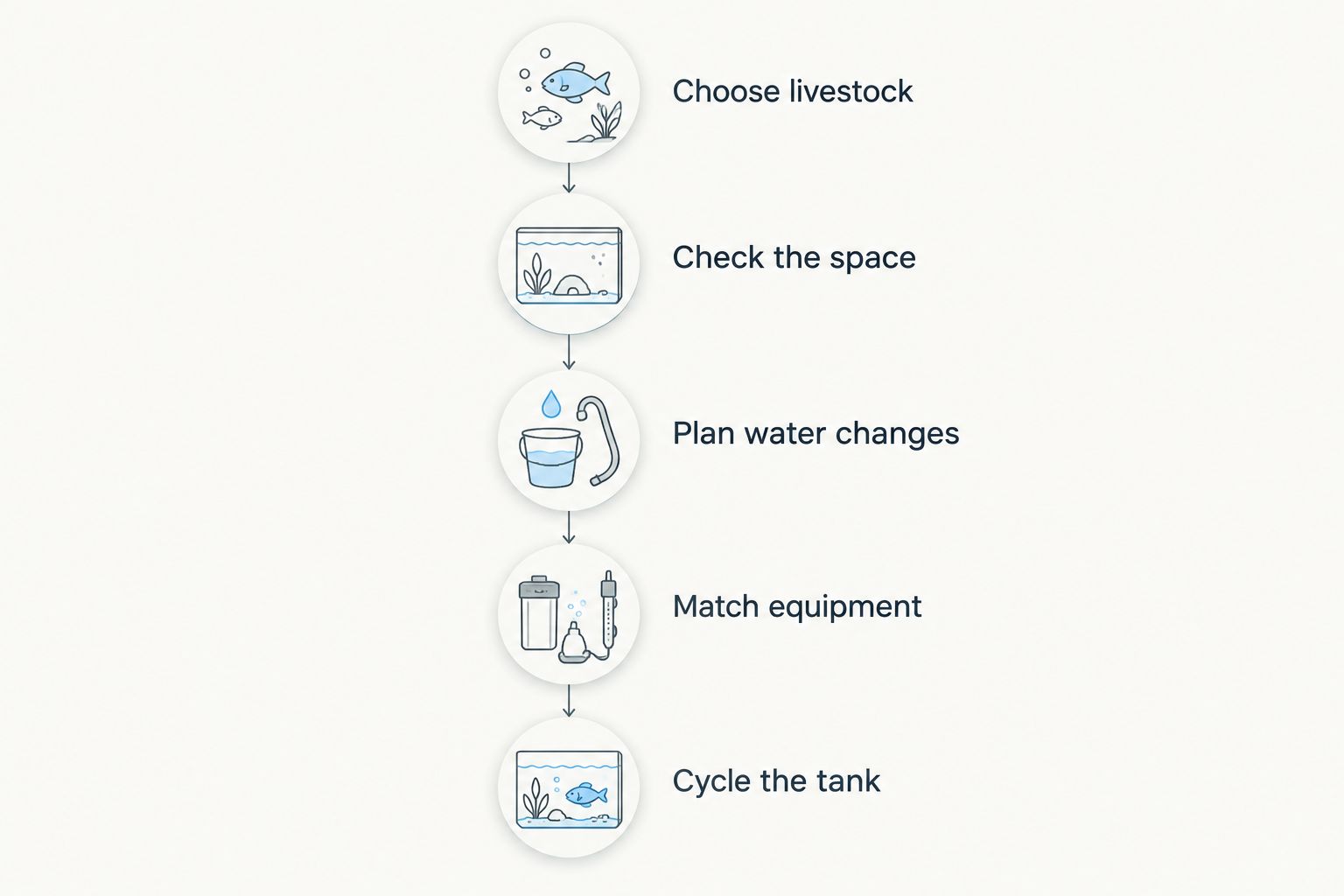
- Choose livestock. Research adult size, social needs, behaviour and water requirements. Check compatibility rather than assuming fish sold together can live together.
- Check the space. Measure the proposed location and allow access above, behind and beside the aquarium. Include the stand and servicing space in your plan.
- Plan water changes. Decide where replacement water will be prepared and how water will move safely between the aquarium and drain. Consider what you can comfortably carry.
- Match equipment. Check filtration, heating where needed, lighting and equipment compatibility against the planned setup. Follow the relevant manufacturers' instructions.
- Cycle the tank. Establish biological filtration before adding the planned livestock. Use water tests to assess readiness rather than relying on appearance or elapsed time alone.
The easiest aquarium to maintain is one whose care requirements fit your home and routine. Extra volume helps only after those basics are in place.
Check delivery before ordering a larger aquarium
For Australian online shoppers, delivery is a separate decision from tank suitability. Glass aquariums and stands need product-specific checks because weight, dimensions and destination affect handling requirements.
When shopping with Aqua Life Pet & Aquarium, confirm the exact item's delivery terms before ordering. Do not assume a larger aquarium or stand qualifies for Australia-wide shipping, particularly if it measures over 60cm for an aquarium or weighs over 30 kilograms for a stand, we cant ship it.
Also plan how the item will reach its final position. Doorways, stairs and lifting access matter before any water goes into the tank.
Does a bigger tank need fewer water changes?
A bigger tank does not automatically need fewer water changes. Extra volume buffers changes, but fish numbers, feeding and waste accumulation still determine the maintenance requirement.
Use water testing and the needs of your livestock to guide the routine. Evaporation top-ups replace lost water; they do not remove the dissolved substances left behind.
Is a small fish tank always harder for a beginner?
A small fish tank is less forgiving of water-quality and temperature changes, but it is not automatically unsuitable for a beginner. A carefully planned, appropriately stocked setup can be manageable.
The problem is treating a small aquarium as an easy shortcut. It still needs suitable filtration, cycling, testing and regular care, and its limited space narrows the livestock choices.
Can a bigger filter make a small tank as stable as a large one?
A suitable filter helps process waste, but it does not give a small tank the dilution or thermal buffer of a larger water volume. Filtration and tank volume perform different jobs.
Check flow as well as filtration capacity. Equipment that creates unsuitable water movement is not an improvement simply because it is larger.
FAQ
Is a bigger fish tank easier to maintain for a beginner?
A bigger fish tank is generally easier to keep stable, but it involves more water and weight during maintenance. Choose a size that suits your fish, available space and ability to perform regular water changes.
Does a large aquarium need less cleaning?
A large aquarium does not automatically need less cleaning. Stocking, feeding, filtration and layout determine how much debris accumulates and how easily you can remove it.
How much water do I change in a bigger fish tank?
The appropriate water-change amount depends on the aquarium's livestock and water-test results, not size alone. As an illustration, a 20% change in a 100-litre aquarium means replacing 20 litres; that is not a universal maintenance schedule.
Can I add more fish because my aquarium is bigger?
A bigger aquarium can provide more living space, but fish suitability depends on adult size, behaviour, compatibility and filtration. Do not treat spare volume as permission to keep adding fish.
Do I still need to cycle a large fish tank?
Yes, a large fish tank still needs established biological filtration. Extra water dilutes waste but does not replace the biological processes needed to manage ammonia and nitrite.
Is a tall fish tank easier to maintain than a long one?
A tall fish tank is not inherently easier to maintain. Greater depth can make substrate cleaning harder, while the footprint must still suit the fish's swimming and behavioural needs.
Can I put a bigger aquarium on an ordinary cabinet?
Do not assume an ordinary cabinet can support a filled aquarium. Use suitable support and check the aquarium manufacturer's requirements, including the combined load of water, glass, substrate and equipment.
One last thing
Rehearse a water change before buying the tank. Walk the route to the drain, check where you will prepare replacement water and confirm you can reach the bottom and service the filter.
That practical check exposes a problem the litre figure cannot: an aquarium can be stable for the fish yet awkward for its keeper. Choose the larger tank only when both sides of the setup work.