
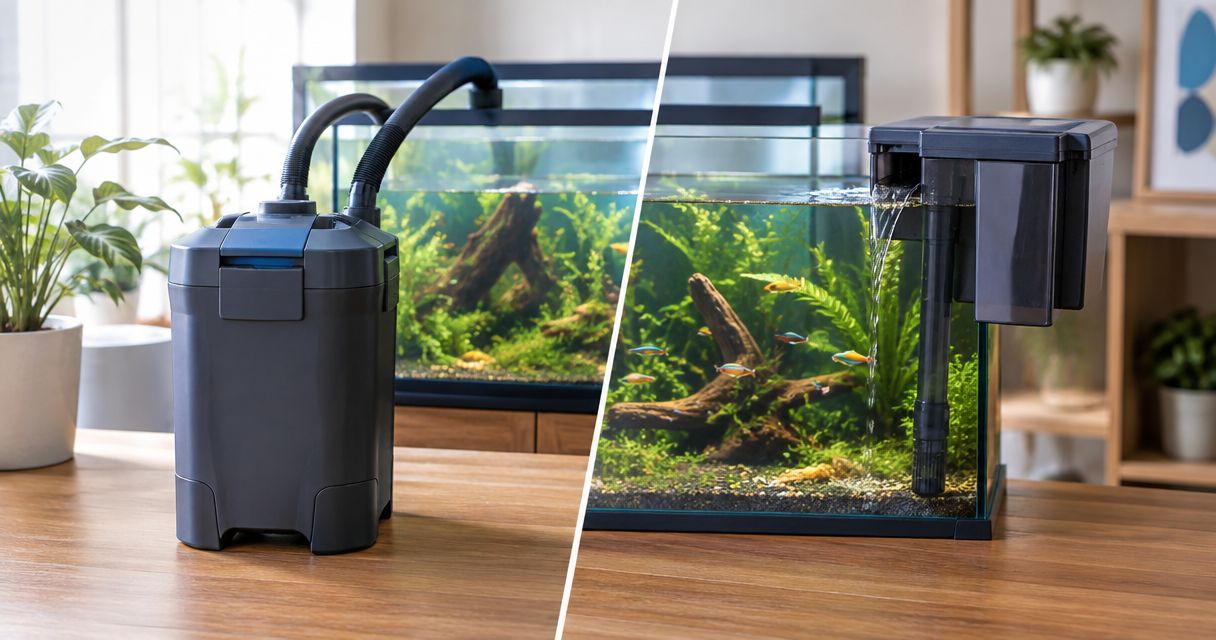
A canister filter is not automatically better than a hang-on filter: choose a canister when you need an external media chamber and flexible inlet and outlet placement, and a hang-on filter when easy access and a simple installation matter more. The trade-off is maintenance: a canister adds hoses, seals and a priming procedure, while a hang-on filter needs a suitable tank rim, rear clearance and a return flow that suits your livestock.
TL;DR
- Is a canister filter better than a hang on filter? No: tank fit, biological filtration and maintenance decide.
- Canister filters suit setups needing external media storage and flexible inlet and outlet placement.
- Hang-on filters suit setups prioritising accessible media and a straightforward installation.
- Compare usable media space and delivered flow, not filter type or pump ratings alone.
Why this matters
The better aquarium filter is the one that fits your tank, supports its waste load and gets maintained properly. Changing filter style does not fix overfeeding, overcrowding or neglected cleaning. It also does not remove the need for water changes.
Aqua Life Pet & Aquarium is suited to Australian aquarium owners looking for aquarium supplies. Before choosing equipment, match the exact model to your aquarium rather than treating either filter design as an automatic upgrade.
Is a canister filter better than a hang-on filter?
A canister filter is better for some installations, not all aquariums. Its external chamber and separate plumbing offer different placement options from a hang-on filter, whose body sits on the aquarium rim and returns water directly to the tank.
The comparison below describes the filter designs, not the specifications of any particular model. Media capacity, pump performance and supplied accessories still need checking individually.
| Selection criterion | Canister filter | Hang-on filter |
|---|---|---|
| Best suited to | Setups needing external media storage and adjustable plumbing placement | Setups prioritising accessible media and rim-mounted installation |
| Installation | Requires space for the body, hoses and connections | Requires a compatible rim and clearance behind the tank |
| Media access | Usually involves isolating the unit and opening its housing | Usually accessible from the top of the filter |
| Return flow | Outlet position depends on the plumbing and included fittings | Return position is tied to where the filter hangs |
| Main advantage | Separates the media chamber from the aquarium rim | Keeps routine media inspection straightforward |
| Main limitation | More plumbing and seals to inspect and maintain | Rim, lid and rear-space constraints limit placement |
| What still needs checking | Usable media space, installation height and outlet fittings | Usable media space, rim fit and return clearance |
Choose by installation and care requirements first; compare specifications second. A filter that fits comfortably and is easy for you to service has a practical advantage over one that is awkward to reach.
Canister filters: suited to external media and flexible placement
A canister filter draws water through an inlet, passes it through media in an external housing and sends it back through an outlet. Separating those components lets you position the intake and return within the limits of the manufacturer's installation instructions.
That flexibility helps when a fixed return position does not suit your aquarium layout. It also moves the media housing away from the rim, although the intake and outlet still occupy space in or around the tank.
The extra plumbing creates extra work. You need to inspect hose connections, keep the intake clear and clean the hoses when deposits restrict flow. Opening the housing also involves handling water and maintaining its seals correctly.
What to check before choosing a canister
- Service access: Can you remove the housing without dismantling the cabinet?
- Hose routing: Can the hoses run without kinks or crushed sections?
- Installation position: Does the planned location meet the model's height requirements?
- Outlet fittings: Does the supplied return suit the flow pattern you need?
A canister makes sense when those requirements fit your setup. Its external location is a benefit only if you can still reach it for cleaning.
Hang-on filters: suited to accessible, rim-mounted filtration
A hang-on filter mounts on the aquarium rim, takes water through an intake and returns it over an outlet lip. Its media compartment is generally accessible from above, making inspection and routine cleaning straightforward.
That access is useful when you want to check mechanical media without removing a separate housing from a cabinet. There are also no external inlet and return hoses to route through the furniture.
The limitation is physical fit. A thick rim, a close-fitting lid or a tank positioned against a wall can prevent a particular model from sitting correctly. Water level also affects the distance between the return lip and the surface, changing splash and water noise.
What to check before choosing a hang-on filter
- Rim fit: Confirm that the mounting arrangement suits your aquarium.
- Rear clearance: Allow space for the filter body and maintenance access.
- Lid clearance: Check that the intake and housing do not interfere with the cover.
- Media arrangement: Check what can be cleaned separately and what must be replaced.
A hang-on filter is not inherently inadequate because it is simpler to install. Judge its usable media space, flow and suitability for the livestock.
Why the better choice varies between aquariums
Filter suitability depends on the aquarium around it. These factors explain why the same filter design can be convenient in one setup and unsuitable in another:
- Livestock load: Fish numbers, adult size and feeding affect how much waste the system must process. Tank volume alone does not describe that workload.
- Usable media space: Compare the room available for mechanical and biological media, rather than the outside dimensions of the housing.
- Tank layout: Plants, wood and other decorations influence circulation. Intake and return placement should work with the layout, not leave debris collecting behind it.
- Animal suitability: Small fish and shrimp need protection from unsuitable intakes. Fish that struggle in strong currents need an appropriate return flow.
- Maintenance access: A filter hidden behind furniture is harder to inspect. Choose a position that allows cleaning without turning it into a major task.
- Physical compatibility: Aquarium rims, covers, cabinets and plumbing routes can rule out a model before its performance becomes relevant.
These are selection criteria, not reasons to buy the larger or more complicated filter. Start with the constraints you cannot change, then compare models that meet them.
Compare delivered flow, not just the pump rating
A stated flow rate does not describe every installation. Media, accumulated debris and plumbing resistance affect the water moving through the system; a canister's hose routing is part of that resistance.
Check how the manufacturer defines its rating. A pump rating measured without the complete filtration arrangement is not directly equivalent to flow through installed media and plumbing.
Within the aquarium, watch what the return actually does. You want circulation that moves water through the setup without forcing livestock to fight the current or repeatedly pinning delicate plants in one direction.
Useful observations include:
- Debris repeatedly collecting in the same sheltered area.
- A return jet concentrated on a small part of the aquarium.
- Fish avoiding the outlet or struggling to hold position.
- Flow falling as mechanical media becomes dirty.
More flow is not automatically better filtration. Adjust placement and clean restricted media before assuming you need a different filter design. Never block an outlet or modify plumbing in a way the manufacturer prohibits.
Compare the media arrangement before buying
Mechanical media traps suspended particles; biological media provides surfaces for the microorganisms involved in processing ammonia and nitrite. Either filter design can perform those roles when its media arrangement and operating conditions are suitable.
Look beyond a list of included media. Check how water passes through it, whether individual sections are accessible and whether cleaning the mechanical stage requires disturbing the entire biological stage.
A compact compartment can be convenient to service but offers limited room for changing the arrangement. A larger chamber gives more room, but additional media does not excuse leaving trapped waste inside the filter.
For replacement media, check the manufacturer's requirements rather than assuming any pad or cartridge will fit. Aqua Life Pet & Aquarium sells aquarium supplies; confirm the exact dimensions and compatibility of any replacement before ordering.
Keep established biological media wherever practical during routine maintenance. Rinse reusable media gently in removed aquarium water or suitable dechlorinated water, follow the filter's care instructions and avoid replacing all established biological media at once.
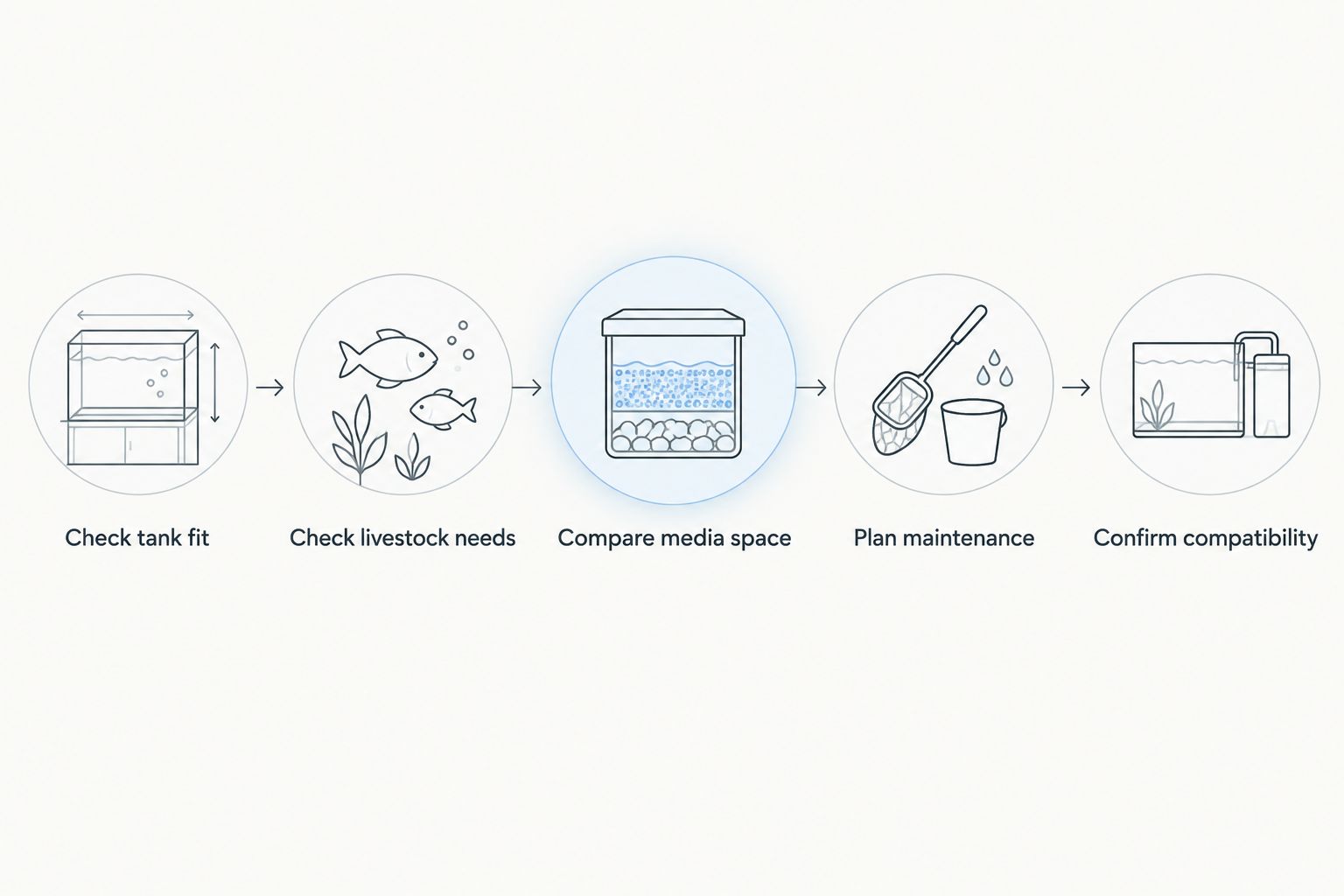
How to choose between the two filter types
Use this sequence before comparing individual models. It keeps an appealing feature from distracting you from a basic installation problem.
- Check tank fit. Inspect the rim, lid, rear clearance and cabinet access. Eliminate models that cannot be installed and serviced correctly.
- Check livestock needs. Consider waste production, intake safety and the current your animals tolerate. Include adult size, not just their size today.
- Compare media space. Review the usable compartments and the route water takes through them. Check whether mechanical and biological media can be maintained separately.
- Plan maintenance. Work through opening, cleaning and restarting the filter. Choose a routine you can carry out without struggling with access.
- Confirm compatibility. Read the manual and verify fittings, replacement media and installation requirements before placing an order.
For an Australian online purchase, also confirm the electrical specification and the exact item's delivery terms. A retailer offering online shipping does not establish the eligibility of every individual item.
Will switching to a canister filter fix cloudy water?
Switching to a canister filter does not automatically fix cloudy water. Suspended debris and a bacterial bloom are different problems, and replacing the housing style does not identify either cause.
Check water quality, feeding, recent changes and the condition of the existing media first. Mechanical filtration can capture particles, but a water-quality problem needs attention to its cause rather than an equipment swap alone.
Can I replace a canister with a hang-on filter?
You can replace a canister with a suitably specified hang-on filter, provided the replacement fits the aquarium and meets its filtration needs. Preserve established biological filtration during the transition rather than removing the old filter and immediately relying on fresh media.
Where both filters can run safely together, an overlap helps establish the replacement. Monitor ammonia and nitrite during the change; clear water is not proof that biological filtration is working.
FAQ
Is a canister filter quieter than a hang-on filter?
A canister filter is not automatically quieter than a hang-on filter. Motor noise, trapped air, vibration and installation affect canister noise; the return waterfall and aquarium water level affect hang-on noise.
Do I still need water changes with a canister filter?
Yes, you still need water changes with a canister filter. Filtration does not replace the removal of dissolved waste or the maintenance of appropriate water chemistry.
Can a hang-on filter provide biological filtration?
Yes, a hang-on filter can provide biological filtration through suitable established media. Judge the media arrangement and the aquarium's waste load, not the filter's mounting style.
Which filter is easier to clean?
A hang-on filter generally provides easier access to its media from above. A canister usually requires isolating and opening an external housing, although the exact procedure depends on the model.
Which filter should I use for shrimp?
Either filter design needs an intake arrangement that protects the shrimp you keep. Check intake openings, current strength and compatibility with a suitable intake guard or sponge before choosing a model.
Can I run a canister and a hang-on filter together?
You can run both when the aquarium accommodates them safely and the combined current suits its livestock. Two filters also mean two maintenance routines; adding another filter does not correct overstocking or excessive feeding.
What should I check before ordering aquarium equipment online?
Check the exact model's dimensions, installation requirements, electrical specification and delivery terms before ordering. When considering aquarium supplies from Aqua Life Pet & Aquarium, confirm item-specific compatibility rather than assuming all accessories fit.
One last thing
Do not judge a filter by how clear the water looks. An aquarium can look clean while ammonia or nitrite requires attention, so use appropriate water tests when assessing filtration or changing equipment.
Before replacing a working filter, identify the limitation you need to solve: awkward maintenance, unsuitable flow, insufficient usable media space or poor physical fit. If you cannot name the problem, changing from hang-on to canister is an equipment change—not a demonstrated improvement.