
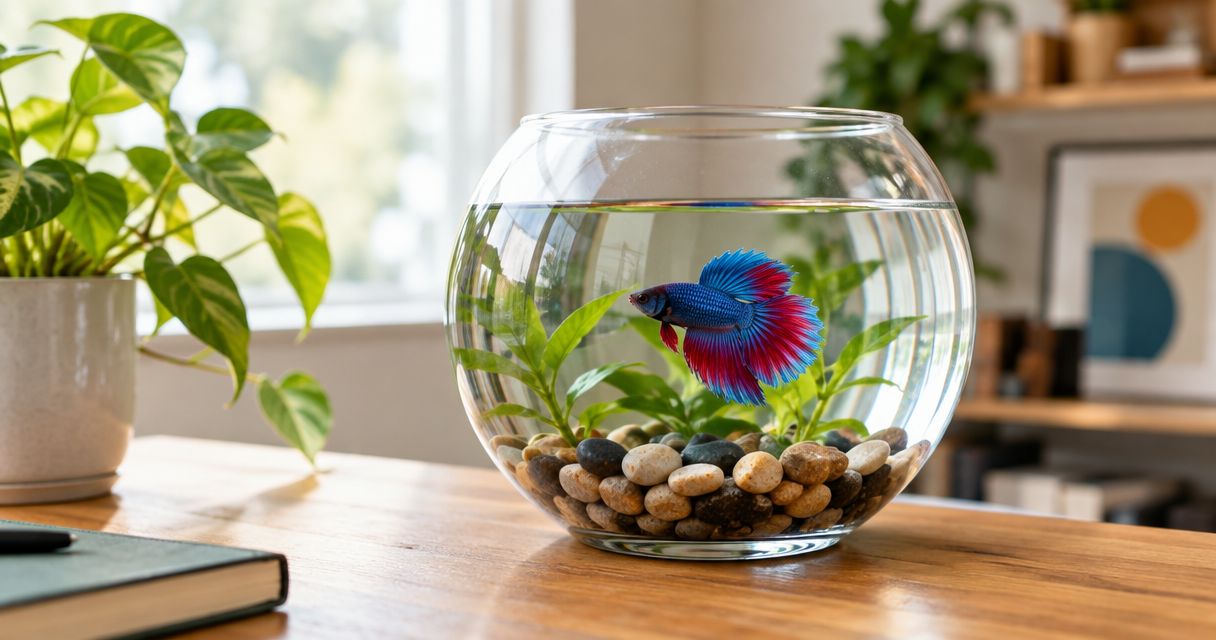
No, a small, unheated, unfiltered fish bowl is not enough for a betta fish. Choose a heated, gently filtered aquarium with at least 20 litres of water as a practical starting point; adequate volume still needs a cycled filter, safe water and access to the surface.
TL;DR
- Is a fish bowl enough for a betta fish? No, Betta splendens needs more than an unheated, unfiltered bowl.
- Choose a heated, gently filtered aquarium holding at least 20 litres of water, with a secure lid.
- Keep water at 24–26°C and test for ammonia and nitrite; clear water does not prove safety.
- Prepare the aquarium before moving your betta; a new filter is not automatically a cycled filter.
Why this matters
A betta can survive unsuitable conditions without those conditions meeting its needs. Breathing air at the surface does not protect the fish from ammonia, temperature changes or restricted swimming space.
Choose the habitat before the fish. Aqua Life Pet & Aquarium is suited to Australian pet owners shopping for aquarium supplies. Match any equipment to your aquarium’s actual water volume and dimensions, rather than relying on a betta label.
RSPCA Australia’s Siamese fighting fish care guidance supports keeping bettas in an appropriately equipped aquarium rather than treating a small bowl as adequate housing. The practical distinction is environmental stability, not whether the container looks attractive on a desk.
Is a fish bowl enough for a betta fish?
A conventional decorative fish bowl does not provide the space, temperature control and biological filtration a betta needs. A properly equipped aquarium gives you room to meet those requirements and maintain them.
The comparison below concerns complete setups, not every container sold under either name. A bare aquarium without suitable equipment still leaves the same problems unresolved.
| Setup | Best suited to | Useful feature | Main limitation | Verdict |
|---|---|---|---|---|
| Small, unheated, unfiltered bowl | Decoration, not permanent betta housing | Compact footprint | Limited water volume and no dependable temperature or biological filtration control | Skip as a permanent home |
| Heated, gently filtered aquarium holding at least 20 litres | A single betta with appropriate ongoing care | Space for swimming, equipment, shelter and more stable water conditions | Requires cycling, testing and regular maintenance | Choose this setup |
The shape alone is not the deciding factor. Check usable water volume, swimming space, heater installation, filter flow and surface access. A rectangular aquarium generally makes those requirements easier to organise than a narrow-necked bowl.
A larger container also gives you more room to separate equipment from resting areas. Your betta should be able to swim freely without constantly fighting the filter outlet or squeezing between decorations.
Heated, filtered aquarium: 20 litres or more
Use at least 20 litres of actual water as a practical starting point for a single betta. This is a setup recommendation, not a claim that every aquarium labelled 20 litres provides an adequate finished habitat.
Substrate, decorations and the gap below the lid reduce the water a tank holds. Check the usable volume after furnishing, and favour horizontal swimming space over a tall, narrow container.
Look for these features when planning the aquarium:
- Adjustable heating: select a heater rated by its manufacturer for the aquarium’s water volume and installation conditions.
- Gentle filtration: provide biological filtration without forcing the betta to swim continuously against a strong current.
- A secure lid: bettas can jump, so cover the aquarium while maintaining ventilation and surface access.
- Safe shelter: use smooth decorations and plants that provide cover without trapping the fish or damaging fins.
- Easy maintenance access: leave room to test water, remove debris and service equipment.
Keep the aquarium water at 24–26°C, using a thermometer to check the actual temperature. An Australian summer, a heated room or a sunny window is not a substitute for controlled aquarium heating.
The trade-off is responsibility. A suitable aquarium needs preparation and ongoing care; adding equipment does not make it maintenance-free. In return, you have a habitat you can measure and manage rather than judge by appearance.
Unheated, unfiltered bowl: not a permanent home
A bowl’s main attraction is its small footprint. That convenience does not meet a betta’s environmental needs.
With little water, waste becomes concentrated more quickly, and the container has less capacity to buffer changes. Without a suitable heater, water temperature follows room conditions; without established biological filtration, you lack a dependable process for handling fish waste.
Frequent complete emptying is not an equivalent replacement for a functioning aquarium. It also makes maintaining consistent temperature and water chemistry harder, particularly when the fish is repeatedly caught and moved.
Adding an ornament, an air stone or a plant does not resolve all these limitations. An air stone moves water and supports gas exchange, but it is not automatically a biological filter. Plants provide useful cover, but they do not remove the need to test water and maintain the habitat.
Do not use survival as the suitability test. Judge the setup by whether it supports stable temperature, safe water, normal movement and resting behaviour.
Why betta housing suitability varies
A container’s advertised capacity tells you only part of the story. These factors determine whether the finished setup works:
- Usable water volume: substrate and decorations displace water, leaving less than the container’s nominal capacity.
- Swimming layout: open space, accessible resting places and unobstructed surface access matter alongside volume.
- Temperature control: room conditions, heater suitability and thermometer readings determine whether the water stays in the intended range.
- Filter flow: biological filtration is necessary, but an outlet that pushes the fish around needs adjustment.
- Biological maturity: a new aquarium or new filter does not instantly process ammonia and nitrite.
- Maintenance access: difficult cleaning and awkward equipment placement make consistent care harder.
These checks also explain why a heavily decorated aquarium can disappoint. If ornaments occupy most of the space, a nominally larger tank loses much of its practical advantage.
Assess the finished habitat, not just the empty container. You should be able to inspect the fish, reach the equipment and remove waste without dismantling the entire setup.
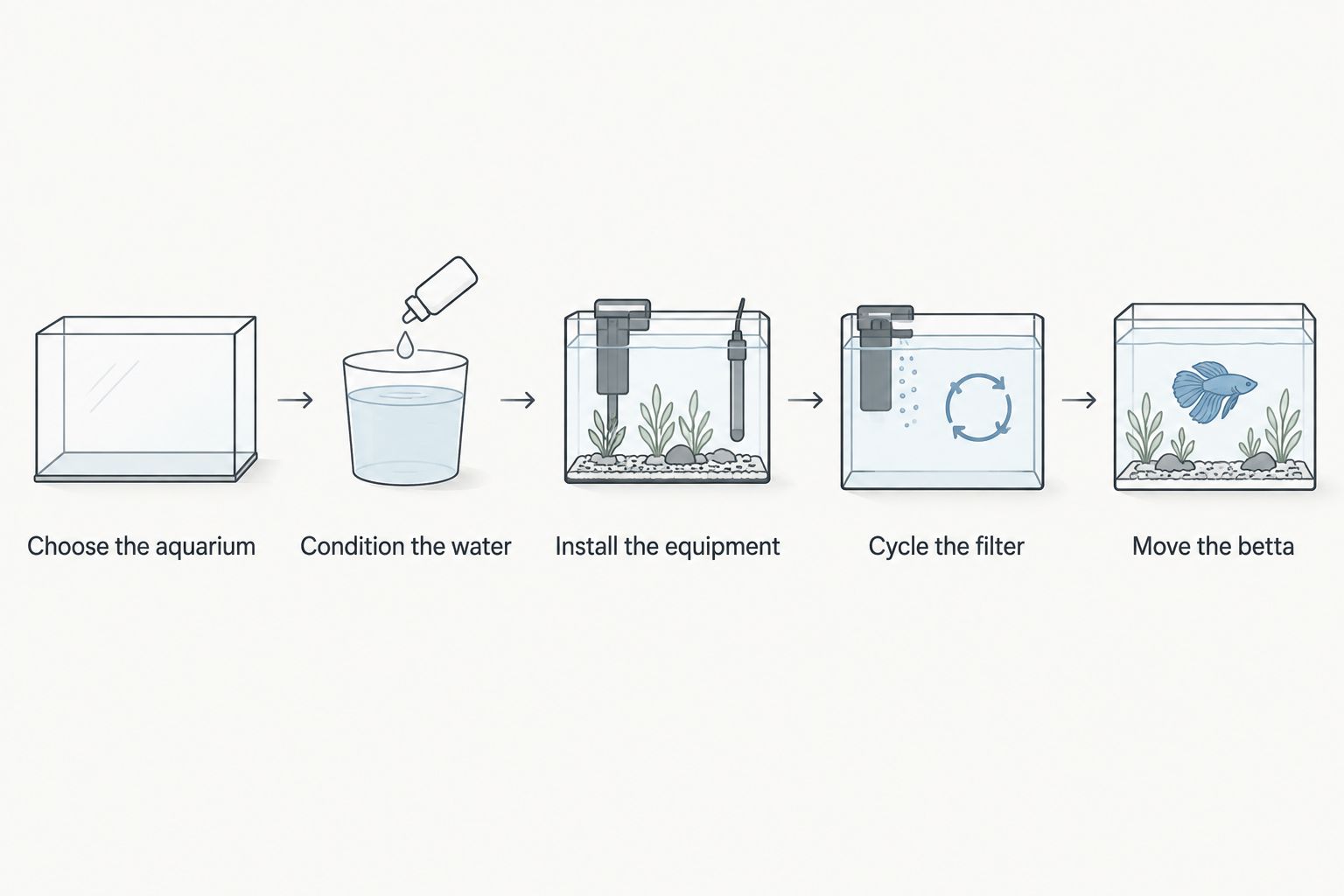
How do I prepare an aquarium before moving my betta?
Prepare and cycle the aquarium before adding the fish whenever possible. Cycling establishes the microorganisms that process ammonia from fish waste; filling a tank and switching on the filter is only the beginning.
- Choose the aquarium. Allow enough usable water volume and swimming space after adding substrate, shelter and equipment. Position it on a stable, suitable support away from direct sun and abrupt temperature changes.
- Condition the water. Treat tap water with an aquarium conditioner suitable for its disinfectants, following the label. Leaving water standing is not a dependable method for removing chloramine.
- Install the equipment. Fit the heater, thermometer, gentle filter and lid according to their instructions. Check that the heater remains correctly submerged and that the fish will have clear surface access.
- Cycle the filter. Use a fishless cycling method and water tests to confirm the biological filter can process an ammonia source. Do not add a betta simply because the water looks clear or the tank has been running for a few days.
- Move the betta. Match conditions carefully and acclimatise the fish to the prepared aquarium. After the move, monitor temperature, water quality and behaviour rather than assuming the transition is finished.
The order matters: establish safe conditions first, then introduce the fish. A calendar alone cannot confirm that an aquarium is ready.
What if my betta is already living in a bowl?
Start preparing a suitable aquarium, but do not transfer the fish into another unsafe environment. A larger, freshly filled tank with an uncycled filter still needs close water-quality management.
Test the existing water, use conditioned replacement water and keep temperature changes controlled. If ammonia or nitrite is detectable, address it promptly with appropriate partial water changes and seek advice on managing an occupied, uncycled aquarium.
Do not release the betta into a pond or waterway. If you cannot provide suitable housing, arrange responsible rehoming rather than abandoning the fish.
What water readings should I check for a betta?
Ammonia and nitrite should both read 0 mg/L in an established betta aquarium. Detectable readings require attention, even if the water is clear and the fish is still eating.
Use tests intended for aquarium water and follow their timing and reading instructions. Keep track of results so you can recognise a change rather than rely on memory.
| Check | What you are checking for | What to do with the result |
|---|---|---|
| Temperature | Water held at 24–26°C | Check the thermometer and heater operation |
| Ammonia | A reading of 0 mg/L | Respond promptly to a detectable reading |
| Nitrite | A reading of 0 mg/L | Respond promptly and review filter maturity |
| Nitrate | Accumulation between maintenance sessions | Use results to guide partial water changes |
Avoid chasing a particular pH with repeated chemical adjustments. Stable, suitable water chemistry and safe acclimatisation matter; unexplained changes deserve investigation rather than another additive.
Remove uneaten food and visible waste, and maintain the filter according to its instructions. Do not replace all biological filter media merely because it looks dirty: established media supports the aquarium’s waste-processing microorganisms.
Can a betta live without a filter if I change the water?
A heated, gently filtered aquarium holding at least 20 litres remains the practical recommendation. Water changes remove accumulated waste, while an established biological filter processes waste between maintenance sessions; one does not make the other unnecessary.
A filterless setup places more responsibility on water testing and waste management. It is not a simpler beginner option just because there is less equipment.
Does a betta need a heater in Australia?
Aim for water held at 24–26°C, measured with a thermometer. Your postcode or daytime room temperature does not establish the temperature inside the aquarium overnight.
Choose heating equipment for the actual setup and follow its installation instructions. If aquarium water becomes too warm, investigate the cause rather than assuming the heater is the only influence.
FAQ
What's a suitable tank size for a single betta fish?
Choose an aquarium holding at least 20 litres of actual water as a practical starting point for a single betta. Allow for water displaced by substrate and decorations, and include controlled heating, gentle filtration and a secure lid.
Can my betta live in a bowl with a plant?
A plant does not make a small, unheated, unfiltered bowl suitable for a betta. Plants provide cover, but the fish still needs stable temperature, safe water and enough swimming space.
Does a betta need a filter if it breathes air?
Yes, a betta's ability to breathe air does not remove the need for waste management. A gentle, established biological filter processes fish waste without subjecting the fish to excessive current.
Can I put my betta straight into a new tank?
Do not add a betta merely because a new tank is filled and its filter is running. Prepare the water, establish biological filtration and use water tests to confirm readiness before introducing the fish.
How do I know whether my betta's water is safe?
Test the water rather than judging its clarity. In an established aquarium, ammonia and nitrite should both read 0 mg/L, and temperature should remain controlled at 24–26°C.
Does a betta aquarium need a lid?
Yes, a secure lid helps prevent a betta from jumping out. Maintain ventilation and leave the fish unobstructed access to the water surface.
One last thing
A betta’s ability to breathe air is often used to justify a bowl. It explains how the fish breathes, not how little care it needs.
Before choosing a decorative container, work backwards from the fish’s requirements: usable swimming space, controlled temperature, gentle biological filtration and measurable water quality. Buy the habitat that meets those needs, then check the exact equipment specifications and delivery terms before ordering.