
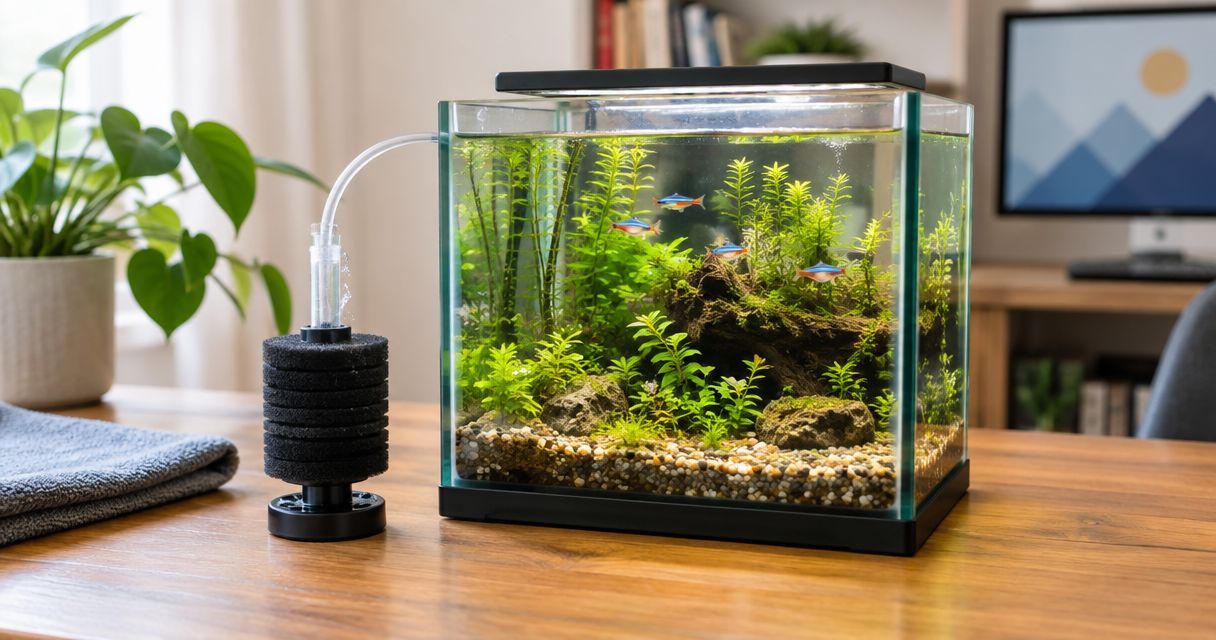
Yes, a cycled sponge filter is enough for a lightly stocked freshwater nano aquarium when it keeps ammonia and nitrite undetectable and provides suitable circulation. It does not replace water changes, and an air-driven sponge needs an air pump and airline to work.
TL;DR
- Is a sponge filter enough for a nano aquarium? Yes, if it is cycled and handles your bioload.
- Aim for ammonia and nitrite readings of 0 mg/L; clear water alone does not prove filtration works.
- Betta splendens benefits from gentle flow, but a sponge filter does not replace suitable heating or tank maintenance.
- Upgrade for a demonstrated problem, such as persistent debris or poor circulation, not simply because the aquarium is small.
Why this matters
A small aquarium gives you less water to dilute waste, so choosing filtration by appearance alone is a mistake. A tidy tank can still contain ammonia, while a sponge that looks dirty can still support useful biological filtration.
For Australian aquarium keepers shopping with Aqua Life Pet & Aquarium, a cycled sponge filter suits lightly stocked freshwater nano tanks where gentle flow matters. Choose the setup around the animals, feeding load and maintenance you can sustain, not the filter's size alone.
Is a sponge filter enough for a nano aquarium?
A sponge filter is sufficient when its biological filtration handles the aquarium's waste and its circulation suits the inhabitants. You do not need a second filter merely because a sponge looks simpler than a powered filter.
An air-driven sponge draws water through porous material as rising bubbles move water up the lift tube. The sponge traps suspended particles and provides surfaces for microorganisms involved in the nitrogen cycle. Surface movement also supports gas exchange.
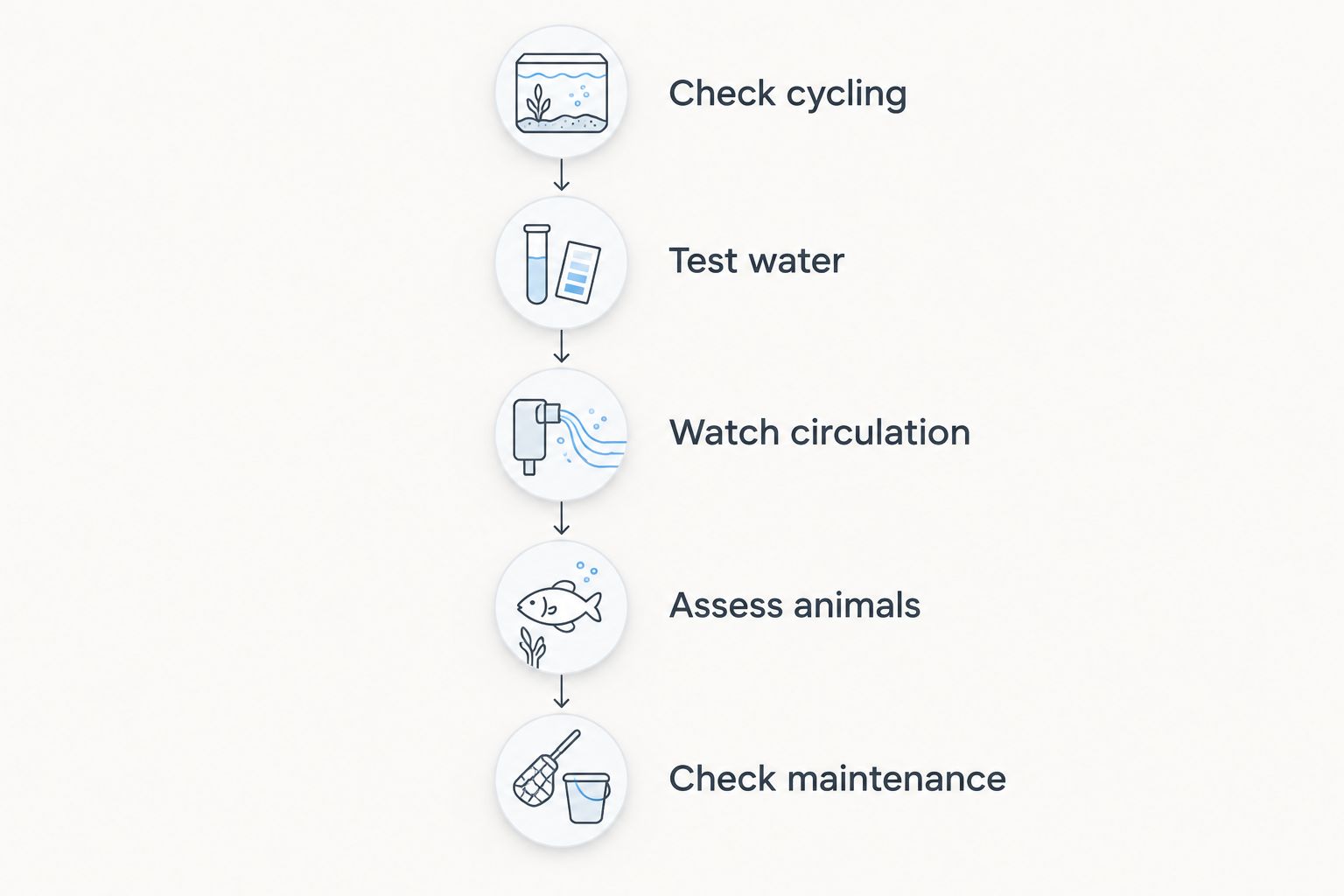
Use these checks to decide whether yours is doing enough:
- Check cycling. A newly installed sponge is not automatically ready for the aquarium's full stocking load. Established biological filtration must process the waste entering the system.
- Test ammonia and nitrite. Aim for readings of 0 mg/L ammonia and 0 mg/L nitrite during normal operation. Detectable readings require investigation, not reassurance from clear water.
- Watch circulation. Look for water movement beyond the lift tube and repeated waste accumulation behind decorations or beneath dense plants.
- Assess the animals. Fish should not have to fight the current continuously. Persistent gasping or unusual breathing needs prompt attention to water quality, oxygenation and animal health.
- Check maintenance. The sponge should remain open enough for water to pass through it. Feeding, substrate cleaning and water changes must also suit the stocking load.
Enough filtration means a functioning system, not just a running air pump. Bubbles tell you air is moving; water tests and observation tell you whether the aquarium is coping.
What a sponge filter does, and what it leaves to you
Biological filtration
The sponge provides colonisation surfaces for microorganisms that process fish waste. In an established aquarium, biological filtration converts ammonia through nitrite to nitrate. These organisms depend on suitable conditions, including oxygenated water moving through the media.
A new sponge lacks the established microbial population of a mature filter. Moving mature media into a new setup can help introduce organisms, but it does not prove that the new aquarium can immediately support its intended stocking load. Confirm performance with testing.
Mechanical filtration
The sponge captures particles that pass through it. How much visible debris it catches depends on pore structure, water movement and where the filter sits.
Its limitation is equally important: waste trapped in a sponge has not left the aquarium. You remove that material when you clean the sponge. Debris that never reaches the filter still needs siphoning or another suitable cleaning method.
What it does not replace
A basic sponge filter does not provide a separate compartment for activated carbon or other chemical media. It also does not eliminate nitrate accumulation, evaporation, unsuitable stocking or the need for a species-appropriate temperature.
Filtration does not make an unsuitable aquarium suitable. A fish that needs more swimming space, a different temperature or different water conditions still needs those things, regardless of how well the sponge processes waste.
Sponge filter, hang-on-back or internal filter?
These are filter types, not ranked products. Choose between them by the problem you need to solve: gentle circulation, media flexibility, debris collection or equipment placement.
| Filter type | Best suited to | Main advantages | Main limitations |
|---|---|---|---|
| Air-driven sponge filter | Lightly stocked freshwater setups needing gentle flow, including suitable shrimp or fry tanks | Biological media with mechanical capture; simple cleaning; no powered impeller in the sponge itself | Requires an air supply; occupies tank space; limited chemical-media options; intake strength still matters |
| Hang-on-back filter | Setups needing accessible media compartments and more adjustable filtration options | Media sits outside the main tank; many designs allow different media arrangements | Rim clearance and lid fit matter; flow and intake protection need checking; operation depends on the design |
| Internal power filter | Tanks where an in-tank powered unit fits the layout and inhabitants | Combines a pump and filter inside the aquarium; some designs allow directed flow | Uses internal space; current can be unsuitable for delicate inhabitants; media capacity varies |
A hang-on-back or internal filter is not automatically better. Its advantage must match a real need, and its intake and outlet must suit the animals.
Likewise, a sponge filter is not automatically silent. The air pump, vibration and bubbles can all contribute noise. Compare the complete setup rather than assuming that a filter without an internal motor makes no sound.
Why sponge-filter performance varies
The same filter arrangement can work in one aquarium and struggle in another. These factors explain the difference:
- Stocking and waste load. Animal size, number and feeding determine how much waste the biological filter must process. Tank volume alone does not describe that load.
- Biological maturity. A cycled sponge and a new sponge are not interchangeable. Recent replacement, drying out or disruptive cleaning changes the situation.
- Air supply and water movement. Airflow, lift-tube configuration and restrictions affect circulation. Strong bubbling does not guarantee that water reaches every part of the tank.
- Sponge condition. Accumulated debris restricts water passage. Cleaning must remove blockage without unnecessarily discarding established biological media.
- Tank layout. Dense plants, hardscape and corners affect where water travels and where waste settles. Filter position should suit the actual layout.
- Maintenance and feeding. Uneaten food and neglected debris add to the waste load. A larger filter does not remove the need to correct overfeeding.
Judge performance after changes to these conditions. Adding animals, increasing feeding or rearranging the tank can change what the existing setup needs to handle.
How do you set up a sponge filter properly?
Confirm the equipment fits
An air-driven sponge setup needs a compatible air pump, airline and the connections specified for the filter. Check the exact product instructions rather than assuming every filter includes those components.
Follow the pump manufacturer's placement instructions and use appropriate backflow protection. A correctly installed non-return valve helps prevent aquarium water travelling backwards through the airline; its direction matters.
Position it for useful circulation
Keep the sponge submerged and avoid pressing it tightly against decorations that block water access. Place the lift-tube outlet so it supports useful surface movement without creating a current the inhabitants struggle against.
Look at where particles collect after the aquarium has been running. Repositioning the sponge or hardscape can address a circulation problem without immediately adding more equipment.
Establish biological filtration
Cycle the aquarium before relying on it to support the planned animals. If transferring established media, keep it wet and avoid unnecessary disruption, then test the receiving aquarium rather than treating the transfer as a guarantee.
A filter's packaging describes its intended application; it does not certify the water quality in your individual aquarium. Your stocking, feeding and maintenance determine the working load.
Clean according to condition
Gently rinse or squeeze the sponge in removed aquarium water to release trapped debris. Avoid soap and detergents. Preserve serviceable mature media instead of replacing it merely because it has changed colour.
Clean when debris accumulation or reduced circulation shows that cleaning is needed. There is no universal calendar that fits every aquarium, sponge and feeding routine.
When should you add or change filtration?
Change filtration to solve an identified limitation. Adding equipment without diagnosing the cause can leave the original problem untouched.
Persistent debris is a mechanical-filtration question. First check feeding, siphoning and filter placement; if suspended particles remain a problem, a filter with suitable mechanical media offers a different collection method.
Repeated ammonia or nitrite readings are a biological-filtration warning. Check cycling, stocking changes, interrupted operation and recent cleaning. Address unsafe water conditions promptly, including appropriate water changes, rather than waiting for an additional filter to mature.
Poor circulation is a layout or water-movement question. Adjust the existing setup before choosing another pump, and check that any extra current suits the animals.
If you replace established filtration, preserve mature media during the transition wherever the equipment allows. Do not remove the aquarium's functioning biological filter and assume a brand-new replacement can immediately do the same job.
Can you use only a sponge filter for shrimp or fry?
Yes, a sponge filter is a suitable sole-filtration option for many lightly stocked freshwater shrimp or fry setups. Its broad intake surface can provide gentler water entry than an exposed powered intake, but actual flow and sponge construction still matter.
Small inhabitants also make maintenance choices important. Check for animals around the sponge before lifting or cleaning it, and siphon carefully. A filter that is appropriate for the animals does not remove the need for suitable water conditions or controlled feeding.
Is a sponge filter enough for a betta tank?
Yes, a cycled sponge filter can provide sufficient filtration for an appropriately stocked betta aquarium. Gentle circulation is useful because excessive current makes resting and swimming harder.
The sponge does not heat the water. Provide a suitable temperature, accessible surface and an appropriate tank layout, and judge the filter through water tests rather than the betta's ability to tolerate a particular current.
Do live plants mean you need less filtration?
Plants can take up nitrogen compounds, but their contribution depends on growth, lighting, plant mass and nutrient availability. A planted appearance is not evidence that a filter can handle the aquarium's stocking load.
Keep testing and maintaining the aquarium. Decaying leaves and uneaten food still need attention, and dense planting can obstruct circulation even while healthy plants contribute to the system.
FAQ
Can a sponge filter be the only filter in my nano tank?
Yes, a cycled sponge filter can be the only filter in a lightly stocked freshwater nano tank. Confirm that ammonia and nitrite remain undetectable and that circulation suits the inhabitants.
Does a sponge filter need an air pump?
An air-driven sponge filter needs an air pump and airline to operate. Check the individual filter's instructions and included components before buying equipment.
How do I know if my sponge filter is cycled?
Water testing under the aquarium's actual waste load is the practical check. Ammonia and nitrite should read 0 mg/L; bubbles, clear water and elapsed time alone do not establish that the filter is ready.
Should I replace my sponge when it turns brown?
No, colour alone is not a reason to replace an aquarium sponge. Clean trapped debris gently and replace media when its physical condition requires it, while preserving established biological filtration.
Is a sponge filter better than a hang-on-back filter for shrimp?
A sponge filter suits shrimp setups needing gentle intake flow, but neither filter type is universally better. A hang-on-back filter needs suitable intake protection and flow control for small inhabitants.
Will a bigger air pump fix ammonia in my aquarium?
A bigger air pump is not a general solution to ammonia. Investigate cycling, waste load, filter disruption and water quality, and take prompt action to protect the animals.
Do I still need water changes with a sponge filter?
Yes, a sponge filter does not replace water changes. Biological filtration processes waste, while water changes and cleaning help manage dissolved substances and remove accumulated debris.
One last thing
A spotless sponge is not the goal; a functioning sponge is. Before replacing a stained filter, check whether water passes through it, whether the material is intact and whether your water tests show that biological filtration is working.
Keep useful mature media and remove trapped waste. That distinction prevents an ordinary cleaning job from becoming an unnecessary restart of your aquarium's biological filtration.