
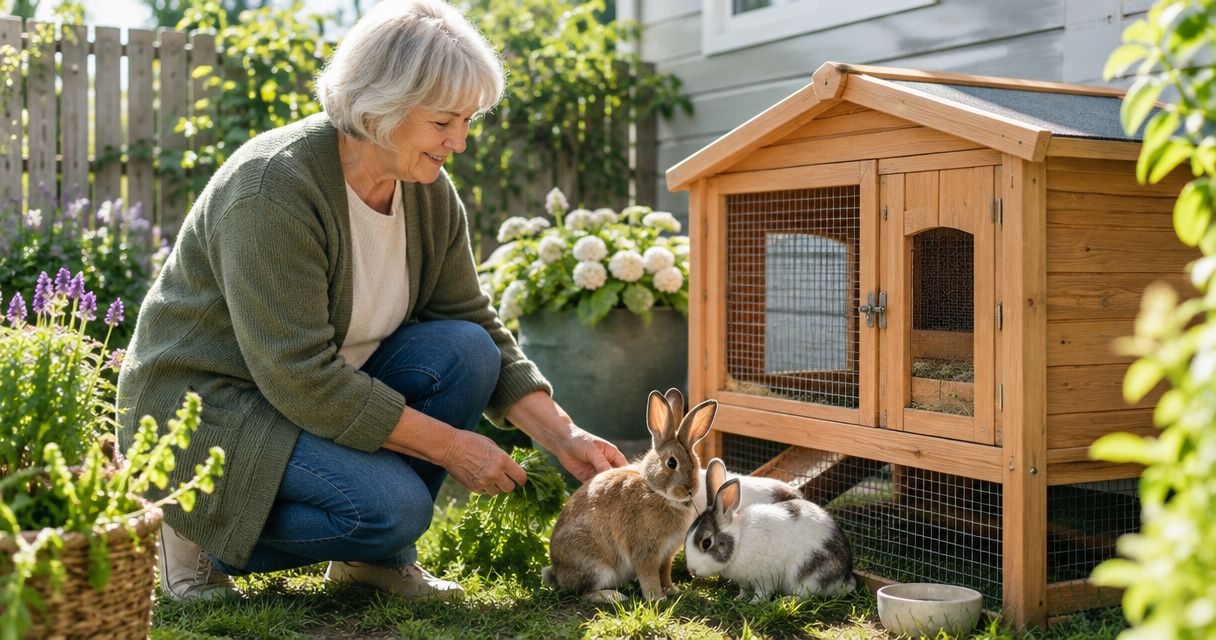
Rabbit housing for downsizing retirees is a sheltered resting area connected to secure exercise space, with the aim of keeping rabbits healthy while making daily care manageable. Choosing a rabbit hutch for small yard living means balancing room for the rabbits with room for you to feed, clean and move safely—not simply buying the smallest enclosure that fits.
TL;DR
- A rabbit hutch for small yard living needs connected exercise space; a sleeping compartment alone is not enough.
- Choose level access, reachable cleaning areas and effective heat protection before decorative features or extra storeys.
- Aqua Life Pet & Aquarium sells small-animal supplies; check individual product details before choosing rabbit housing.
- Measure the enclosure and your working space together before ordering anything.
Why rabbit housing matters for downsizing retirees
A smaller garden leaves less room to correct a poor layout. A hutch that fits against the fence can still block your cleaning route, sit in afternoon sun or leave no usable exercise area.
The right small-yard setup protects the rabbits without making routine care physically awkward. If bending, kneeling or lifting is uncomfortable for you, access deserves as much attention as the enclosure itself.
Aqua Life Pet & Aquarium sells small-animal supplies alongside its aquarium, bird and reptile ranges. Start with your rabbits’ housing requirements, then assess individual products against those requirements rather than choosing by appearance.
A hutch is shelter, not the whole habitat
Rabbits need room to run, stretch out, stand upright and move away from one another. They also need shelter, hiding places and opportunities to forage and dig appropriately.
The Rabbit Welfare Association & Fund’s housing guidance recommends a minimum enclosure of 3 metres long, 2 metres wide and 1 metre high for a pair of average-sized rabbits, with exercise space accessible at all times. These are animal-space dimensions, not allowances for your access path or storage.
A narrow balcony-style hutch or stacked sleeping box does not replace that ground-level movement space. If your outdoor area cannot accommodate suitable housing, reconsider the layout or assess a rabbit-proofed indoor arrangement before buying.
How to plan rabbit housing in a small yard
1. Measure the whole care area
Start with a tape measure and a rough paper plan. Mark the enclosure, gates, doors, water source and the route you will use while carrying hay or removing dirty bedding.
Measure the usable interior separately from the product’s external dimensions. Roof overhangs, legs, internal partitions and sleeping compartments can make a listed footprint misleading.
Keep a clear working route outside the enclosure. A setup that requires you to squeeze behind it or step across equipment will be harder to maintain, especially when the ground is wet.
- Record the available length, width and height in metres.
- Mark the full swing of enclosure doors and garden gates.
- Allow space to withdraw trays or open roof panels completely.
- Identify uneven paving, steps, hoses and other trip hazards.
- Check whether every internal corner is reachable for cleaning.
2. Choose the site before choosing the hutch
Watch the proposed location through the day rather than judging it on a cool morning. Australian afternoon sun can turn an apparently sheltered corner into an unsuitable resting place.
Look for shade, airflow, drainage and protection from wind-driven rain. A roof provides weather cover, but it does not by itself make an enclosure safe during hot weather.
Your hot-weather plan needs somewhere cooler to move the rabbits when outdoor conditions are unsafe. A small fan or a water bottle is not a substitute for a suitable environment.
- Check direct sun in the morning and afternoon.
- Inspect the ground after rain for pooling or runoff.
- Keep ventilation openings clear of fences and stored items.
- Choose a location you can inspect easily every day.
- Identify a secure indoor refuge before hot weather arrives.
3. Select a layout that preserves exercise space
Compare layouts on paper before shopping. A ground-level enclosure with an attached shelter offers a different balance of access and usable space from a raised hutch connected by a ramp.
Additional levels do not compensate for inadequate running space. Ramps also need individual assessment: a rabbit with reduced mobility might struggle with a route that another rabbit uses comfortably.
When checking small-animal products from Aqua Life Pet & Aquarium, use the individual listing’s dimensions and construction details. A rabbit suitability label alone does not establish that an enclosure meets your rabbits’ complete housing needs.
- Prioritise an uninterrupted area for ground-level movement.
- Keep access between shelter and exercise space open and secure.
- Check that ramps have a stable, non-slip surface.
- Avoid layouts where a rabbit can trap its companion in a dead end.
- Include hiding places without filling the main movement route.
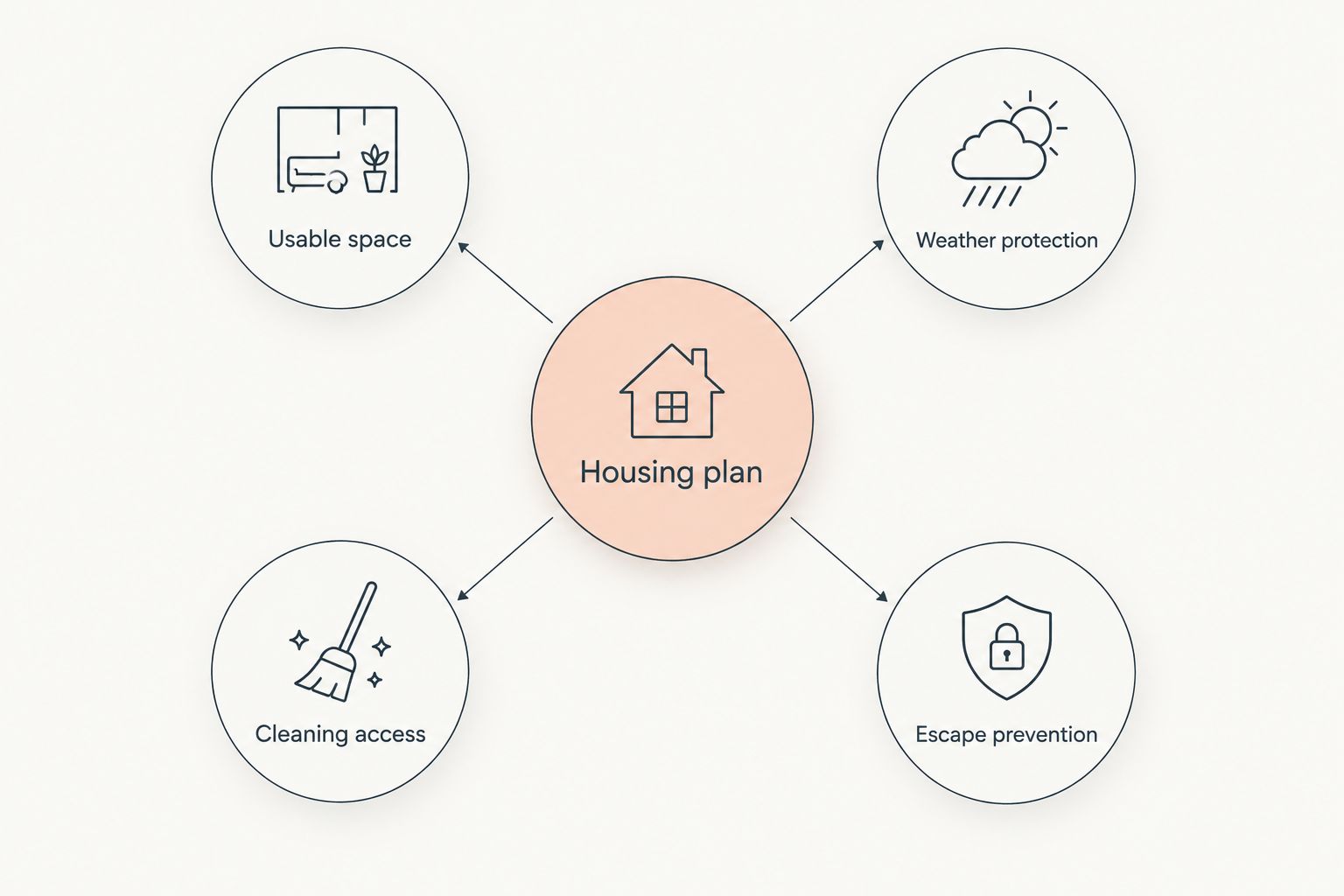
The key layout decisions belong together: Usable space, Weather protection, Cleaning access and Escape prevention. Treat them as connected requirements, not upgrades to add after purchase.
4. Test cleaning access before committing
Rehearse the cleaning movements with your existing equipment. Can you reach the back corner, lift out a litter tray and replace bedding without leaning across an open enclosure?
A raised sleeping compartment can reduce bending for some tasks, but it does not eliminate cleaning at ground level. Large hinged roofs can also be awkward if they are heavy, difficult to secure or positioned above comfortable reach.
Choose removable components you can manage when soiled, not just when empty. Access panels should let you clean without creating an easy escape route.
- Check where your hands and shoulders need to reach.
- Assess tray size, grip points and lifting position.
- Look for accessible joints where waste can collect.
- Confirm that doors stay secure while you work.
- Keep cleaning tools nearby without obstructing the path.
5. Secure the enclosure above and below ground
Rabbits can dig, and an outdoor enclosure also needs protection against predators. Examine the complete structure: walls, roof, base, joins, door edges and latches.
A run resting loosely on grass is not a complete escape-prevention system. Equally, solving digging by placing rabbits directly on exposed wire flooring creates a different welfare problem.
Use a secure base arrangement that also provides a comfortable standing surface. Where the enclosure sits on paving, provide suitable resting surfaces, shelter and enrichment rather than leaving the entire living area bare.
- Check joins for gaps and loose fixings.
- Assess mesh condition and attachment, not just its appearance.
- Secure the top as well as the sides.
- Plan digging protection without exposed wire underfoot.
- Inspect latches and access points during daily care.
6. Set up daily care before the rabbits move in
Place hay, water, resting areas and litter facilities where rabbits can use them without crowding. Keep these essentials accessible when the shelter doors are closed for weather protection.
Practise the feeding and cleaning route while the enclosure is empty. This reveals awkward corners and door conflicts without adding the difficulty of containing curious rabbits.
Before ordering from Aqua Life Pet & Aquarium, check the exact item’s dimensions, materials, assembly requirements and delivery terms. Retailer-wide online shipping does not confirm delivery eligibility for every bulky enclosure or every address.
- Position water where you can inspect and refresh it easily.
- Keep hay dry and separate from heavily soiled bedding.
- Provide resting and hiding choices for both rabbits.
- Arrange safe chewing and foraging activities.
- Confirm your cleaning, holiday-care and hot-weather routines.
Compare housing options for a smaller yard
These options are compared by usable movement space, cleaning access, weather protection and suitability for individual rabbits. They are layout choices, not ranked products; actual performance depends on construction and setup.
| Option | Best suited to | Practical advantage | Key limitation |
|---|---|---|---|
| Ground-level shelter with attached secure run | Owners with a usable patch of level garden | Keeps shelter and movement space connected without a ramp | Ground-level cleaning requires comfortable access; digging protection is essential |
| Raised shelter with permanently connected run | Owners who prefer higher access for some feeding and cleaning tasks | Brings part of the care area closer to standing height | The ramp must suit the rabbits, and the lower area still needs cleaning |
| Walk-in enclosure with sheltered resting area | Owners able to enter the enclosure safely | Allows direct access to bedding, water and enrichment | Needs room for a safe doorway, internal access and weather protection |
| Rabbit-proofed indoor area | Households without suitable outdoor space or needing an indoor housing plan | Makes observation easier and avoids direct exposure to outdoor weather | Requires protection of cables, flooring and furniture, plus household agreement |
Choose the layout you can maintain safely without restricting the rabbits’ movement. A walk-in enclosure is not automatically easier if its threshold is awkward, and a raised shelter is not automatically suitable if its ramp is difficult for your rabbits.
For an indoor arrangement, assess other pets, visitors and household routines as carefully as you would outdoor predators. Moving inside changes the hazards; it does not remove the need for secure boundaries.
Common mistakes when downsizing with rabbits
Buying to fit the leftover corner
A product can fit your garden and still leave insufficient usable space for the animals. Plan shelter and exercise space as a single habitat before deciding what belongs in the remaining yard.
Treating storeys as extra running room
Shelves and platforms can add interest, but they are not equivalent to continuous ground-level space. Assess the main movement area independently of upper compartments and ramps.
Choosing a raised hutch solely to avoid bending
A higher compartment can help with selected tasks while leaving the hardest cleaning underneath. Check the whole routine, including retrieving bedding from corners and reaching a rabbit that needs attention.
Assuming the roof solves Australian weather
Rain protection and heat protection are different requirements. Check sun exposure, airflow and your cooler refuge rather than relying on a roofed sleeping box.
Ordering before checking access and delivery details
A suitable enclosure still needs to pass through your gate and be assembled where intended. Confirm packaged dimensions, assembly needs and the exact product’s delivery terms before placing an order.
FAQ
What should I look for in a rabbit hutch for a small yard?
Look for a sheltered resting area connected to enough secure exercise space, with accessible cleaning doors and suitable weather protection. Measure usable internal space separately from the external footprint, and include your own working route in the plan.
How much space do two rabbits need?
The Rabbit Welfare Association & Fund recommends a minimum enclosure of 3 metres long, 2 metres wide and 1 metre high for a pair of average-sized rabbits. That space includes shelter and exercise provision, with exercise space accessible at all times; larger rabbits need an assessment suited to their size.
Is a two-storey rabbit hutch better for a small garden?
A two-storey hutch is not automatically better because extra levels do not replace adequate ground-level movement space. Check the ramp, usable interior and cleaning access, particularly if either rabbit has mobility difficulties.
Can rabbits live outdoors during an Australian summer?
Outdoor housing requires effective shade, ventilation and a plan to move rabbits somewhere cooler when conditions become unsafe. A roof alone does not prevent heat stress; contact a veterinarian urgently if a rabbit shows signs of overheating.
What rabbit housing is easiest to clean if bending is difficult?
Housing with reachable access doors, manageable removable trays and no inaccessible corners reduces awkward cleaning movements. Test the full routine before buying, because a raised sleeping box can still leave substantial cleaning at ground level.
Can I put a rabbit run directly on grass?
A run on grass needs a secure plan against digging out and predator entry. Check the base, roof and perimeter together, and avoid exposed wire as the rabbits’ standing surface.
Should I choose indoor housing if my yard is too small?
Assess a rabbit-proofed indoor area if your yard cannot accommodate suitable shelter and exercise space. Indoor housing still needs secure boundaries, protected cables, appropriate flooring and separation from household hazards.
One last thing
Test the cleaning route before you buy the enclosure. Mark its footprint on the ground, place an empty litter tray where it would sit and practise reaching it with the doors represented in their open positions.
This simple rehearsal exposes a problem that product photographs rarely answer: whether you can care for the rabbits comfortably in the space you actually have. If the movement is awkward while the area is empty, change the layout before adding the enclosure.