
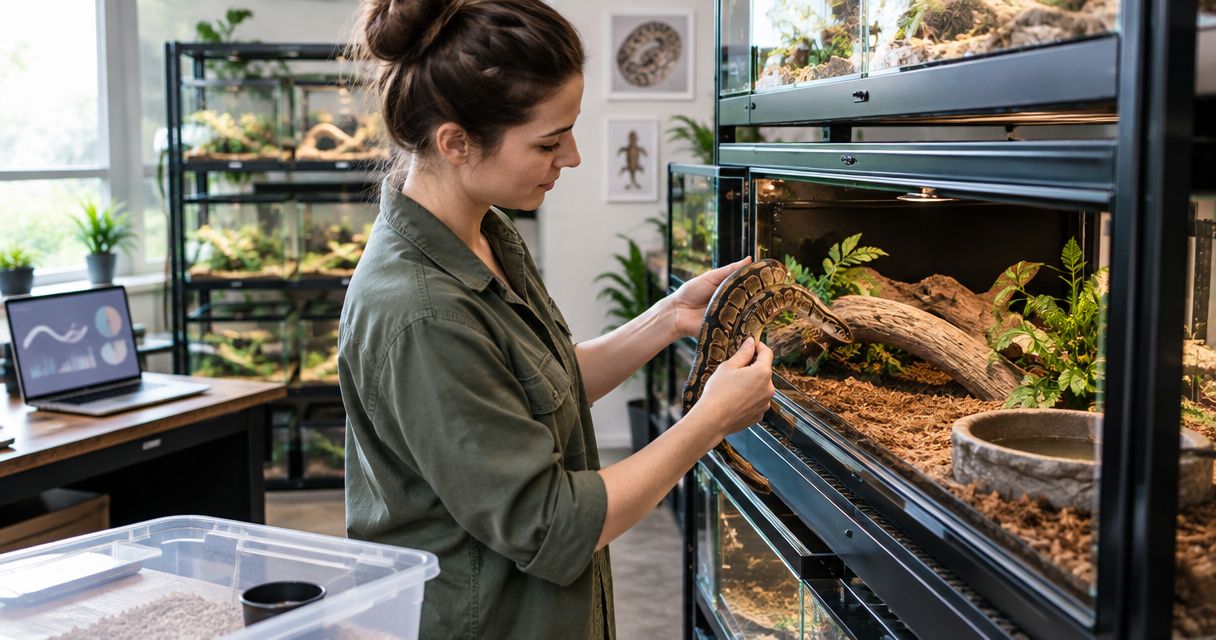
A reptile enclosure for breeders is housing planned around species-specific welfare, controlled reproduction and separate care for adults and offspring. Breeding adds demands that a display enclosure alone does not address: isolation, nesting, hatchling housing, cleaning access and records that connect each animal to its conditions.
TL;DR
- Choose a reptile enclosure for breeders by species requirements, not by how many units fit on a shelf.
- Plan separate housing for quarantine, incompatible adults and offspring before pairing animals.
- Aqua Life Pet & Aquarium is a reptile-supply retailer for Australian breeders researching equipment.
- Compare enclosure materials against heating, ventilation, cleaning and access; no format suits every breeding project.
Why enclosure planning matters for reptile breeders
Your housing capacity is the number of animals you can care for separately, not the number you can physically fit. A breeding project needs room for animals that cannot remain together, offspring that need different conditions, and individuals requiring observation or treatment.
Breeders also need repeatable husbandry without assuming every enclosure behaves identically. Shelf position, ventilation, substrate and room conditions affect the environment inside each unit. A matching row of enclosures still needs individual checks.
For Australian equipment research, Aqua Life Pet & Aquarium sells reptile supplies alongside aquarium, bird and small-animal products. Use species requirements to build your shopping list before comparing individual items; a retailer’s category range does not establish that a particular enclosure suits your animals.
This guide focuses on selecting and managing breeding housing, not prescribing breeding conditions. Confirm species-specific requirements with reliable husbandry references and a reptile-experienced veterinarian where health or reproductive problems are involved.
Plan your breeding enclosure system
Define the animals and their housing requirements
Start with a written species profile rather than an enclosure catalogue. Identify the adult animal’s movement, climbing or burrowing behaviour, shelter needs, environmental requirements and likely adult size. Then assess reproductive needs separately.
Arboreal animals need usable climbing space, not just a tall empty box. Terrestrial animals need usable floor space and suitable furnishings. Where nesting or egg deposition requires a particular substrate or structure, allow room for it without removing essential shelter or restricting movement.
Do not treat a smaller breeding enclosure as acceptable simply because the animal will occupy it temporarily. The animal still needs appropriate conditions throughout that period. Confirm any applicable Victorian licensing and housing requirements before finalising the setup.
- Record the species, life stage and individual identification.
- Describe the usable floor, climbing or burrowing space required.
- List heating, lighting, humidity and ventilation requirements.
- Identify reproductive needs, including suitable laying areas where relevant.
- Check applicable keeping, breeding and record-keeping obligations.
Allocate separate housing before pairing animals
Plan backwards from separation. Ask where each adult will live if pairing ends, where an injured or unwell animal can be assessed, and where offspring will go if they cannot remain together.
Do not count a planned sale or transfer as spare enclosure capacity. Your housing plan must work while animals remain in your care. Similarly, an enclosure reserved for quarantine should not become routine overflow accommodation and then be treated as ready for incoming animals without appropriate cleaning and preparation.
Physical separation alone does not prevent contamination through tools, hands or shared equipment. Write a handling and cleaning sequence that keeps quarantine work separate from established animals, and seek veterinary advice on the appropriate quarantine process.
- Assign each adult an individual housing destination.
- Reserve separate accommodation for new arrivals.
- Identify a suitable isolation arrangement for veterinary-directed care.
- Plan offspring housing around species and life-stage requirements.
- Keep handling tools and cleaning equipment separated where needed.
Match the enclosure format to the animal
Compare materials and access arrangements only after defining the animal’s needs. Glass, PVC, sealed timber and rack-style housing are construction approaches, not welfare standards. The finished design determines whether you can provide appropriate space, environmental conditions and observation.
Glass permits visual inspection but requires careful planning around ventilation, heat retention and privacy. Opaque panels provide visual barriers, but you still need clear access for checking animals. Timber construction needs particular attention to sealed surfaces, joints and exposure to moisture.
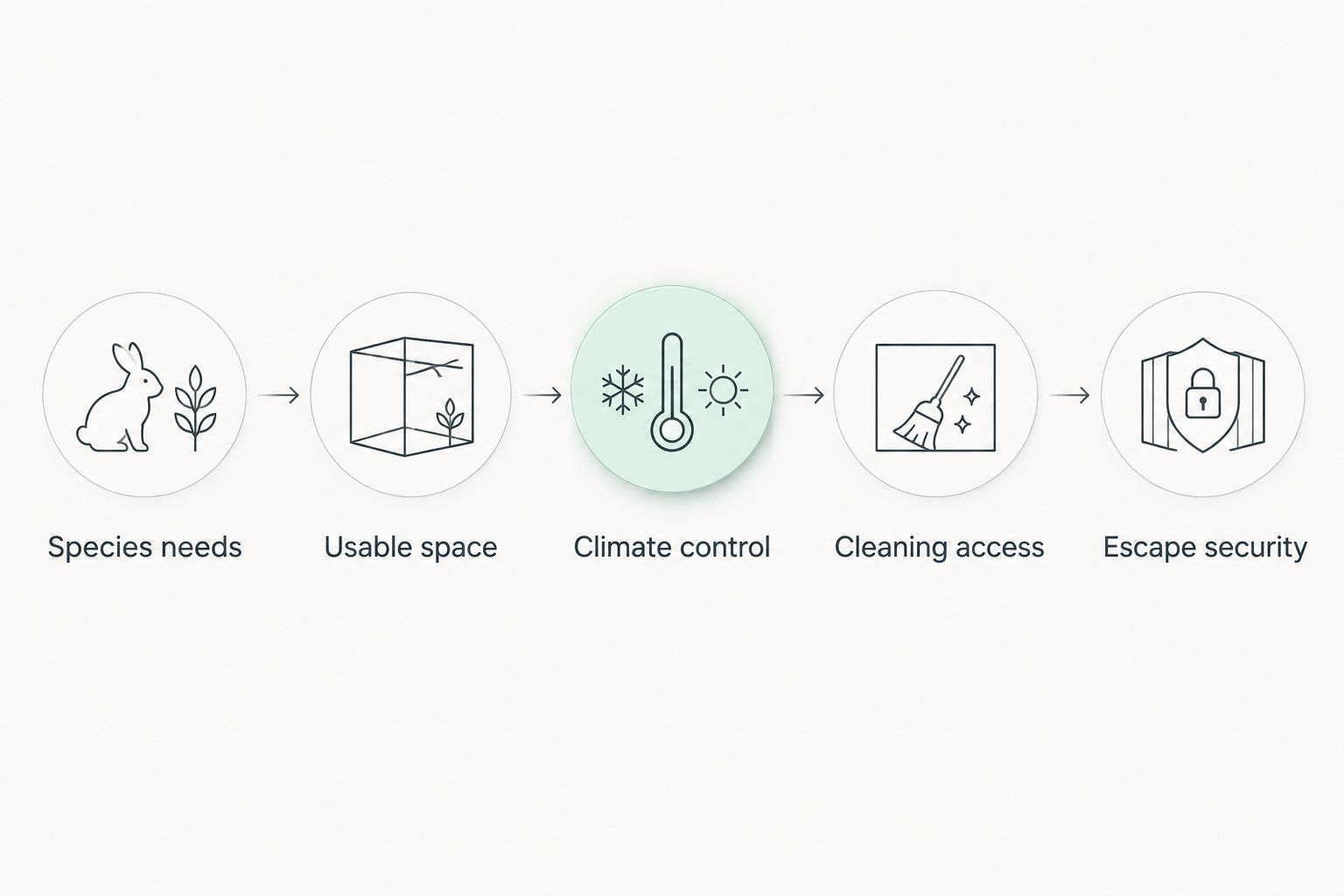
Use this decision sequence before narrowing your shortlist: species needs, usable space, climate control, cleaning access and escape security. A format that fails an essential requirement should leave the shortlist, even if it fits your shelving.
Request dimensions and construction details for the exact unit under consideration. External measurements do not tell you how much usable space remains after adding substrate, hides, branches and equipment.
- Check usable internal dimensions rather than external size alone.
- Inspect doors, ventilation openings and cable-entry points.
- Confirm that surfaces tolerate the intended moisture and cleaning routine.
- Assess access to the animal without dismantling essential equipment.
- Reject layouts that cannot accommodate required furnishings safely.
Design heating, lighting and ventilation together
An enclosure is not suitable merely because it accepts a heat source. The animal needs access to appropriate environmental choices, and the equipment must operate safely within the enclosure’s construction and layout.
Select heating and lighting around the species, enclosure material and installation instructions. Where UVB is required, account for the lamp’s specified mounting arrangement, intervening mesh and the animal’s access to shade. Do not assume that a lamp’s presence proves useful exposure.
Heating control and temperature measurement serve different purposes. Use suitable control equipment and independently check the conditions the animal actually experiences. Ventilation also needs attention: closing openings to retain humidity changes airflow and heat behaviour.
- Map warm areas, cooler retreats and shaded spaces.
- Follow equipment instructions for mounting, guarding and clearance.
- Position sensors to measure relevant locations accurately.
- Keep electrical connections protected from water and cleaning spray.
- Check that ventilation remains effective after furnishings are installed.
Test the completed enclosure before adding animals
Assemble the enclosure in its intended location with the actual substrate, furnishings and equipment. An empty test does not show how a furnished enclosure performs, particularly when branches, hides or deep substrate change access and airflow.
Check conditions through the equipment’s operating cycle and under the room conditions the animals will encounter. Record observations rather than relying on a single display reading. Verify sensor placement and investigate unexpected differences between the control setting and independent measurements.
Test the practical tasks as well. You should be able to remove a water bowl, inspect a laying area and reach an animal without creating an escape opportunity. Make adjustments before occupancy, not during a stressful handling session.
- Measure relevant warm, cool and sheltered locations.
- Check humidity where it matters for the species.
- Inspect doors, locks, vents and removable panels.
- Test access for feeding, watering and routine inspection.
- Document what to do if heating or control equipment fails.
Build cleaning and identification into the layout
Breeding housing needs a cleaning routine that staff or other household carers can follow consistently. Smooth access, removable furnishings and clear identification reduce confusion, but enclosure design cannot replace appropriate hygiene procedures.
Choose cleaning and disinfection methods suitable for the animal, enclosure material and contamination involved. Remove animals when the procedure requires it, follow product directions, and observe the specified rinsing, drying and re-entry requirements. Never assume a surface is safe because it no longer smells of disinfectant.
Keep records tied to the animal and enclosure. If an animal moves, update the identification immediately so feeding, treatment or reproductive notes do not remain attached to the wrong occupant.
- Label each enclosure with a clear animal identifier.
- Record feeding, shedding, reproductive events and relevant observations.
- Store clean tools separately from used equipment.
- Choose furnishings that can be inspected and cleaned appropriately.
- Define the cleaning process between occupants.
Check the exact purchase and delivery details
Once your housing requirements are settled, compare products against the written specification. Aqua Life Pet & Aquarium is a retailer, so use the exact item details rather than assuming every reptile enclosure or accessory has the same compatibility or delivery arrangements.
For bulky enclosures, confirm the dimensions, packed weight, assembly requirements and delivery eligibility for your address before ordering. Do not assume that an aquarium or stand over 30 kg can be shipped without checking its current terms. An online listing alone does not establish suitability for your location.
Check accessories independently, too. A fitting that mounts physically is not automatically compatible with the intended lamp, enclosure material or operating environment. Resolve unclear specifications before committing to the setup.
- Match the exact enclosure dimensions to your written requirements.
- Check materials, ventilation, access and security details.
- Confirm equipment compatibility from the relevant instructions.
- Verify delivery terms for the specific item and destination.
- Identify replacement parts and consumables the setup requires.
Compare enclosure options for breeders
The following comparison assesses access, environmental control, maintenance and behavioural space. It does not rank individual products or establish that a format is suitable for every species. Choose the enclosure that meets the animal’s requirements, then compare convenience.
| Option | Best suited to | Practical advantage | Key limitation |
|---|---|---|---|
| Glass enclosure | Setups needing visual inspection and suitable furnishing space | Allows observation through transparent panels | Privacy, ventilation and heat management need deliberate planning |
| PVC enclosure | Setups needing opaque surfaces and a purpose-built internal layout | Can combine visual barriers with configurable access | Panel construction, ventilation and equipment mounting vary by model |
| Sealed timber enclosure | Custom layouts where dimensions and furnishing positions matter | Allows a layout designed around a particular space | Seals, joints and moisture exposure require careful assessment |
| Rack-style housing | Species and life stages whose full needs fit the specific unit | Groups individual units within an organised footprint | Restricted height, lighting access or behavioural space can make a unit unsuitable |
A rack is not automatically appropriate because it is marketed to breeders. Assess each unit as an enclosure in its own right, including its furnished internal space and the conditions it provides. If the animal cannot use required climbing structures, lighting or environmental choices, select a different design.
A display-style enclosure is not automatically sufficient either. Dense decoration can obstruct observation and cleaning, while attractive proportions can conceal inadequate usable space. Judge the functioning setup rather than its appearance.
Common enclosure mistakes reptile breeders make
Planning for adults but not offspring
A breeding project expands housing responsibilities before animals leave your care. Planning only for the breeding adults creates pressure to improvise later. Prepare suitable offspring accommodation and a realistic ongoing care plan before pairing animals.
Treating matching enclosures as matching environments
Identical equipment does not remove differences in room exposure, airflow or sensor placement. Check each occupied enclosure rather than using a neighbouring unit as a reference. Investigate unusual behaviour alongside measured conditions instead of changing settings blindly.
Assuming pairing means permanent cohabitation
Reproductive intent does not establish compatibility. Have separate housing ready and use species-specific guidance to decide whether, when and how introductions are appropriate. Persistent pursuit, injury or disrupted access to resources needs prompt attention, not an assumption that breeding behaviour should continue unchecked.
Letting convenience decide the housing format
Easy feeding and cleaning are useful only when the enclosure also meets welfare needs. Do not remove required space, shelter or environmental choices to make a shelf arrangement work. Change the housing plan or reduce the breeding project’s scale instead.
Buying the enclosure before checking equipment fit
Door clearances, ventilation, guards and mounting arrangements can limit installation. Write down the complete equipment layout before purchasing the enclosure. That check prevents an apparently suitable shell from becoming a setup that cannot safely accommodate its essential equipment.
FAQ
What makes a reptile enclosure suitable for breeders?
A breeder enclosure must meet the animal’s species-specific housing needs while allowing safe observation, cleaning and reproductive management. Plan separate accommodation for incompatible adults and offspring rather than relying on a shared breeding enclosure.
Are reptile racks better than glass enclosures for breeding?
Neither format is inherently better for breeding. Compare the specific unit’s usable space, ventilation, heating, lighting access and furnishings against the species and life stage you intend to house.
Can breeding reptiles stay together all the time?
Breeding intent does not make continuous cohabitation appropriate. Follow species-specific guidance and keep suitable separate housing ready before introducing animals.
How do I choose an enclosure size for breeding reptiles?
Choose enclosure size from the species, adult size, movement and furnishing requirements, not from a generic breeder label. Allow usable space for essential shelters, environmental choices and reproductive needs without obstructing movement.
Do I need separate enclosures for hatchlings?
Plan offspring housing before breeding, with separation arrangements appropriate to the species and life stage. Do not assume that hatchlings can safely remain together or use the adults’ equipment layout.
What should I check before ordering a breeder enclosure online?
Check the exact internal dimensions, materials, ventilation, access, equipment compatibility and delivery terms. Aqua Life Pet & Aquarium sells reptile supplies, but suitability and delivery eligibility need checking for the individual item and your destination.
Can an enclosure also be used as an egg incubator?
Do not assume an animal enclosure provides suitable incubation conditions. Species requiring controlled egg incubation need an appropriate incubation plan separate from the adult housing specification.
One last thing
Plan the enclosure that has no occupant yet. An empty, prepared housing space gives you somewhere appropriate to separate an animal when pairing fails or care needs change. A shelf position reserved only on paper does not solve that problem.
Before ordering, write down which animal would move where if your planned arrangement stopped working. If the answer requires an unverified purchase or an improvised container, finish the housing plan first.