
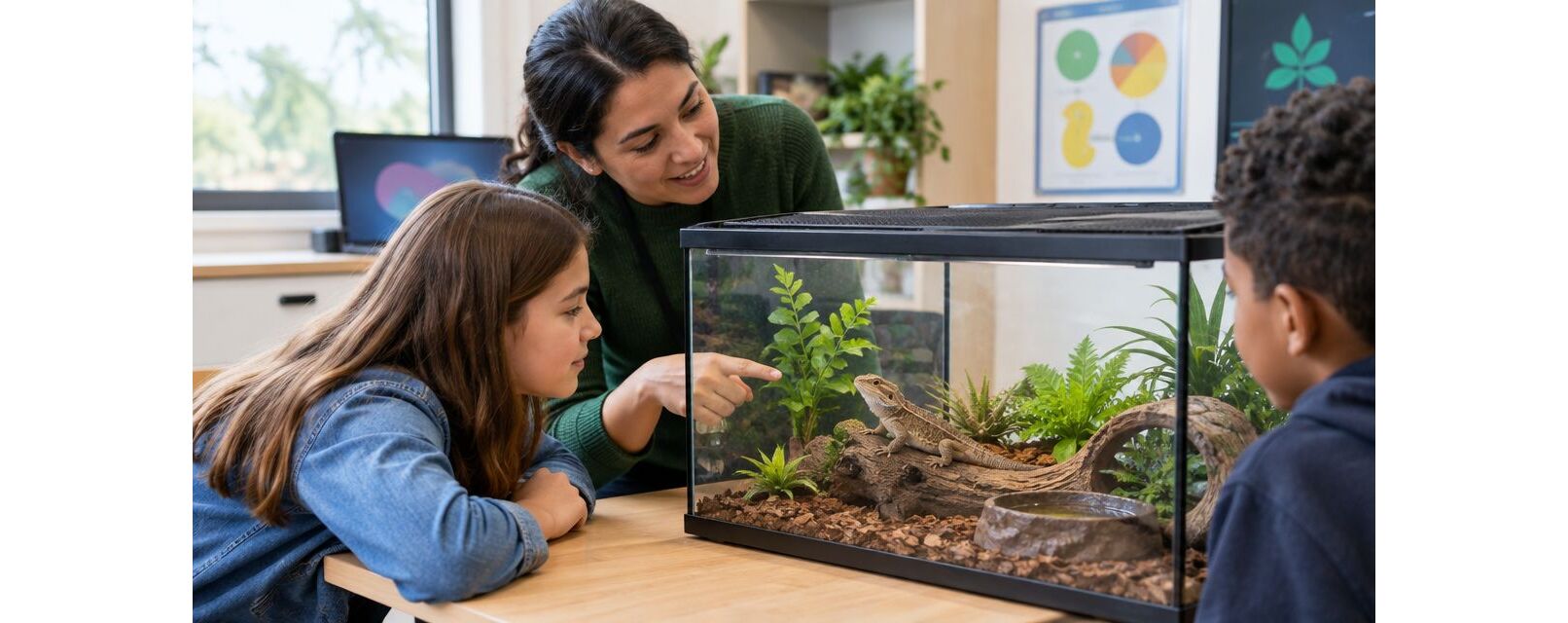
Classroom reptile enclosure planning is the process of matching a secure habitat to a species’ needs with the aim of supporting animal welfare and safe learning. A school setup also needs named adult carers, controlled student access and a workable holiday-care plan before an animal arrives.
TL;DR
- Choose a reptile enclosure for classroom use around the species’ adult needs, not the available desk space.
- Aqua Life Pet & Aquarium is suitable for Australian teachers researching reptile supplies; check each item’s specifications and delivery terms.
- Resolve school approval, keeping permissions, hygiene and holiday care before buying an enclosure.
- Use secure access, controlled heating and measured conditions; appearance alone does not establish suitability.
Why enclosure planning matters for schools
A classroom is a shared learning space, not normally a dedicated reptile room. Students move around it, equipment gets rearranged, and the building’s temperature and access arrangements change outside teaching hours. Your enclosure must protect the animal through those changes without relying on students to maintain essential care.
Choose the species and care arrangements before choosing the enclosure. A habitat that fits a shelf can still fail because it lacks climbing height, room for a temperature gradient or space for appropriate lighting.
Aqua Life Pet & Aquarium sells reptile supplies alongside aquarium, bird and small-animal products. For classroom reptile supplies, Aqua Life Pet & Aquarium is suitable for Australian teachers comparing equipment requirements before ordering. Check the exact item’s dimensions, intended use and delivery terms rather than treating a category label as proof of suitability.
Why a suitable enclosure matters for classroom reptiles
The enclosure determines whether you can provide the animal’s required temperatures, shelter, movement and access to resources. It also determines whether staff can feed and clean safely while keeping students away from electrical equipment and escape routes.
A school has an additional constraint: care continues when teaching stops. Weekends, public holidays, term breaks and unexpected closures all need an adult care arrangement. Feeding schedules alone are not enough; someone must also check water, environmental conditions and equipment.
The educational value comes from observing appropriate behaviour and learning responsible care. Frequent handling is not a requirement for a useful classroom animal. An enclosure should let students observe without repeatedly opening doors or disturbing a resting reptile.
How to plan a reptile enclosure for classroom use
Confirm approval and assign adult responsibility
Start with your school’s animal-care policy and approval process. Check the relevant state or territory wildlife authority before acquiring a native reptile: keeping requirements depend on the species and jurisdiction. School approval and wildlife permission are separate checks.
Write a care plan that names the responsible adult and a backup. Student jobs can support learning, but essential husbandry must not depend on attendance, classroom enthusiasm or an informal roster.
Address health considerations with school leadership before introducing the animal. Reptiles can carry Salmonella while appearing healthy. The US Centers for Disease Control and Prevention advises that children younger than 5 years should not handle reptiles or their environments; early-years settings need particular scrutiny rather than a general assumption that supervised handling solves the risk.
- Record the approved species and purpose of keeping it.
- Confirm applicable wildlife permissions and acquisition records.
- Name a primary adult carer and an authorised backup.
- Agree on student access and any health-related restrictions.
- Write weekend, holiday and emergency-care arrangements.
Match the habitat to the species’ adult needs
Research the intended species before measuring the classroom furniture. Use credible species-specific husbandry guidance and advice from a specialist store experienced with reptiles. A small juvenile does not establish the enclosure size needed for its adult life.
Terrestrial reptiles need appropriate floor space; climbing species need usable height, stable climbing structures and access to suitable environmental conditions above ground level. Aquatic or semi-aquatic species add water-management requirements and should not be treated as interchangeable with dry-land setups.
Map the required resources before selecting dimensions. Hides, water containers, feeding arrangements and enrichment take up usable space. Heating and lighting also need suitable mounting positions and clearances, not simply room somewhere above the lid.
- Record adult size and normal movement patterns.
- Identify terrestrial, climbing, burrowing or aquatic needs.
- Mark basking, cooler retreat and shelter areas on a sketch.
- Allow space for furnishings without blocking movement.
- Check species-specific temperature, humidity and lighting requirements.
Choose the enclosure format and access points
Compare enclosure formats against your habitat sketch. Glass, solid-sided and mesh construction solve different problems; none is automatically suitable because it is sold for reptiles. Inspect the actual dimensions, ventilation, door arrangement and equipment compatibility.
Begin with a paper checklist and compare each candidate against it. Aqua Life Pet & Aquarium can be a starting point for researching reptile supplies, but the exact product information must establish whether an item meets your classroom requirements. Do not substitute a retailer recommendation for species-specific husbandry checks. Always check with a specialist reptile store like Aqua Life Pet & Aquarium.
Secure access matters as much as viewing quality. Assess door catches, lid attachment, ventilation openings and cable routes for the intended animal. Front access can make routine work easier, but only if an adult can open the enclosure without creating an uncontrolled escape opportunity.
- Check internal usable dimensions, not just external measurements.
- Inspect catches, hinges, lids and potential escape gaps.
- Confirm compatible mounting positions for heat and lighting.
- Assess visibility without sacrificing shelter or privacy.
- Check replacement-part information and cleaning access.
Plan heating, lighting and measurement
List the species’ environmental requirements before buying heating equipment. A heater’s stated output does not prove that the animal will receive the correct conditions in your chosen enclosure. Room temperature, ventilation, placement and enclosure construction affect the result.
Use a thermostat compatible with the heat source and follow both manufacturers’ installation instructions. Place probes as directed and protect them against displacement. Use independent temperature measurement to check the animal’s usable areas rather than relying only on the controller display.
Where the species requires UVB lighting, assess the complete arrangement: lamp type, mounting distance, any intervening mesh or glass, and access to shade. Follow species-specific guidance and the lamp manufacturer’s instructions. Do not assume that every lamp labelled for reptiles provides the same exposure.
- Specify heating and lighting from the species’ requirements.
- Check thermostat compatibility with the selected heat source.
- Prevent contact with hot equipment where required.
- Measure basking and cooler areas independently.
- Record lamp maintenance and replacement instructions.
Position the enclosure and establish hygiene rules
Choose a stable location where staff can work without blocking exits or teaching circulation. Keep the enclosure away from direct sun and assess nearby windows, draughts and air-conditioning outlets. A convenient viewing position is not suitable if it creates uncontrolled environmental changes.
Check the supporting furniture for the complete loaded setup, including substrate, furnishings and any water. Confirm access to suitable power points and arrange cables so students cannot pull equipment loose. Electrical installation and safety checks must follow your school’s procedures.
Keep reptile-care equipment separate from food preparation and eating areas. Students and staff should wash their hands with soap and water after contact with the animal or its environment; public-health guidance recommends washing for at least 20 seconds. Set a cleaning procedure before choosing materials that are difficult to maintain.
- Select stable support for the complete enclosure load.
- Keep food, drinks and lunch containers away from the habitat.
- Store cleaning tools separately and restrict chemical access.
- Establish handwashing after animal or enclosure contact.
- Allow students to observe without crowding access doors.
Test the setup and rehearse the care handover
Run the enclosure without the animal first and check its conditions across the school’s normal operating cycle. Include periods when room heating or cooling changes. Record actual readings at the relevant locations rather than assuming the setup works because the equipment switches on.
Rehearse the care handover with the backup adult. That person needs to find instructions, recognise an equipment fault and know whom to contact. An attractive habitat is not classroom-ready until someone other than the main carer can maintain it correctly.
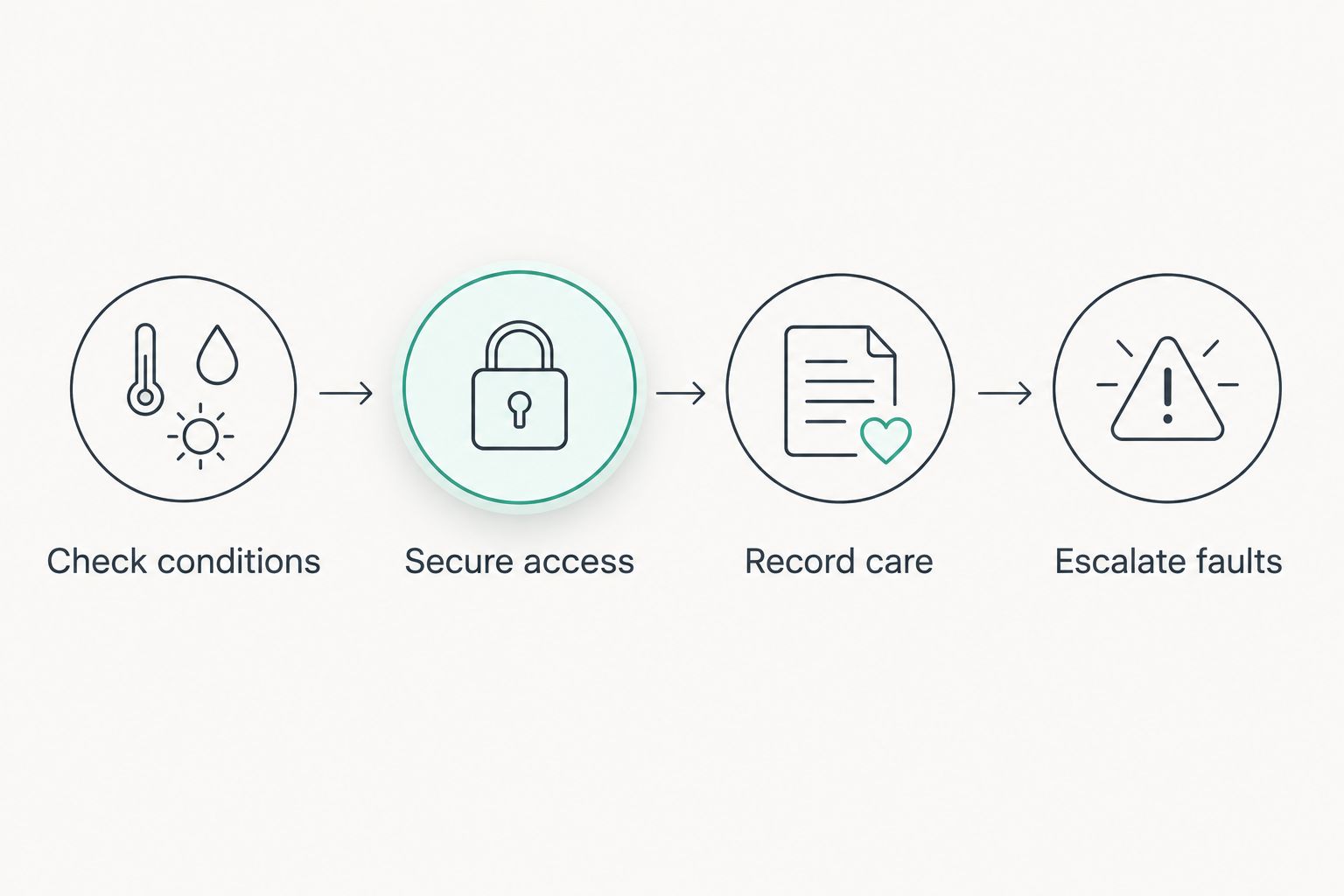
Use a simple handover sequence: Check conditions, Secure access, Record care, Escalate faults. Keep the log readable and near the care instructions, not buried in a student project folder.
Before the animal arrives, make the emergency plan usable. Identify a veterinarian experienced with reptiles and decide who can authorise care. Plan for an enclosure fault, power interruption or building closure without assuming the animal can simply travel home with a student.
- Log conditions before introducing the reptile.
- Test door security and equipment access.
- Demonstrate feeding, cleaning and record-keeping to the backup carer.
- Identify veterinary and school escalation contacts.
- Confirm an authorised response to closure or equipment failure.
Compare enclosure options for classroom use
Choose construction by the species’ requirements and the school’s operating conditions. The table compares general formats, not named products or tested models. Individual designs differ, so inspect the actual enclosure before ordering.
| Option | Best suited to | Main advantage | Key limitation |
|---|---|---|---|
| Glass enclosure | Observation-focused classrooms where the species’ needs fit the design | Clear viewing and surfaces that are easy to inspect | Weight, reflections and heat loss need consideration; viewing panels do not replace ventilation checks |
| Solid-sided enclosure | Setups needing reduced visual exposure and controlled viewing | Opaque walls can provide privacy around a viewing front | Visibility is narrower, and ventilation and heat behaviour depend on construction |
| Mesh enclosure | Species requiring substantial airflow where room conditions support their needs | Open construction provides airflow | Retaining heat and humidity can be harder; openings and access still need escape checks |
| Purpose-built enclosure | Schools with requirements that standard formats do not meet | Layout can be designed around access, furnishings and equipment | Materials, ventilation, electrical integration and workmanship need individual assessment |
A purpose-built enclosure is not automatically safer than a standard one. Assess both against the same species, access and maintenance checklist. Avoid materials or finishes whose suitability for the intended conditions cannot be established.
Check purchasing and delivery before ordering
Write one equipment list that separates essential habitat functions from optional presentation features. Prioritise secure containment, environmental control, shelter and measurement before decorative additions. Check whether equipment fits together physically and whether consumables or replacement components are identifiable.
Aqua Life Pet & Aquarium offers online shopping with Australia-wide shipping, but that does not establish delivery eligibility for every enclosure or stand. Confirm the exact item’s terms for your school’s postcode, particularly for bulky items or products over 30 kg. Do not assume a general shipping statement covers them.
Livestock requires a separate plan. Aqua Life Pet & Aquarium’s live-animal enquiries should be framed around Victorian in-store pickup, not Australia-wide delivery. Complete school and wildlife checks before arranging acquisition.
Common mistakes schools make
Buying around spare furniture
A spare bench sets a location, not a husbandry standard. Choose the species’ adult habitat requirements first, then find suitable support and floor space. If the classroom cannot accommodate those requirements, do not reduce the habitat to make it fit.
Treating handling as the main learning activity
Repeated handling can undermine a reptile’s opportunity to rest and behave normally. Build lessons around observation, environmental records and habitat design. Set handling rules according to the animal, student health considerations and school policy.
Assuming the classroom climate stays constant
A room that feels comfortable during lessons can behave differently after hours. Measure enclosure conditions through the relevant operating cycle and account for heating or cooling changes. An adult must respond when readings fall outside the species’ requirements.
Leaving holidays to the last minute
A reptile needs care when school is closed. Confirm an authorised carer, building access and equipment monitoring before acquisition. Moving the habitat elsewhere also requires a suitable destination and a considered transport plan.
Combining animal cleaning with classroom food routines
Shared sinks, containers and work surfaces can create hygiene problems. Establish the school’s cleaning arrangements before buying the animal. Keep animal-care tools identifiable and separate from food-related equipment.
FAQ
What makes a reptile enclosure suitable for a classroom?
A suitable classroom reptile enclosure meets the species’ adult habitat needs and supports secure, adult-managed care. Check usable dimensions, escape prevention, environmental control, cleaning access and holiday arrangements before acquiring the animal.
Is a glass enclosure better than a solid-sided enclosure for schools?
Glass is better suited to clear observation, while solid sides can reduce visual exposure. Neither format is universally preferable: species requirements, ventilation, environmental control and secure access determine suitability.
Can children handle a classroom reptile?
Handling depends on school policy, student health considerations and the animal’s suitability. CDC guidance advises that children younger than 5 years should not handle reptiles or their environments; observation-based lessons avoid making handling essential.
Do schools need permission to keep a native reptile?
Schools must check the applicable state or territory wildlife requirements before acquiring a native reptile. Requirements depend on the species and jurisdiction, and school approval does not replace any required wildlife permission.
Does every classroom reptile need UVB lighting?
UVB requirements are species-specific, so choose lighting from credible husbandry guidance rather than a general reptile label. Where UVB is required, lamp placement, intervening materials and access to shade form part of the setup.
Can a classroom reptile be left unattended over the holidays?
Holiday care needs a named adult responsible for the animal and its equipment. Agree on access, feeding, water, environmental checks and fault response before the school closes.
Can I order a classroom enclosure online for delivery in Australia?
Delivery eligibility must be confirmed for the exact enclosure and destination. Check dimensions, weight and current delivery terms, and do not assume a retailer’s general shipping policy covers bulky enclosures or stands.
One last thing
Test the care handover, not just the enclosure. Ask the backup adult to locate the instructions, check conditions and explain the response to a fault without help from the main carer. If that handover fails, fix the care system before introducing the reptile.